(714) 332-6302

The Mini Split vs Central AC Cost Comparison Every Orange County Homeowner Should See First
When making a mini split vs central AC cost comparison, the right answer depends almost entirely on one thing: whether your home already has ductwork in good condition.
Here’s a quick breakdown to address that question directly:
| Factor | Mini Split | Central AC |
|---|---|---|
| Best for homes with existing ducts | No (usually) | Yes |
| Best for homes without ducts | Yes | No (very expensive) |
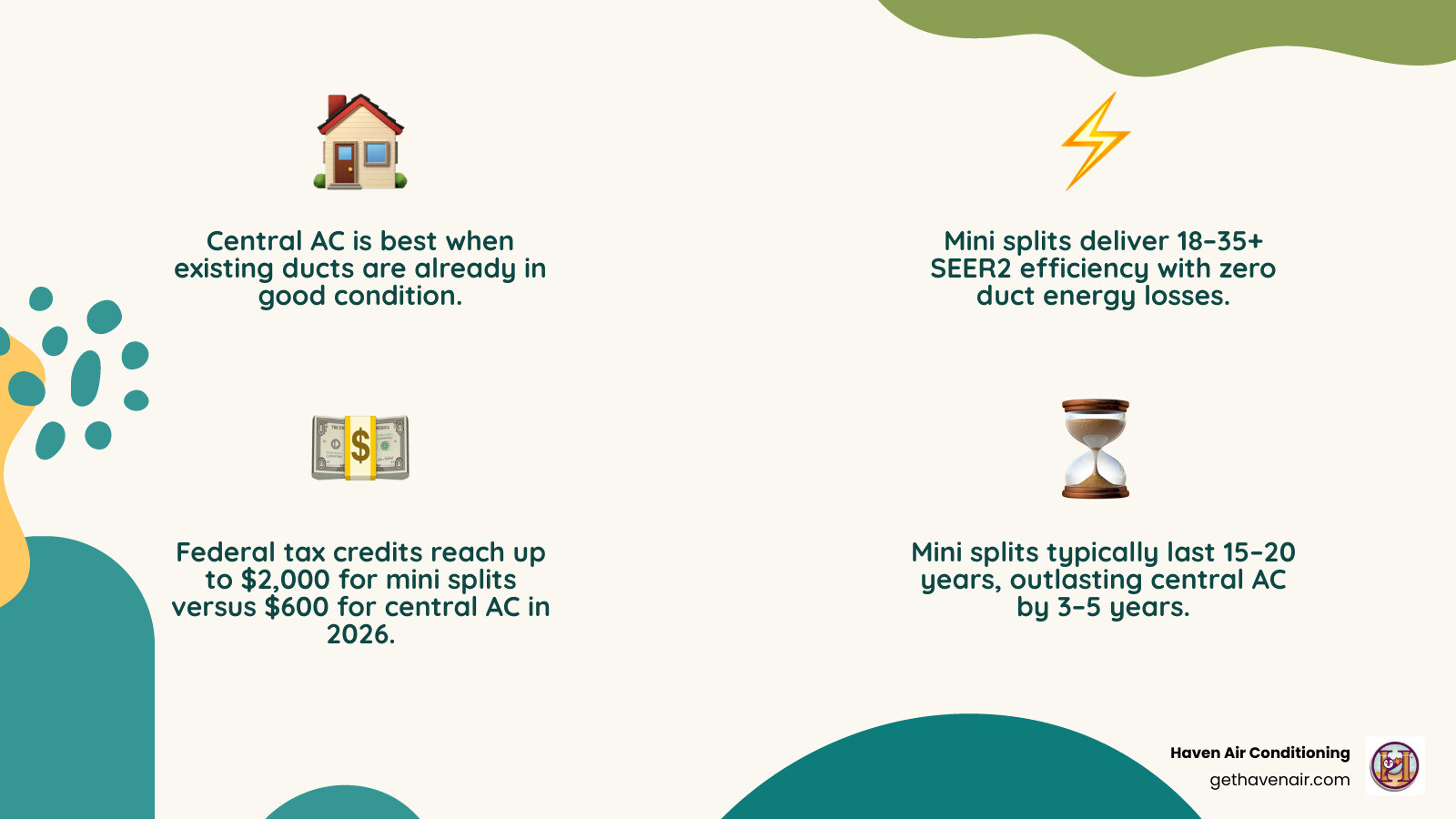
| Energy efficiency (SEER2) | 18–35+ | 14–21 |
| Duct energy losses | None | Up to 20–30% |
| Zoned temperature control | Built-in | Requires add-ons |
| Lifespan | 15–20 years | 12–15 years |
| Federal tax credit (2026) | Up to $2,000 | Up to $600 |
| Heats and cools | Yes (heat pump) | Cooling only |
If your Orange County home already has solid, well-sealed ductwork, central AC is often the more straightforward and affordable path. If you’re in an older Anaheim bungalow, a Fullerton home with problem rooms, or a property without any ductwork at all, a ductless mini split will almost always save you more money — both upfront and on your monthly electric bill.
One homeowner in a 1920s stone farmhouse without existing ducts received central AC quotes between $14,000 and $18,000. A three-zone mini split came in at $7,800 — nearly half the cost, with better efficiency built in.
That kind of gap is exactly why this comparison matters so much before you commit to either system. In the sections below, we’ll walk through every layer of the cost picture — installation, energy bills, maintenance, incentives, and long-term value — so you can make a confident decision for your home and budget.
Mini split vs central ac cost comparison terms explained:
- adding cooling without ductwork options compared
- central ac vs ductless mini split comparison
- central air vs mini split for orange county homes
Upfront Installation: Mini Split vs Central AC Cost Comparison
When we sit down with homeowners in Anaheim or Irvine to discuss a new cooling system, the first hurdle is always the initial investment. The upfront mini split vs central ac cost comparison isn’t just about the price tag on the unit; it’s about the complexity of the labor required to get that unit running.
Central AC systems are essentially “all-or-nothing” installations. You have one large outdoor condenser and one indoor evaporator coil (usually tucked away in a closet or attic). If you already have a network of ducts snaking through your crawlspace, the installation is relatively straightforward. However, if those ducts are aging or undersized for modern high-efficiency equipment, you might face significant hidden costs.
Mini splits, on the other hand, are modular. You have an outdoor unit connected to one or more indoor “heads” via small refrigerant lines. This eliminates the need for massive metal or flex-duct runs. While the technology inside a mini split is often more advanced—utilizing inverter-driven compressors—the lack of structural renovation often makes them the winner for specific home types.
For a deeper dive into what influences these numbers, check out our New AC Installation Cost Ultimate Guide and our AC Replacement Cost Guide 2025.
The Ductwork Factor in Anaheim and Fullerton
In older parts of Anaheim and Fullerton, we often see beautiful historic homes with plaster walls and narrow crawlspaces. In these scenarios, the mini split vs central ac cost comparison shifts dramatically.
Installing new ductwork in a home that wasn’t built for it is a massive undertaking. It often involves cutting into ceilings, building out “soffits” (those boxy structures that hide pipes and ducts), and significant drywall repair. Research indicates that adding a full duct system to an existing home can add up to $18,000 to your project total. That is often more than the cost of the AC unit itself!
By choosing a ductless option, you preserve your home’s architectural integrity. A mini split only requires a small three-inch hole through the wall for the conduit. This “minimally invasive” approach is why many homeowners choose to go ductless, as explained in our Ductless AC Installation Guide. If you are looking for a local expert who understands these structural challenges, our AC Installation Company Anaheim CA Guide can help you navigate the process.
Multi-Zone Mini Split vs Central AC Cost Comparison for Larger Homes
For a 2,000-square-foot home in Santa Ana or Huntington Beach, a single mini split head won’t cut it. You’ll need a multi-zone system. This is where the mini split vs central ac cost comparison gets interesting.
A multi-zone setup involves one larger outdoor compressor connected to several indoor units (up to eight in some residential applications). While this increases the equipment cost, it provides something central AC cannot: true room-by-room control.
- Central AC: One thermostat controls the whole house. If the upstairs is hot and the downstairs is cold, the system just keeps running, wasting energy.
- Multi-Zone Mini Split: You can turn off the AC in the guest room while keeping the master bedroom at a crisp 68 degrees.
The Multi Zone Mini Split Installation Cost and the general Cost to Install Multi Zone Mini Split reflect this added complexity. However, ensuring you have the Proper Sizing for Home AC Split Mini Systems is the only way to ensure the upfront cost translates into long-term comfort.
Energy Efficiency and Monthly Operating Expenses
Efficiency is where the mini split vs central ac cost comparison really starts to favor the ductless side. As of May 2026, SEER2 (Seasonal Energy Efficiency Ratio 2) standards are the yardstick we use to measure how much cooling you get for every dollar spent on electricity.
Most modern central AC systems range from 14 to 21 SEER2. That’s solid, but mini splits are in another league, with some units reaching up to 35 SEER2. The secret lies in “inverter technology.”
Traditional central AC is like a light switch—it’s either 100% on or 100% off. When the house gets warm, it kicks on with a massive surge of power, cools the house, and shuts off. A mini split is like a dimmer switch. Its variable-speed compressor can slow down to a tiny trickle of power, just enough to maintain the temperature without the “start-stop” energy spikes.
We’ve seen homeowners in Buena Park and Costa Mesa reduce their summer cooling bills by 25% to 40% just by making the switch. For more on this, read Why Your Home Might Prefer a Mini Split Over Central Air.
| System Type | Typical SEER2 Range | Est. Monthly Savings (vs 14 SEER) |
|---|---|---|
| Standard Central AC | 14–16 | Baseline |
| High-Efficiency Central AC | 18–21 | 15–20% |
| High-Efficiency Mini Split | 22–35+ | 30–50% |
Zoning Benefits and Your Electric Bill
The biggest hidden cost of central air is “duct loss.” The U.S. Department of Energy notes that the average home loses 20% to 30% of its conditioned air through leaky, uninsulated, or poorly connected ducts. If your ducts run through a scorching hot attic in Riverside, your AC has to work overtime just to combat the heat the air picks up before it even reaches your living room.
Mini splits deliver air directly into the room. There is zero duct loss. Furthermore, the Zone Control Benefits with Mini Split AC allow you to stop paying to cool empty rooms. This targeted cooling is a game-changer for your electric bill.
If you’re tired of “cooling the whole neighborhood” because of leaky ducts, The Homeowners Guide to Going Ductless Without Losing Your Cool is a must-read.
Long-Term Value: Total Cost of Ownership Over 15 Years
When we look at the mini split vs central ac cost comparison over a 15-year horizon, the “Total Cost of Ownership” (TCO) becomes the most important metric. TCO includes your initial purchase, 15 years of electricity, and the likely cost of repairs and maintenance.
Central AC systems typically last between 12 and 15 years in our Southern California climate. Because they cycle on and off frequently, the components—especially the compressor and fan motors—experience significant wear and tear. Mini splits, thanks to their smoother operation, often last 15 to 20 years.
While mini splits might have a higher upfront cost for a whole-house setup, the combination of lower utility bills and a longer lifespan often results in a lower TCO. Check our Mini Splits Guide 2025 for a breakdown of how these systems hold up over time. Understanding the different Types of HVAC Systems can also help you see where each fits into your long-term financial plan.
Maintenance Requirements for Orange County Homeowners
Maintenance is a recurring cost that many homeowners forget to factor into their mini split vs central ac cost comparison.
- Mini Splits: These require high homeowner engagement. You should rinse the indoor filters every 2 to 4 weeks. If you don’t, the efficiency drops rapidly, and the unit can even freeze up. Professionally, they need a deep cleaning of the coils and blowers once or twice a year to prevent “dirty sock syndrome” (mold/mildew buildup).
- Central AC: Maintenance is simpler for the homeowner—just swap the pleated filter in the intake vent every 3 months. However, the system requires more professional oversight of the ductwork. Over 15 years, you will likely need duct sealing or professional duct cleaning, which can cost thousands.
We provide specialized Ductless AC Installation Services that include maintenance education. Whether you are looking for AC Installation in Buena Park CA or elsewhere in the county, we always recommend a professional tune-up at least once a year.
Incentives, Tax Credits, and Year-Round Comfort
In May 2026, the financial landscape for HVAC is heavily influenced by the Inflation Reduction Act. This federal program provides significant tax credits for homeowners who choose energy-efficient heat pump technology.
Currently, you can claim a federal tax credit of up to 30% of the project cost, capped at $2,000 per year, for an ENERGY STAR-certified heat pump mini split. In contrast, a standard cooling-only central AC unit might only qualify for a $600 credit. This $1,400 difference can wipe out the “price gap” between a high-end mini split and a mid-range central AC system.
Beyond federal credits, local utilities in Orange County often offer rebates for high-SEER2 equipment. When we discuss The Great HVAC Debate: Heat Pumps vs the Rest, these financial incentives are often the deciding factor.
Heating Performance: Mini Split vs Central AC Cost Comparison in Winter
One of the biggest advantages of a mini split is that it’s almost always a heat pump. This means it provides both heating and cooling. In our mild Orange County winters, a heat pump is incredibly cost-effective.
Instead of burning natural gas or using expensive electric resistance heat, a mini split moves heat from the outside air into your home. Even when it’s 40 degrees in Corona or Norco, there is enough ambient heat for the system to work efficiently.
If you are currently using an old furnace, switching to a mini split allows you to retire that aging gas appliance. For a comparison of these technologies, see Heat Pumps vs Furnaces: Which is Better? and Heat Pumps vs Air Conditioning. If you’re still a bit confused about how these all fit together, start with our primer: What is HVAC?.
Choosing the Right System for Your Home Layout
The final piece of the mini split vs central ac cost comparison is aesthetics and space. Central AC is “invisible”—all you see are small grates in the ceiling or floor. Mini splits require an indoor unit in every room.
While the traditional “wall-mounted box” is the most common, modern options include:
- Ceiling Cassettes: These sit flush with the ceiling, looking much like a standard vent.
- Floor-Mounted Units: These sit near the baseboard, similar to a radiator.
- Slim-Duct Units: These are hidden behind a wall or in a small attic space, giving you the “look” of central air with the “efficiency” of a mini split.
These Space Saving Ductless AC in Modern Homes are becoming very popular in places like Newport Beach and Laguna Niguel. Proper Ductless AC Placement Maximizes Home Comfort and ensures you don’t have a bulky unit ruining your interior design.
Best Use Cases for Mini Splits in Orange County
- Room Additions: Avoid the cost of up-sizing your main central AC and running new ducts.
- Converted Garages/ADUs: Perfect for guest houses or home offices in Anaheim or Fullerton.
- “Problem” Rooms: That one bedroom over the garage that never gets cold.
- Older Homes: Homes without existing ductwork where you want to avoid a $15,000+ duct bill.
- Master Suites: For people who want their bedroom significantly colder than the rest of the house at night.
Frequently Asked Questions about AC Costs
Is a mini-split cheaper than central AC if I already have ducts?
Usually, no. If your ducts are in good shape, a central AC replacement is typically the most cost-effective upfront. However, if you only need to cool one or two specific rooms, a single-zone mini split might still be cheaper than a whole-house central unit.
How much can I save with the Inflation Reduction Act in 2026?
As of 2026, you can claim up to $2,000 annually for a qualifying heat pump installation. This is a “non-refundable” tax credit, meaning it reduces the amount of tax you owe to the IRS.
Which system lasts longer in the Southern California climate?
Mini splits generally have the edge, often lasting 15 to 20 years compared to the 12 to 15 years we see from central AC units. The key to that longevity is regular maintenance and cleaning the filters every few weeks.
Conclusion
Choosing between these two systems is a big decision, but you don’t have to make it alone. At Haven Air Conditioning, we’ve spent years helping our neighbors in Anaheim, Fullerton, Irvine, and across Orange County find the perfect balance between upfront cost and long-term savings.
Whether you’re looking for a second opinion on a central AC quote or you’re curious if a multi-zone mini split is right for your Norwalk or Whittier home, we’re here to help. We pride ourselves on transparency, expert sizing (no “guessing” on the BTUs), and a friendly, professional approach.
Our membership maintenance plans ensure your new system—whichever you choose—runs at peak efficiency for its entire lifespan, and our members enjoy priority scheduling for that ultimate peace of mind.
Ready to see which system makes the most sense for your home? Contact us today for a professional assessment. We’ll take care of your comfort so you can relax in your home.