(714) 332-6302

Deciding Between Systems: A Central AC vs Ductless Mini Split Comparison
Central AC vs ductless mini split comparison is one of the most common questions Orange County homeowners ask when it’s time to upgrade or replace their cooling system — and it’s not hard to see why. Both systems keep your home comfortable, but they work in very different ways and suit very different situations.
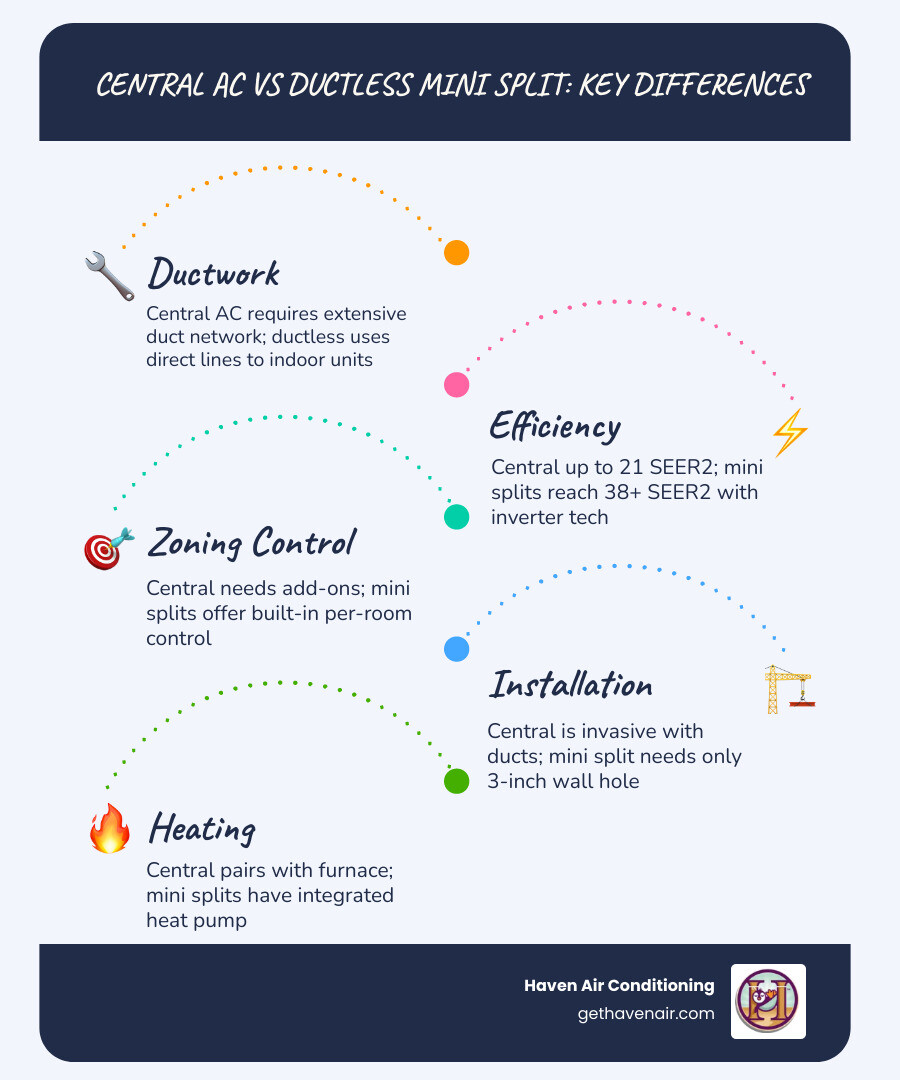
Here’s a quick side-by-side to help you decide at a glance:
| Factor | Central AC | Ductless Mini Split |
|---|---|---|
| Requires ductwork? | Yes | No |
| Best for home size | 2,500+ sq ft | Up to ~2,000 sq ft |
| Efficiency (SEER2) | Up to 21 SEER2 | Up to 38+ SEER2 |
| Zoning control | Add-on required | Built-in per room |
| Installation | More invasive | Minimal (3-inch wall hole) |
| Heating capability | Needs separate furnace | Built-in heat pump option |
| Air quality integration | Excellent | Moderate |
| Upfront cost (no ducts) | Much higher | More affordable |
The short answer: If your home already has solid, well-sealed ductwork, central AC is often the most practical and cost-effective choice. If you have no ductwork, a room addition, or want room-by-room temperature control, a ductless mini split is likely the smarter move — and could cut your cooling costs significantly.
But the real answer depends on your specific home, how you use it, and what matters most to you. Here in Orange County, where summers are long and comfort is non-negotiable, choosing the right system makes a real difference — both on your energy bill and in your day-to-day comfort.
In this guide, we’ll walk through everything you need to know to make a confident decision.
When we look at how these systems operate in April 2026, the technology has never been more advanced. Whether you are in Anaheim or Irvine, both systems rely on the same fundamental science: moving heat from inside your home to the outside using a refrigerant cycle. However, the delivery method is what sets them apart.
A central air conditioner is a “split system” that uses a large outdoor condenser and an indoor evaporator coil usually tucked away in a closet or attic. It relies on a network of ducts to push chilled air through vents in every room.
On the other hand, a Mini Split AC does away with the “middleman” (the ducts). The outdoor unit connects directly to one or more indoor air handlers via a slim conduit. This allows for Ductless Cooling that delivers comfort straight into the living space.
In 2026, we are also seeing a major industry shift in refrigerants. New systems are moving away from R-410A toward more environmentally friendly options like R-32 and R-454B. These new refrigerants are more efficient at carrying heat, which helps both system types perform better during those scorching Santa Ana wind events.
Core System Components
- Outdoor Condenser/Compressor: The “muscle” of the system that releases heat outside.
- Indoor Air Handler/Evaporator: The unit that absorbs heat from your indoor air.
- Refrigerant Lines: Copper tubing that carries the cooling medium between units.
- Drainage Line: Removes the condensation created during the cooling process.
- Thermostat or Remote: Your interface for controlling the temperature.
Energy Savings: A Central AC vs Ductless Mini Split Comparison for OC Homeowners
Efficiency is where the central ac vs ductless mini split comparison gets really interesting. If you’ve been looking at energy labels recently, you’ve likely seen the term SEER2 (Seasonal Energy Efficiency Ratio 2).
While a high-end central AC system might reach 21 SEER2, ductless mini splits are currently shattering those records, with some premium models achieving 38 SEER2 or higher. Why is there such a massive gap? It comes down to two main factors: duct loss and inverter technology.
Research shows that leaky or poorly insulated ducts can reduce a central AC system’s effective efficiency by as much as 30%. In older homes in Fullerton or Santa Ana, ducts often run through hot attics, losing “coolness” before the air even reaches your bedroom. Ductless systems eliminate this waste entirely.
Furthermore, most mini splits utilize “inverter technology.” Unlike a standard central AC that is either 100% on or 100% off (like a light switch), an inverter compressor acts more like a dimmer switch. It ramps up or down to maintain a steady temperature, using only the exact amount of energy needed.
Many of these systems are also heat pumps. Understanding What is a Heat Pump – How Does it Work? is vital for local homeowners. Because they move heat rather than generate it, they are incredibly efficient. When looking at Heat Pumps vs Air Conditioning, a ductless heat pump provides a two-for-one solution for our mild Orange County winters and hot summers.
Home Value and Aesthetics: A Central AC vs Ductless Mini Split Comparison
We know that aesthetics matter to our neighbors. Central AC is the “invisible” winner here; all you see are small floor or ceiling vents. This often helps with resale value in traditional neighborhoods where buyers expect a standard HVAC setup.
However, modern ductless units have come a long way. Beyond the standard white wall-mounted “head,” there are now floor-mounted units that look like radiators and ceiling cassettes that sit flush with the drywall. Space-Saving Ductless AC in Modern Homes has become a popular choice for those living in contemporary condos or smaller bungalows in Costa Mesa.
Noise is another factor. Central AC units can be loud when they kick on, and the sound of air rushing through ducts can be distracting. Ductless units are remarkably quiet, often operating at 19 to 26 decibels — literally softer than a whisper. If you ever find your Mini-Split AC Making Unusual Sounds, it’s usually a sign that it needs a quick maintenance check, not a fault of the technology itself.
Installation Costs and the Ductwork Factor

The biggest “fork in the road” for your budget is your current ductwork.
If your home in Anaheim or Orange already has a healthy duct system, replacing an old central unit is relatively straightforward. However, if you are in a historic home without ducts, or if your existing ducts are falling apart, the cost of Duct Installation can be significant — sometimes adding $7,000 to $15,000 to the project.
For homes without ducts, Mini-Split AC Installation is almost always the more affordable and less invasive route. We only need to drill a small three-inch hole in the wall to connect the units, meaning no major construction or drywall repair is required.
In 2026, homeowners should also take advantage of the Inflation Reduction Act tax credits. Qualifying high-efficiency heat pumps (both ducted and ductless) can earn you a federal tax credit of up to $2,000, which significantly offsets the initial investment.
| Installation Scenario | Central AC | Ductless Mini Split |
|---|---|---|
| Existing Ducts (Good Condition) | Most Cost-Effective | Moderate Cost |
| Existing Ducts (Need Repair) | Requires Duct Repair | Often Better to Go Ductless |
| No Existing Ductwork | High Cost / Invasive | Most Affordable / Easy |
| Room Additions / Garages | Difficult to Extend | Ideal Solution |
Comfort, Zoning, and Air Quality
One of the greatest benefits of a mini split is built-in zoning. In a central AC system, the thermostat is usually in the hallway. If that spot is cool, the system turns off, even if your upstairs bedroom is still sweltering. While you can add HVAC Zoning to a central system using dampers and extra thermostats, it can be a complex and expensive upgrade.
With ductless, every indoor unit is its own zone. You can keep the living room at 72 degrees while the guest room stays at 78. This Zone Control Benefits with Mini-Split AC ensures that everyone in the family is happy and you aren’t wasting money cooling empty rooms.
Proper Ductless AC Placement Maximizes Home Comfort. By positioning units where you spend the most time, you can Improve Air Distribution Mini-Split AC performance throughout the house.
Regarding air quality, central AC has a slight edge because it can accommodate thick, high-MERV filters and whole-home air purifiers. Ductless units use smaller, washable filters. While they are great at catching dust and allergens, they require more frequent attention. If you notice Odors from AC Mini-Split Home Guide, it’s often a sign that the filters or the internal drainage tray need a cleaning.
Frequently Asked Questions about HVAC Upgrades
We get a lot of questions when we’re out in the field in places like Huntington Beach or Riverside. Here are a few of the most common ones regarding the central ac vs ductless mini split comparison.
Can a mini split provide enough heat for Orange County winters?
Absolutely. Modern Ductless Heating is incredibly effective. In our climate, where temperatures rarely drop below freezing, a mini split heat pump is often more than enough to keep you cozy. When comparing Heat Pumps vs Furnaces – Which is Better?, the heat pump usually wins for Southern California homeowners because it doesn’t require a separate gas line or bulky furnace.
How often do I need to clean the filters on a ductless system?
Since ductless units don’t have the massive filtration surface area of a central system, we recommend checking the filters every 2 to 4 weeks during heavy use. You can simply rinse them in the sink, let them dry, and pop them back in. For central systems, you should still consider professional Duct Cleaning every few years to keep the air fresh.
Is it possible to use both central air and a mini split in the same house?
Yes! We call this a “hybrid” or “supplemental” setup. Many of our customers use central AC for the main part of the house but install a single-zone mini split for a “problem room,” like a converted garage, a sunny home office, or a master suite that never seems to get enough air.
Conclusion
Choosing between central air and a ductless mini split doesn’t have to be a headache. At Haven Air Conditioning, we’ve spent years helping homeowners in Anaheim, Fullerton, Irvine, and across the Greater Orange County area find the perfect fit for their unique homes.
Whether you need the whole-home power of a traditional system or the precision and efficiency of a mini split, our goal is to provide you with peace of mind. We pride ourselves on neighborly service and transparent advice — we’ll never push a system that doesn’t make sense for your floor plan or your budget.
If you’re still on the fence, we invite you to reach out for a second opinion or to schedule a home comfort assessment. Don’t forget to ask about our membership maintenance plans, which offer priority scheduling and regular tune-ups to keep your system running perfectly for years to come.
Your indoor comfort is in expert hands with us. Let’s make sure your home is ready for whatever the California weather throws your way.