(714) 332-6302

Is Your AC Really Getting a Full Tune-Up? Here’s What Should Be on the Checklist
If you’ve been searching for an ac tune up checklist what your technician should check, here’s a quick answer before we dive deeper:
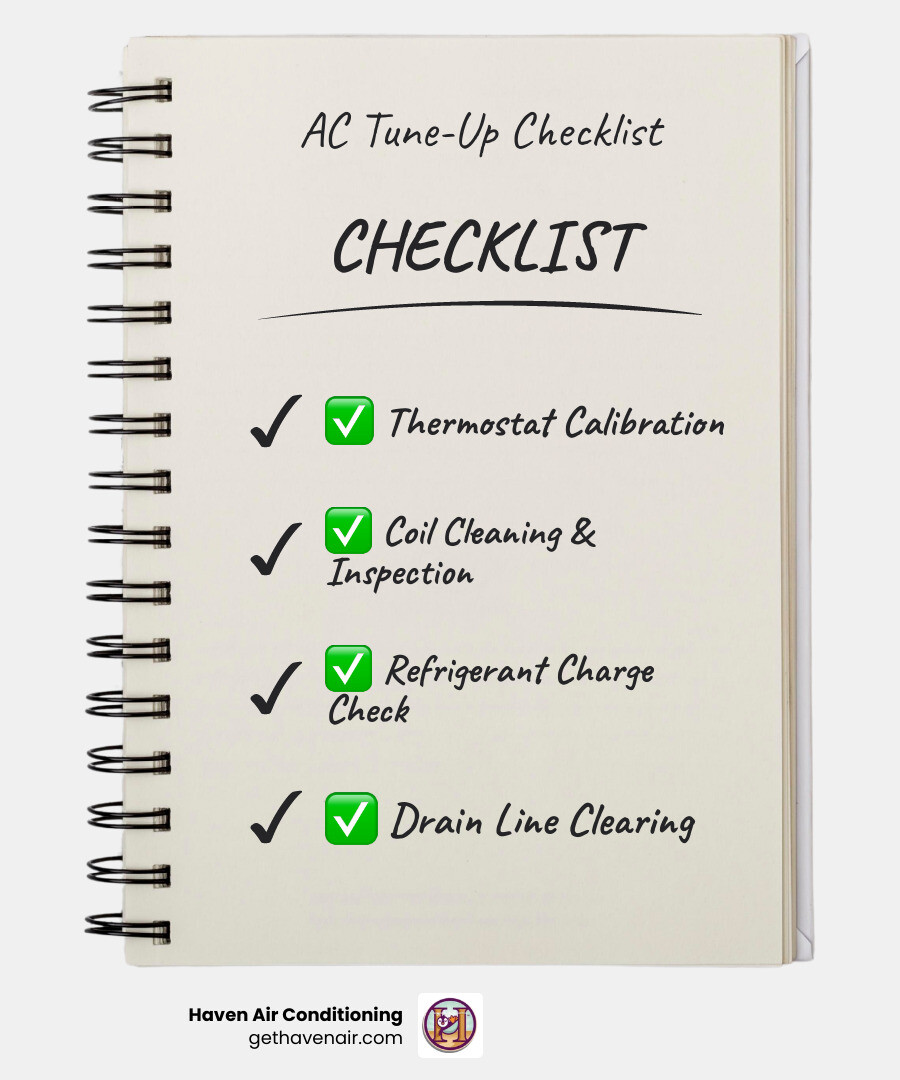
A proper AC tune-up should include these key checks:
- Thermostat calibration and controls testing
- Air filter inspection and replacement
- Evaporator coil and condenser coil cleaning
- Refrigerant level check and leak detection
- Electrical connections, capacitor, and contactor inspection
- Blower motor, fan blades, and belt condition
- Condensate drain line clearing
- Ductwork inspection for leaks
- Safety controls and float switch verification
- Full system performance and temperature split test
Here in Orange County — from Anaheim to Irvine to Fullerton — summers push AC systems hard. When temperatures climb into the triple digits, your air conditioner isn’t just a comfort appliance. It’s essential.
The problem is, not every “tune-up” is created equal. Some companies show up, swap a filter, glance at the outdoor unit, and call it done. Meanwhile, the components most likely to cause a mid-summer breakdown — a failing capacitor, a clogged drain line, low refrigerant — go completely unchecked.
A truly thorough AC tune-up follows a 12- to 20-point inspection process. Skipping it can mean a dirty or neglected system working up to 20% harder than it should, driving up your utility bills and shortening your equipment’s life. According to the U.S. Department of Energy, a clogged filter alone can increase energy consumption by 5% to 15% — and that’s just one item on the list.
The good news: when you know what a proper tune-up looks like, you can hold your technician accountable and make sure you’re getting real value from every service visit.
Why Professional Maintenance is Essential for Orange County Homeowners
As we move through May 2026, the heat in the Greater Orange County area is already starting to build. For homeowners in cities like Anaheim, Fullerton, and Irvine, preventative maintenance isn’t just a luxury—it’s a financial protection strategy.
Think of your AC like a car. You wouldn’t drive a vehicle for years without an oil change and expect it to survive a road trip through the desert. Your HVAC system is the “marathon runner” of your home, and a tune-up is the essential stretching and hydration it needs before the big race.
Energy Efficiency and Lower Utility Bills
One of the most immediate benefits of a professional tune-up is the impact on your wallet. A proper 12-point inspection can reduce energy consumption by up to 15%. When your system is clean and calibrated, it doesn’t have to run as long or work as hard to reach your desired temperature. Without this care, a system can lose approximately 5% of its efficiency every single year.
Extending Equipment Lifespan
Air conditioning units are a significant investment. Regular HVAC Preventive Maintenance ensures that small, inexpensive issues—like a worn belt or a loose wire—don’t escalate into “system killers” like a burnt-out compressor. By catching these early, we help you avoid the $4,000 to $8,000 cost of a premature replacement.
Warranty Validity
Many homeowners don’t realize that their manufacturer’s warranty often comes with “fine print” that requires annual professional maintenance. If your system fails and you cannot provide proof of regular tune-ups, the manufacturer may void the warranty, leaving you to foot the entire bill for repairs.
The Professional AC Tune Up Checklist: What Your Technician Should Check
When our Haven Air Conditioning technicians arrive at your home, they don’t just “look” at the unit. They perform a deep diagnostic dive. If you want to know exactly what an ac tune up checklist what your technician should check looks like, it starts with the “brain” and “nervous system” of your AC.

Thermostat Calibration
The thermostat is the command center. If it’s off by just a few degrees, your system might cycle too frequently or not long enough, wasting energy and reducing comfort. We verify that the temperature the thermostat “sees” matches the actual room temperature.
Electrical Connections and Safety
Loose electrical connections are a primary fire hazard and a leading cause of system failure. During Spring AC Tune-Ups and System Inspection, we tighten all terminals and measure voltage and amperage on the motors.
Capacitor and Contactor Testing
Capacitors are like small batteries that give your motors the “kick” they need to start. They are also the #1 part to fail during a heatwave. We test their “microfarad” levels to ensure they are within the manufacturer’s specified range. Similarly, we check the contactor (the switch that turns the unit on) for “pitting” or burn marks that could cause the system to get stuck in the “on” or “off” position.
Essential Refrigerant and Coil Steps on an AC Tune Up Checklist What Your Technician Should Check
The cooling process relies on the physics of heat transfer, which happens within your coils and through the refrigerant.
- Refrigerant Charge: Your AC does not “consume” refrigerant like a car consumes gas. If the levels are low, it means there is a leak. We use precise digital gauges to check the charge. If it’s off, your system can’t absorb heat effectively, leading to frozen coils and high bills.
- Leak Detection: If levels are low, we don’t just “top it off”—federal law and best practices require finding the source. We look for oil spots or use electronic leak detectors to find the culprit.
- Superheat and Subcooling: These are technical measurements that tell us exactly how the refrigerant is performing. It’s the difference between a “glamorized filter change” and a professional AC Service – What Our Professionals Offer.
- Coil Cleaning: A thin layer of dust on your evaporator (indoor) or condenser (outdoor) coil acts like a thermal blanket. It prevents heat from escaping. We clean these coils to ensure maximum heat transfer.
- Fin Straightening: The aluminum fins on your outdoor unit are fragile. If they are bent (by hail, a stray ball, or a pressure washer), they block airflow. We use a “fin comb” to straighten them out.
Mechanical and Airflow Items on an AC Tune Up Checklist What Your Technician Should Check
Airflow is the lifeblood of your HVAC system. If the air can’t move, the system can’t cool.
- Blower Motor and Fan Blades: We inspect the blower motor for balance and debris. A dirty fan blade can become unbalanced, causing vibrations that crack refrigerant lines or damage bearings.
- Belt Tension: On older systems, we check the tension and condition of the fan belt. A frayed belt is a breakdown waiting to happen.
- Motor Lubrication: While many modern motors are “sealed,” some still require manual lubrication to prevent friction and overheating.
- Air Filter Replacement: This is the simplest but most vital step. In dusty areas or homes with pets, filters may need changing every 30 to 60 days. A clogged filter is the primary reason for a Summer AC Performance Check in Orange turning into a repair call.
- Static Pressure: This measures how hard your fan has to work to push air through your ducts. High static pressure is a “silent killer” of blower motors.
Critical Safety, Drainage, and Ductwork Inspections
Many of the most expensive home repairs aren’t caused by the AC failing to cool, but by the secondary damage it can cause when neglected.
The Condensate Drain Line
Your AC doesn’t just cool the air; it dehumidifies it. That moisture has to go somewhere. It collects in a pan and flows out a drain line. Over time, algae and “sludge” can clog this line. If it clogs, the water will back up into your home, causing mold and expensive ceiling damage. During an End of Summer AC System Check, we flush this line and treat it to prevent growth.
Float Switches
A float switch is a safety device that shuts the system down if the drain line clogs. We test this to make sure it actually works. It’s much better for your AC to turn off than for your living room to get flooded.
Ductwork and Air Loss
Did you know that leaky or obstructed ducts can waste up to 30% of your cooled air? That means 30 cents of every dollar you spend on electricity is cooling your attic instead of your bedroom. We perform a visual inspection of the ductwork to look for gaps, disconnected sections, or crushed pipes. This is a key part of a Summer AC System Inspection – What to Look For.
Frequently Asked Questions about AC Maintenance
We know you have questions about whether a tune-up is worth the investment. Here is a breakdown of how professional service compares to what you can do yourself.
| Maintenance Task | DIY (Homeowner) | Professional Technician |
|---|---|---|
| Change Air Filter | Yes | Yes |
| Clear Debris Around Unit | Yes | Yes |
| Clean Coils with Chemicals | No | Yes |
| Check Refrigerant Levels | No | Yes |
| Test Capacitors & Contactors | No | Yes |
| Flush Drain Line | Partial | Yes |
| Calibrate Thermostat | No | Yes |
| Measure Amperage/Voltage | No | Yes |
How often should I schedule a professional AC tune-up?
For homeowners in the Greater Orange County area, we recommend a professional tune-up once a year, ideally in the spring (March through May). In our hot climate, your system works harder than it would in cooler regions. Some homeowners with older systems or high-usage needs prefer a second check in the fall to prepare for the heating season. Keeping this schedule ensures you prevent mid-season breakdowns when repair companies are at their busiest.
What are the signs that my AC needs a tune-up right away?
If you notice any of the following, don’t wait for your annual appointment:
- Strange Noises: Squealing, grinding, or loud “bangs” when the system starts.
- Weak Airflow: You can feel the air, but it’s not blowing as strongly as it used to.
- Rising Bills: Your electricity usage is significantly higher than the same month last year.
- Frequent Cycling: The unit turns on and off every few minutes (short-cycling).
- Uneven Cooling: One room is an icebox while the other is a sauna.
Can a tune-up really lower my monthly energy bills?
Absolutely. By cleaning the coils, optimizing the refrigerant charge, and ensuring the blower motor is running at peak efficiency, you can reduce energy waste by 15% to 25%. When a system is neglected, it’s like trying to breathe through a straw while running a marathon—it takes way more energy to get the job done.
Conclusion: Your Comfort in Expert Hands
At Haven Air Conditioning, we’ve seen it all—from rats chewing through wires in Anaheim to “mystery leaks” in Costa Mesa. We know that a home is more than just a building; it’s where your family should feel safe and comfortable.
Our team of certified professionals is dedicated to providing the most thorough tune-ups in the Greater Orange County and Riverside areas. We don’t believe in shortcuts or “glamorized filter changes.” We believe in transparency, neighborly service, and ensuring that when you turn your AC on, it works exactly as it should.
For the ultimate peace of mind, consider our Air Conditioner Maintenance Plan. Our members enjoy priority scheduling, discounts on repairs, and the confidence that their system is being cared for by the best in the business.
Don’t wait for a triple-digit day to find out your AC isn’t up to the task. Whether you’re in Huntington Beach, Santa Ana, or Corona, we’re here to help. Schedule your professional AC tune-up in Orange County today and let us take care of your comfort so you can relax.