(714) 332-6302

The Cooling Decision Every Orange County Homeowner Eventually Faces
Central air vs mini split for Orange County homes is one of the most common questions homeowners across Irvine, Fullerton, Anaheim, and Yorba Linda face when their system breaks down — or when they’re ready for a smarter upgrade. And it’s not a simple answer. Orange County’s unique mix of coastal breezes, scorching inland summers, and unpredictable Santa Ana wind events means the “right” system really depends on your home, your habits, and your budget.
Here’s a quick breakdown to help you decide at a glance:
| Factor | Central Air | Ductless Mini Split |
|---|---|---|
| Best for | Larger homes (2,500+ sq ft) with existing ducts | Older homes, room additions, garages, zones |
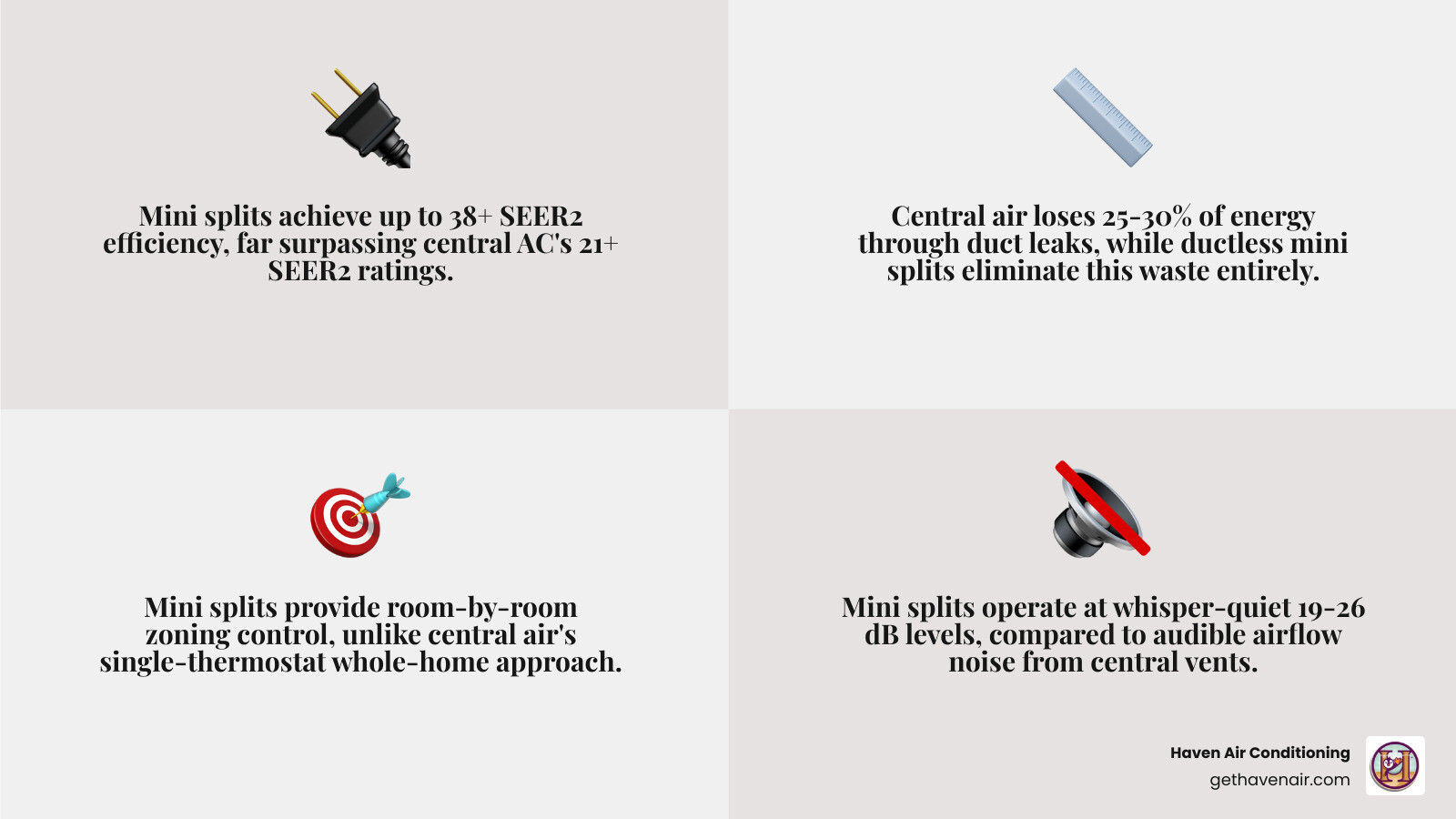
| Efficiency | Up to 21+ SEER2 | Up to 38+ SEER2 |
| Duct losses | 25-30% energy lost through leaks | No ducts, no loss |
| Upfront cost | Lower if ducts exist; much higher without | Higher upfront, lower operating costs |
| Zoning | Whole-home, single thermostat | Room-by-room control |
| Noise | Audible airflow through vents | 19-26 dB (whisper quiet) |
| Heating | Separate furnace often needed | Built-in heat pump, no furnace required |
| Incentives (2026) | Limited | Federal tax credit up to $2,000; HEEHRA rebates available |
In short: if you already have solid ductwork and a large floor plan, central air is often the simpler path. If your home is older, has a room addition, or your ducts are leaking energy into the attic, a mini split — or a hybrid of both — is likely the smarter long-term move.
In this guide, we’ll walk through everything Orange County homeowners need to know to make a confident, informed decision in 2026.
Understanding the Core Differences: Central Air vs Mini Split for Orange County Homes
When we talk about central air vs mini split for orange county homes, we are essentially comparing two different philosophies of comfort. One is a “whole-home” approach, while the other offers “surgical precision.”

A traditional central air system is a split system consisting of an outdoor condenser unit and an indoor evaporator coil, usually paired with a furnace or air handler. It relies on a network of ducts to push air into every room simultaneously. This is the “invisible” choice many homeowners prefer because the only things visible inside are small, unobtrusive vents. If you are interested in a full system overhaul, our AC Installation Services ensure your home stays cool with the latest high-efficiency equipment.
On the flip side, a ductless mini split bypasses the ductwork entirely. It uses an outdoor unit connected to one or more indoor air handlers via small refrigerant lines. This setup is a natural fit for Heat Pumps vs. Air Conditioning comparisons because most mini splits are actually highly efficient heat pumps that provide both heating and cooling.
How central systems distribute air
Central systems utilize “forced air” technology. The system pulls air from your home, cools it over the evaporator coils, and then blasts it back through the ducts. This is excellent for maintaining a consistent temperature across a large, open floor plan. However, it relies heavily on your home’s existing infrastructure. If your ducts are old, dusty, or disconnected in the attic, the system has to work twice as hard. For those with established homes in Anaheim or Fullerton, our HVAC Services in Orange County, CA can help evaluate if your current ductwork is up to the task.
The surgical precision of ductless units
Mini splits are the masters of “zoning.” Each indoor air handler acts as its own thermostat. If you want the master bedroom at 68 degrees but the guest room at 74, you can do that easily. Most modern units utilize inverter technology, which acts like a dimmer switch for your AC. Instead of the “blast and lull” cycle of older units, inverter-driven compressors ramp up or down to maintain a perfectly steady temperature. For a deeper dive into these systems, check out our Mini Splits Guide 2025.
Efficiency, Costs, and 2026 Rebates
Efficiency is where the gap between these two systems really widens. In May 2026, energy rates in Southern California continue to be a major concern for families.
| Metric | Central AC | Ductless Mini Split |
|---|---|---|
| Max Efficiency | Up to 21-26 SEER2 | Up to 38+ SEER2 |
| Energy Loss | 25-30% (Duct leaks) | 0% (No ducts) |
| Monthly Bill (Avg) | $110 – $160 | $60 – $95 |
The “Achilles’ heel” of central air is the ductwork. The U.S. Department of Energy estimates that typical duct systems lose 25% to 30% of cooling energy through leaks and poor insulation. This is what we call the “ductwork tax”—you are essentially paying to cool your attic. This is a primary reason Why Your Home Might Prefer a Mini Split Over Central Air.
Upfront installation costs in Yorba Linda and Anaheim
We know budget is a top priority. Generally, replacing a central AC unit in a home that already has functional ductwork is the more affordable upfront option. However, if you need to install brand-new ductwork in an existing home, that can add up to $18,000 to the project cost.
A multi-zone mini split system often carries a higher initial price tag for the equipment itself, but you save significantly by avoiding invasive duct construction. For a detailed breakdown of what to expect, our New AC Installation Cost Ultimate Guide offers more context on regional pricing trends.
Available incentives and tax credits in 2026
The good news for Orange County residents is that 2026 is a fantastic year for rebates. Under the Inflation Reduction Act, you may qualify for a Federal tax credit of 30% (up to $2,000) for qualifying heat pump mini splits.
Additionally, California’s HEEHRA rebates provide up to $8,000 for low-to-moderate income households (in Orange County, the 80% Area Median Income is approximately $85,000 for a family of four). Programs like TECH Clean California and Southern California Edison incentives further sweeten the deal. These incentives are a major part of The Great HVAC Debate: Heat Pumps vs. The Rest, making high-efficiency upgrades more accessible than ever.
Choosing the Right Fit for Your Home’s Layout and Age
Orange County architecture varies wildly, from 1920s bungalows in Fullerton to sprawling modern estates in Yorba Linda. Your home’s “bones” often dictate the best choice.
Why older homes prefer a mini split for Orange County homes
If you live in a historic home with original plaster walls, the thought of cutting into them to install bulky ducts probably makes you cringe. Mini splits are a “game-changer” here. They only require a tiny three-inch hole in the wall for refrigerant lines. They are also the “perfect” solution for:
- Room Additions: Cooling a new space without overtaxing your main unit.
- Garage Conversions: Turning a 95-degree garage into a comfortable home gym or ADU.
- Attics/Basements: Areas where duct routing is physically impossible.
Our guide on Multi-Zone Mini Split Systems explains how these setups can preserve your home’s architectural integrity while providing modern comfort. However, Proper Sizing for Home AC Split Mini Systems is critical to ensure you don’t end up with a unit that’s too powerful for a small space.
When central air vs mini split for Orange County homes makes the most sense
Central air remains the “safe, expected choice” for many. It is often superior for:
- Large Floor Plans: Homes over 2,500 sq ft where you want consistent air movement in every hallway and bathroom.
- Resale Value: Some buyers still prefer the “invisible” look of central vents over wall-mounted units.
- Aesthetics: If you strongly dislike the look of indoor air handlers, central air is the clear winner.
Even with central air, you can achieve better efficiency through Zone Control Benefits with Mini Split AC by using dampers to direct air only where it’s needed.
Maintenance, Air Quality, and Noise Levels
How your system sounds and how it cleans your air will affect your daily life more than you might think.
Filtration and indoor air quality
Central air systems generally have the upper hand when it comes to whole-home air purification. Because they move a large volume of air through a central filter, you can easily integrate HEPA filters or UV light purifiers to combat Orange County’s seasonal allergens.
Mini splits capture dust effectively with their built-in filters, but they are localized. If you suffer from severe allergies, you may want to supplement a ductless system with a standalone air purifier. For more on keeping your air clean, see our HVAC Services in Orange County, CA page.
Long-term reliability and upkeep
Maintenance for a mini split is a “five-minute task”—you just need to rinse the reusable filters every 2 to 4 weeks. Central air requires more diligence, including periodic duct inspections to ensure you aren’t losing air to leaks.
Both systems are moving toward environmentally friendly refrigerants like R-454B in 2026. With professional annual tune-ups, you can expect either system to last 15 to 20 years in our mild climate.
Frequently Asked Questions about Orange County Cooling
Can mini splits provide enough heat for Orange County winters?
Absolutely. Modern mini splits are heat pumps that move heat rather than generating it. Since Orange County winters rarely drop below 40 degrees, they operate in their “sweet spot” of efficiency. You can often eliminate the need for a gas furnace entirely, which is a major step toward home electrification. This is a key point in the Heat Pumps vs. Air Conditioning discussion.
Is a hybrid approach (Central AC + Mini Split) a good option?
Yes! In fact, this is one of the most popular solutions for Orange County tract homes. Many homeowners keep their central AC for the main floor but add a mini split to a “problem room,” like a hot upstairs master suite or a home office. This allows you to stay comfortable without freezing out the rest of the house. This is a smart way to address Why Your Home Might Prefer a Mini Split Over Central Air.
How do these systems perform during Santa Ana wind events?
Santa Ana winds bring heat and a massive amount of dust. Inverter-driven systems (found in most mini splits and high-end central units) handle these spikes better by adjusting their speed to maintain stability. However, you’ll want to check your filters more frequently during these events to prevent dust infiltration from choking your system.
Conclusion
Choosing between central air vs mini split for orange county homes doesn’t have to be a headache. Whether you’re looking for the whole-home coverage of a central system or the “surgical precision” and energy savings of a ductless mini split, Haven Air Conditioning is here to help.
Based right here in Anaheim, our team of certified, friendly professionals provides expert HVAC services across the Greater Orange County and Riverside areas. We pride ourselves on attention to detail and exceptional customer service—treating your home like it’s our own. From Aliso Viejo to Yorba Linda, we’ll take care of your comfort so you can relax.
We serve the following communities:
- Anaheim, Fullerton, and Santa Ana
- Irvine, Costa Mesa, and Newport Beach
- Yorba Linda, Brea, and Chino
- Laguna Beach, Laguna Niguel, and Aliso Viejo
- Garden Grove, Westminster, and Fountain Valley
Ready to find the perfect cooling solution for your home? Contact our team for a professional home comfort assessment today. We’ll provide an honest, transparent recommendation tailored to your specific needs.