(714) 332-6302

Why Electrical and Capacitor Problems Are Quietly Killing Heat Pumps Across Orange County
How electrical and capacitor problems affect your heat pump comes down to one core issue: when the components that start and power your motors fail, your entire system suffers. Here is a quick breakdown:
- System won’t start – A failed capacitor means motors can’t get the energy burst they need to turn on
- Humming or clicking noises – Motors struggling to start without proper capacitor support
- Short cycling – The system turns on and off rapidly, wearing down components fast
- Higher energy bills – Weak capacitors force motors to draw more power than normal
- Reduced heating or cooling – Fan and compressor motors can’t reach full speed or efficiency
- Compressor damage – The most expensive outcome: prolonged strain burns out the compressor entirely
One day your heat pump is running fine. The next, the house feels off — not dramatically broken, just wrong. For many Orange County homeowners in Anaheim, Irvine, Fullerton, and surrounding cities, that quiet discomfort traces back to a small cylindrical component most people have never thought about: the capacitor. It is not glamorous, but it is critical. Think of it the way some HVAC professionals describe it — like the spark plug of your heat pump. Without it firing correctly, nothing else works the way it should.
Capacitors typically last somewhere between 5 and 10 years under normal conditions, though Orange County’s intense summer heat can shorten that window considerably. And because the warning signs start out subtle — a slight hum here, a slow startup there — it is easy to miss the problem until it becomes a much more expensive one.
This guide walks you through everything you need to know: what capacitors actually do, how to spot trouble early, what other electrical faults can compound the problem, and when to call in a certified technician before a small repair turns into a compressor replacement.
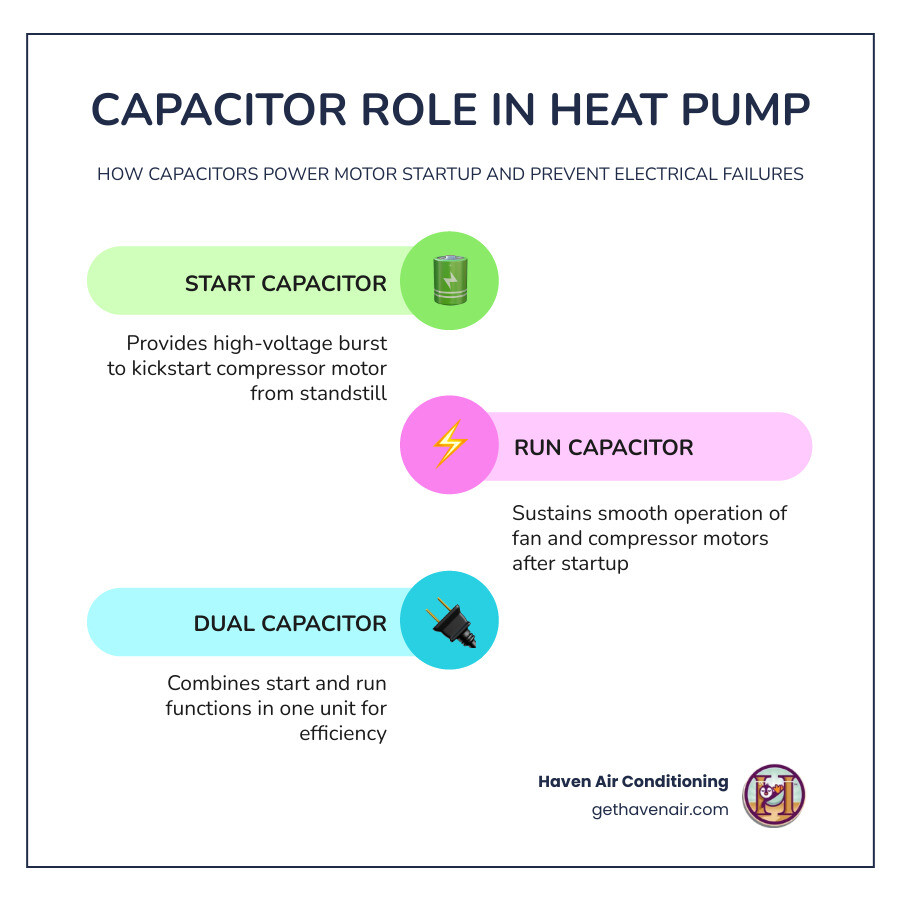
The Role of Start, Run, and Dual Capacitors in Your System
To understand how electrical and capacitor problems affect your heat pump, we first have to look at what these little silver canisters actually do. In the simplest terms, a capacitor is a temporary battery that stores and releases electrical energy in precise bursts.
Your heat pump relies on large motors to drive the compressor and the outdoor fan. These motors require a massive amount of torque to get moving from a dead stop—far more than the standard electrical circuit in your home can provide in a single instant. This is where Heat Pump 101 How It Heats And Cools Your Home comes into play; the system needs that extra “kick” to begin the refrigeration cycle.
There are three main types of capacitors you’ll find in a modern unit:
- Start Capacitors: These provide a high-torque boost for just a few seconds to get the motor spinning. Once the motor reaches about 75% of its speed, the start capacitor drops out of the circuit.
- Run Capacitors: These stay active the entire time the motor is running. They provide a steady electrical buffer that keeps the motor spinning efficiently and maintains the correct phase shift for the motor’s magnetic field.
- Dual Run Capacitors: In most modern homes from Fullerton to Mission Viejo, you’ll find a “dual” capacitor. This clever component houses two capacitors in one shell—one for the compressor (labeled HERM) and one for the fan (labeled FAN).
Capacitors are measured in microfarads (µF) and voltage. If these ratings drift even slightly—usually more than 5% or 10% from the factory spec—the motor won’t get the right amount of energy. It’s like trying to run a marathon while breathing through a straw; the motor might keep going, but it’s under immense stress.
How Electrical and Capacitor Problems Affect Your Heat Pump Performance
When we talk about how electrical and capacitor problems affect your heat pump, we aren’t just talking about a total breakdown. Often, the performance degrades slowly over time.

If a capacitor is weak but not yet dead, your motors will struggle to reach their optimal RPM. This creates a ripple effect throughout the system. You might notice that the air coming from your vents isn’t as cold or as warm as it used to be. You might also find yourself wondering Why Your Ac Is Not Turning On How To Fix It when the unit hesitates for several seconds before finally clicking into gear.
Understanding How Electrical and Capacitor Problems Affect Your Heat Pump Efficiency
Efficiency is the first victim of a failing electrical system. A weak capacitor causes the motor to draw higher amperage. In the electrical world, higher amperage equals more heat and more power consumption.
If you’ve noticed My Heat Pump Is Not Heating effectively during a chilly night in Anaheim Hills, it could be that the compressor is lagging. This sluggish startup and inefficient run cycle mean your unit stays on longer to reach the thermostat setting. In May 2026, with energy costs always a concern, a $50 part could be adding $50 to your monthly bill just by forcing the system to work harder than it should.
Why Ignoring How Electrical and Capacitor Problems Affect Your Heat Pump Leads to Compressor Failure
This is the “emergency” side of HVAC care. While a capacitor is a relatively inexpensive part, the compressor is the heart of the system—and it is very expensive to replace.
When a capacitor fails to provide the necessary “spark,” the compressor motor experiences “hard starting.” It tries to turn over, fails, builds up heat, and tries again. This repeated “inrush current” can literally melt the internal windings of the motor. This leads to a system lockout, where the heat pump’s safety sensors shut everything down to prevent a fire. If you find yourself looking for Emergency Heat Pump Fixes That Wont Keep You Up All Night, it’s often because a $200 repair was ignored until it became a $3,000 catastrophe.
| Symptom | Healthy Electrical System | Failing Capacitor/Electrical |
|---|---|---|
| Startup Sound | Quick, smooth click and hum | Loud “clunk,” buzzing, or clicking |
| Air Temperature | Consistent and reaches set point | Fluctuating or “room temp” air |
| Energy Bill | Steady based on weather | Unexplained spikes in usage |
| Circuit Breaker | Never trips | Trips during unit startup |
| Unit Vibration | Minimal | Excessive shaking during start |
Recognizing the Symptoms of a Failing Capacitor
You don’t need to be a certified technician to spot the early warning signs. Your heat pump will usually try to tell you it’s struggling.
- Auditory Cues: Listen for a loud humming or buzzing sound coming from the outdoor unit. This is often the sound of a motor that has power but cannot start because the capacitor isn’t providing the necessary torque. You might also hear a repetitive clicking—this is the contactor trying to engage the system.
- Performance Issues: Is your system short cycling? If the unit turns on, runs for three minutes, and shuts off, it might be overheating due to electrical strain. If you’re asking Why Is My Heat Pump Blowing Cold Air in the middle of winter, a failed capacitor might be preventing the compressor from engaging the heating cycle properly.
- Visual and Sensory Signs: If you (safely) look through the side of your unit’s service panel, a failing capacitor often looks physically deformed. It might be swollen or bulging at the top, resembling a soda can that’s been left in a freezer. In some cases, you might see an oily liquid leaking from the top or smell a faint “electrical burn” scent.
What Causes Electrical Failures in Anaheim and Irvine Homes?
Living in the Greater Orange County area provides a unique set of challenges for HVAC systems. While our weather is generally beautiful, the heat in places like Anaheim and Riverside can be brutal on electrical components.
- Extreme Heat: Heat is the number one enemy of capacitors. They are filled with a dielectric fluid that can expand and leak when temperatures under the service panel exceed 130°F—which happens easily during an August heatwave.
- Power Surges: Our local grid is reliable, but summer brownouts or lightning strikes can send a surge through the lines. Capacitors often act as a “sacrificial lamb,” taking the hit to protect the motor, but this fries the component in the process.
- Age and Wear: Most capacitors are rated for about 60,000 hours of use. In a high-use climate like ours, that usually means a 5 to 10-year lifespan.
- Pitting and Loose Wiring: Sometimes the problem isn’t the capacitor itself but the “contactor”—the switch that tells the unit to turn on. If the contactor is pitted or has a “wasp nest” inside (a common OC problem!), it can cause Why Furnace Keeps Tripping Circuit Breaker issues.
- Lack of Maintenance: Dust and debris around the outdoor unit restrict airflow, causing the electrical compartment to run even hotter. If you’ve wondered why your Furnace Wont Start Electrical Problems, it often traces back to a system that hasn’t been cleaned in years.
Professional Testing vs. Dangerous DIY Repairs
It is tempting to look at a YouTube video and think, “I can swap that part out for $20.” However, we strongly advise against DIY capacitor replacement for several reasons.
First and foremost is safety. A capacitor’s entire job is to store electricity. Even if you turn off the power at the breaker, a capacitor can hold a lethal electrical charge for hours or even days. Touching the terminals without properly discharging the unit can result in a severe, life-threatening shock.
When our technicians perform Heat Pump Repair Riverside Ca, we use specialized digital multimeters to measure the exact microfarad output. We don’t just “guess” if it’s bad; we verify the math.
Furthermore, a “bad capacitor” is sometimes just a symptom of a deeper problem. If we just swap the part and don’t realize your compressor is drawing too many amps because of a refrigerant issue, the new capacitor will fail again in a week. Professional diagnostics ensure we fix the cause, not just the symptom, protecting your warranty and your peace of mind.
Frequently Asked Questions about Heat Pump Capacitors
How long does a typical heat pump capacitor last?
In the Greater Orange County and Riverside areas, you can expect a high-quality capacitor to last between 5 and 10 years. Systems that are properly shaded and maintained usually lean toward the 10-year mark, while units that are over-worked or exposed to direct, intense sun may fail sooner.
Can I run my heat pump if I suspect the capacitor is weak?
We recommend turning the system off immediately. Running a heat pump with a weak capacitor forces the motors to operate at high temperatures and high amperage. What could have been a simple capacitor replacement can quickly turn into a motor or compressor burnout if you try to “push through” the problem.
What is the average cost for a professional capacitor replacement in 2026?
While we don’t list specific prices due to the variety of brands and models, a professional replacement is one of the most affordable HVAC repairs. It typically involves the cost of the part, a diagnostic fee, and labor. It is significantly less expensive than replacing a fan motor or a compressor.
Conclusion
At Haven Air Conditioning, we’ve seen how electrical and capacitor problems affect your heat pump systems from Anaheim to San Clemente. These small parts carry a heavy load, and when they lose their “spark,” your home’s comfort goes with them.
Whether you are in Fullerton, Irvine, or Riverside, our team of certified professionals is here to provide the expert care your system deserves. We believe in transparency, neighborly service, and ensuring your indoor comfort is in expert hands.
Don’t wait for a total system failure to find out your capacitor was struggling. Our membership maintenance plans include regular electrical inspections to catch these issues before they leave you sweating in the summer heat. If your heat pump is humming, clicking, or just not feeling right, give us a call for a professional check-up or a second opinion.