(714) 332-6302

What Is a Heat Pump and How Does It Actually Work?
How does a heat pump work is one of the most common questions homeowners in Orange County ask when they’re thinking about upgrading their home comfort system — and for good reason. Heat pumps are one of the most energy-efficient ways to both heat and cool your home, but the technology can feel mysterious at first.
Here’s the short answer:
A heat pump works by moving heat — not creating it. It uses a refrigerant looped through four key components to transfer thermal energy from one place to another, depending on the season.
In heating mode:
- The outdoor unit absorbs heat from the outside air (even cold air contains usable heat energy)
- The refrigerant carries that heat inside
- The indoor unit releases the heat into your home
- The refrigerant cycles back outside to repeat the process
In cooling mode:
- The indoor unit absorbs heat from inside your home
- The refrigerant carries it outside
- The outdoor unit releases that heat into the exterior air
- Cool, comfortable air is circulated back indoors
Because a heat pump moves heat instead of burning fuel to generate it, it can deliver 3 to 5 units of heating or cooling energy for every 1 unit of electricity it uses — making it significantly more efficient than a traditional furnace or electric resistance heater.
For homeowners across Anaheim, Irvine, and the wider Orange County area, that efficiency translates to real savings on monthly energy bills and a more consistent, comfortable home year-round.
In this guide, the team at Haven Air Conditioning breaks down exactly how a heat pump works — from the refrigeration cycle and key components, to heating and cooling modes, efficiency ratings, and how to choose the right system for your home.
Understanding the Basics: How Does a Heat Pump Work?
To truly grasp how does a heat pump work, we have to look at the physics of heat transfer. Most of us are used to the idea of “making” heat. When you turn on a gas stove or a space heater, you are converting fuel or electricity directly into thermal energy. A heat pump, however, is more like a “heat transporter.”
Think of a heat pump as a two-way sponge for thermal energy. In the summer, it soaks up the heat inside your house and squeezes it out into the backyard. In the winter, it finds heat in the outdoor air (yes, even when it feels chilly in Fullerton or Corona!) and brings it inside to warm your living room.
The Science of the Refrigeration Cycle
The heart of this process is the refrigeration cycle. This cycle relies on a special substance called refrigerant, which has a very low boiling point. By changing the pressure of this refrigerant, we can force it to evaporate (absorb heat) or condense (release heat) at specific temperatures.
This process involves “latent heat.” When a substance changes from a liquid to a gas, it absorbs a massive amount of energy without necessarily getting much hotter. Conversely, when it turns back into a liquid, it releases that stored energy. By manipulating these phase changes, a heat pump can move significant amounts of thermal energy with very little electrical input. For a deeper look at the fundamentals, check out our guide on What is a Heat Pump & How Does it Work?

The Four Essential Components of the System
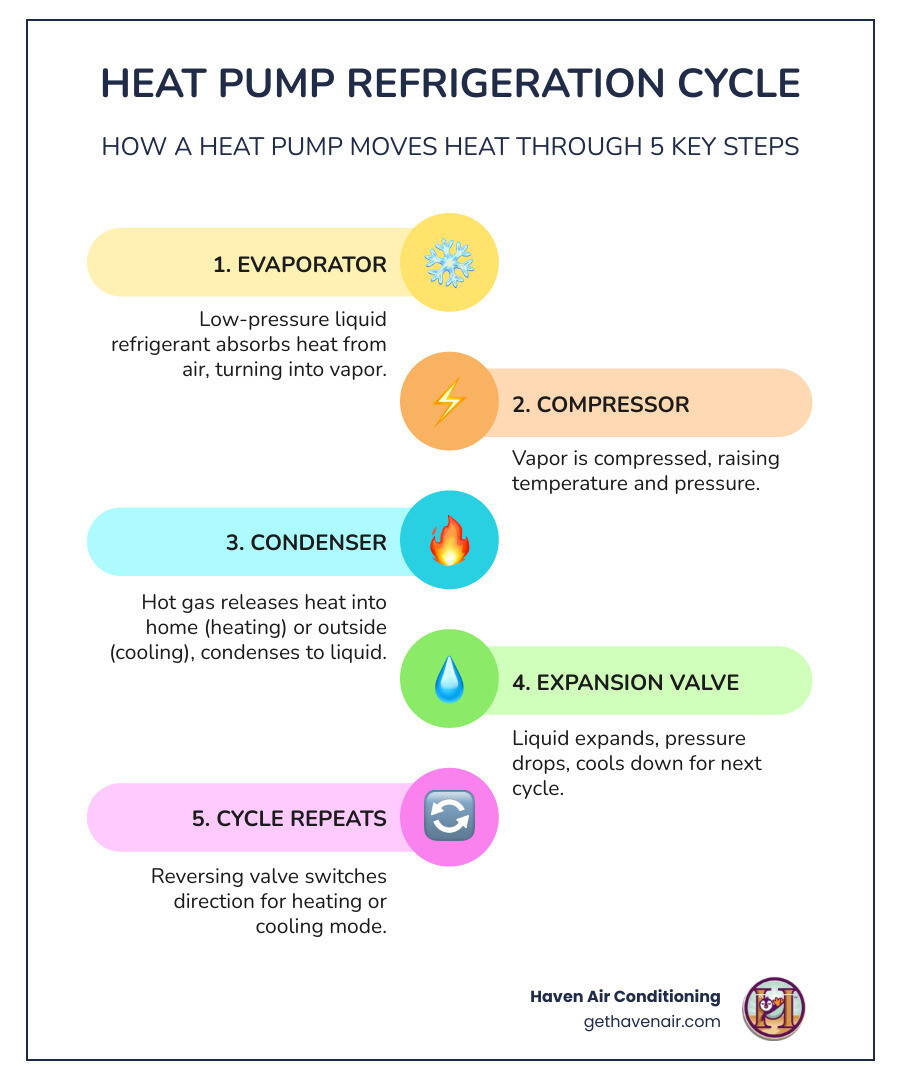
To move that heat around, every heat pump relies on four main mechanical parts:
- The Evaporator: This is where the magic starts. Cold, liquid refrigerant flows through coils. As air passes over these coils, the refrigerant absorbs heat and evaporates into a low-pressure gas.
- The Compressor: This is the “engine” of the heat pump. It takes that low-pressure gas and squeezes it tightly. As the pressure increases, the temperature of the gas skyrockets.
- The Condenser: The hot, high-pressure gas moves through these coils. As it releases its heat to the surrounding air, it cools down and turns back into a liquid.
- The Expansion Valve: This component acts like a nozzle on a spray bottle. It quickly drops the pressure of the liquid refrigerant, causing it to cool down significantly before it heads back to the evaporator to start the cycle again.
The secret weapon that makes a heat pump different from a standard air conditioner is the reversing valve. This clever component allows us to flip the direction of the refrigerant flow, effectively turning the “inside” of the system into the “outside” and vice versa.
Why a Heat Pump is Different from a Furnace or AC
While a heat pump looks almost identical to a central air conditioner, their capabilities are worlds apart. A standard AC is a “one-way street”—it can only move heat out of your house. A furnace, on the other hand, creates heat by burning natural gas or using electric resistance coils.
| Feature | Heat Pump | Gas Furnace | Standard Air Conditioner |
|---|---|---|---|
| Primary Function | Heating & Cooling | Heating Only | Cooling Only |
| Energy Source | Electricity | Natural Gas / Propane | Electricity |
| Mechanism | Heat Transfer | Fuel Combustion | Heat Transfer |
| Efficiency (COP) | 3.0 – 5.0 | 0.80 – 0.98 | N/A (Cooling only) |
| Eco-Friendliness | High (No on-site emissions) | Low (Brings fossil fuels) | Medium (Cooling only) |
When deciding between these systems, it often comes down to your specific home needs and local climate. You can explore these differences further in our articles on Heat Pumps vs Air Conditioning and Heat Pumps vs Furnaces: Which is Better?
The Step-by-Step Process: Heating and Cooling Modes
One of the coolest things about a heat pump is its bidirectional operation. With the flip of a switch on your thermostat, the reversing valve changes the path of the refrigerant. This allows the system to serve as your primary heater in the winter and your primary cooler in the summer.
How does a heat pump work in heating mode?
When you set your thermostat to “Heat” during a cool Anaheim evening, the system follows these steps:
- Absorption: The outdoor unit acts as the evaporator. Even if it’s 40°F outside, the refrigerant is much colder, allowing it to absorb heat from the air.
- Vaporization: The refrigerant turns into a gas and travels to the compressor.
- Compression: The compressor squeezes the gas, raising its temperature to well over 100°F.
- Release: This hot gas flows to the indoor coils. Your home’s fan blows air over these coils, picking up the heat and distributing it through your vents.
- Return: The refrigerant condenses back into a liquid, passes through the expansion valve to cool down, and heads back outside.
If you ever find that your system isn’t quite hitting the right temperature, it’s worth investigating. We’ve put together resources for when My Heat Pump is Not Heating or if you’re wondering, Why is My Heat Pump Blowing Cold Air?
How does a heat pump work in cooling mode?
In the summer, the process is simply reversed. The indoor unit becomes the evaporator, soaking up the heat from your hallways and bedrooms. The refrigerant carries that heat to the outdoor unit (now acting as the condenser), where it is released into the Irvine sun.
An added benefit of this mode is dehumidification. As the warm, humid air in your home hits the cold indoor coils, moisture condenses on the coils and is drained away. This leaves your home feeling much cooler and less “sticky.” If your cooling ever feels sluggish during an Orange County heatwave, it might be time for a professional Heat Pump Repair. For more on the dual nature of these systems, see our post on the AC-Heat Pump connection.
Efficiency Metrics and Performance in Different Climates
When we talk about how does a heat pump work, we have to talk about how well it works. Because heat pumps move heat rather than creating it, their efficiency is off the charts compared to traditional systems.
Understanding COP, SEER2, and HSPF2
- Coefficient of Performance (COP): This is the gold standard for measuring heating efficiency. A COP of 4.0 means that for every 1 kWh of electricity you put in, you get 4 kWh of heat out. Most air-source heat pumps have a COP between 3 and 5.
- SEER2 (Seasonal Energy Efficiency Ratio): This measures cooling efficiency over a typical season. Modern high-efficiency models can reach 20+ SEER2.
- HSPF2 (Heating Seasonal Performance Factor): This measures heating efficiency over a season. Look for ratings between 8 and 10 for optimal performance in our region.
Research shows that heat pumps can transfer 1 to 4.5 kWh of thermal energy into a building for every 1 kWh of electricity used. This makes them 3 to 5 times more energy-efficient than electric heaters or fossil fuel-based solutions. Plus, there are significant Heat Pump Rebates in California available to help offset the initial investment.
Extracting Heat from Extreme Cold
A common myth is that heat pumps don’t work in the cold. While it’s true that efficiency can drop as the temperature difference between inside and outside increases, modern technology has changed the game.
High-efficiency “cold climate” heat pumps can now operate effectively at temperatures as low as -22°F. In the Greater Orange County and Riverside areas, we rarely see temperatures anywhere near that, meaning a heat pump is incredibly reliable here. On the rare occasion it gets truly frosty, the system may enter a “defrost cycle” to melt any ice on the outdoor coils, or use a small amount of supplemental electric heat to keep you cozy.
Choosing the Right Type for Your Orange County Home
Not all heat pumps are created equal. Depending on your home’s layout in Whittier or your yard size in Laguna Niguel, one type might be better than the rest.
- Air-Source Heat Pumps: The most common residential type. They look like standard AC units and exchange heat with the outside air.
- Ground-Source (Geothermal): These systems use a loop of pipes buried underground. Since the earth stays at a constant temperature (around 55°F), these are incredibly efficient, with COPs typically in the 3–6 range. However, they require significant yard space for installation.
- Ductless Mini-Splits: Perfect for homes without existing ductwork or for room additions. These allow for “zoned” heating and cooling, so you aren’t wasting energy on empty rooms.
If you’re ready to see which fits your home, take a look at our Heat Pump Installation Guide or our AC Heat Pump Installation Complete Guide.
Environmental Impact and Modern Refrigerants
As we move toward a greener future in April 2026, the refrigerants used in these systems matter more than ever. Older refrigerants like Freon were harmful to the ozone layer. Modern systems use R32 or R290 (propane), which have much lower Global Warming Potential (GWP).
By choosing a heat pump, you are significantly reducing your home’s carbon footprint. Since they run on electricity, they can even be powered by solar panels, making your home’s climate control entirely carbon-neutral. And because they are built to last, you can enjoy these benefits for a long time. For more on longevity, read How Long Does a Heat Pump Last?
Frequently Asked Questions about Heat Pumps
Do heat pumps use a lot of electricity?
Actually, they use far less than you might think. While they do run on electricity, they use it to power the compressor and fans, not to generate the heat itself. Annual energy consumption typically falls between 6,176 and 10,244 kWh, depending on your home’s size and insulation. Compared to electric baseboard heaters, a heat pump can reduce your electricity use for heating by approximately 50%.
At what temperature does a heat pump become ineffective?
Standard models begin to lose efficiency when temperatures drop below 25°F to 40°F. However, in our Mediterranean climate across Orange County and Riverside, temperatures rarely stay in that range for long. For our neighbors in colder mountain pockets, specialized cold-climate models maintain high performance even well below freezing.
Can a heat pump replace both my furnace and my air conditioner?
Yes! That is one of the primary advantages. By installing a heat pump, you are essentially getting two systems in one. This simplifies your home maintenance and frees up space that a bulky furnace might otherwise occupy.
Conclusion: Your Local Partner for Year-Round Comfort
Understanding how does a heat pump work is the first step toward a more comfortable, efficient, and eco-friendly home. Whether you are in Anaheim, Santa Ana, or Corona, these systems offer a versatile solution to our unique Southern California climate.
At Haven Air Conditioning, we pride ourselves on being your trusted neighbors. We know exactly what it’s like when the Santa Ana winds kick up or when a summer heatwave hits Fullerton. Our team of certified professionals is here to ensure your “Indoor Comfort is in Expert Hands.”
From expert installations to our comprehensive maintenance plans that offer priority scheduling, we take the stress out of HVAC. We’re not just here to sell you a unit; we’re here to ensure you can relax in your home knowing your system is running at peak efficiency.
If you’re curious about how a heat pump could work for your specific home, or if you just need a second opinion on your current setup, we’d love to help. Schedule your residential HVAC service today and let us take care of the heavy lifting so you can stay cool (or warm!) all year long.