(714) 332-6302

What Causes Heat Pump Ice Buildup — and What to Do About It
Understanding heat pump ice buildup causes and what to do can save you from a cold home and a costly repair bill. Here’s a quick overview:
Common causes of heat pump ice buildup:
- Dirty or clogged air filters restricting airflow
- Low refrigerant levels causing the coil to run too cold
- A faulty defrost cycle, sensor, or control board
- Blocked vents or debris around the outdoor unit
- Drainage problems causing meltwater to refreeze
- Extreme cold or high humidity weather conditions
What to do:
- Turn off the heat pump at the thermostat and switch to Emergency Heat
- Clear debris and snow from around the outdoor unit
- Replace a dirty air filter
- Allow the unit to thaw naturally — typically 2 to 4 hours
- Call a professional if ice persists beyond 6 hours or keeps coming back
You step outside on a chilly Orange County morning and find your heat pump encased in a thick shell of ice. It looks alarming — and honestly, it can be. While a light coating of frost on the outdoor coils is completely normal during cold, humid weather, heavy ice that won’t clear on its own is a sign something isn’t right. Left unchecked, that buildup can block airflow, strain your compressor, and leave your home without reliable heat.
The good news? Many causes of heat pump icing are straightforward to understand, and some can even be resolved with a few simple steps before you ever need to call anyone. This guide walks you through what’s normal, what’s not, how to safely thaw a frozen unit, and how to keep it from happening again — especially for homeowners in Anaheim, Irvine, Fullerton, and the greater Orange County area, where winter humidity and freeze-thaw cycles can catch heat pumps off guard.
Is Frost Normal? Understanding Heat Pump Ice Buildup Causes and What to Do
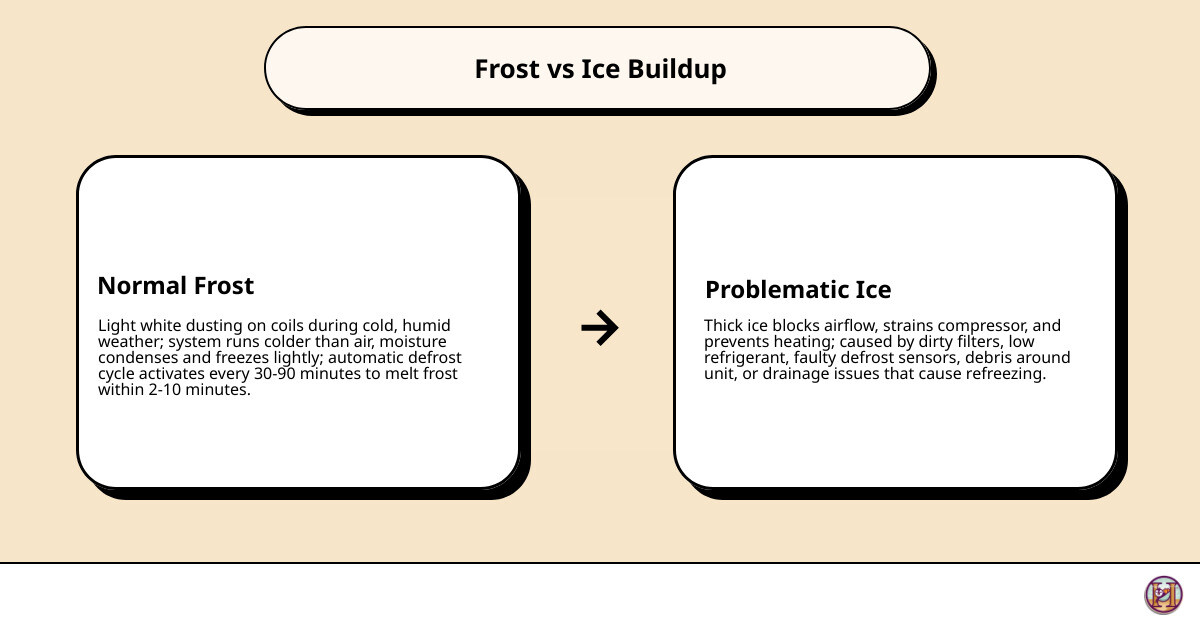
If you see a light, white dusting on your outdoor unit’s coils, don’t panic! In many cases, this is actually a sign that your system is working exactly as it should. Because the outdoor coil acts as an evaporator during the winter, it often runs several degrees colder than the ambient air. When the humidity is high — which is common in coastal areas like Huntington Beach or Laguna Hills — that moisture hits the cold coils and turns into frost.
To handle this, every modern system has a built-in “defrost cycle.” This is a clever process where the system temporarily reverses its operation. Instead of pulling heat from the outside to warm your home, it sends hot refrigerant back to the outdoor coils to melt the frost. During this time, the outdoor fan will usually stop, and you might even see steam rising from the unit. This is completely normal! These cycles typically trigger every 30, 60, or 90 minutes and last between 2 and 10 minutes.
To truly understand the mechanics behind this, it helps to know What Is a Heat Pump & How Does It Work? or check out our Heat Pump 101: How It Heats and Cools Your Home guide.

When Frost Becomes a Problem
So, when should you start to worry? The rule of thumb we use here in Orange County is the 4-hour rule. If the frost has turned into a solid block of ice that completely encases the unit, or if that ice hasn’t melted after several hours of operation, you have a problem.
Thick ice acts as an insulator, preventing the refrigerant from absorbing heat from the air. This leads to a vicious cycle: the unit works harder to find heat, the coils get even colder, and more ice forms. If you notice your home feels chilly despite the thermostat being set correctly, you might be dealing with a situation where My Heat Pump Is Not Heating because it’s literally frozen in its tracks.
Common Reasons Your Heat Pump Is Freezing Over
When a heat pump fails to defrost itself, there is usually an underlying issue that needs to be addressed. In our experience servicing homes from Anaheim to San Clemente, the causes generally fall into three categories: airflow, mechanics, or the environment.
| Category | Specific Cause | Impact on System |
|---|---|---|
| Airflow | Clogged Air Filters | Slows down heat transfer, causing coils to drop below freezing. |
| Airflow | Debris/Leaves | Blocks the outdoor unit from “breathing,” leading to rapid icing. |
| Mechanical | Faulty Defrost Board | The system “forgets” to run its self-cleaning cycle. |
| Mechanical | Bad Reversing Valve | The system can’t switch into defrost mode to melt ice. |
| Refrigerant | Low Charge/Leaks | Coils become excessively cold, freezing moisture instantly. |
| Environmental | Poor Drainage | Meltwater pools at the base and refreezes into an ice mound. |
If your system is struggling with any of these, it might explain Why Is My Heat Pump Blowing Cold Air? when you need warmth the most. It’s also a good time to consider how these systems compare to traditional setups in our Heat Pumps vs. Furnaces: Which Is Better? article.
Airflow Restrictions and Heat Pump Ice Buildup Causes and What to Do
Airflow is the lifeblood of your HVAC system. If air can’t move freely over the coils, the heat exchange process fails.
- Dirty Indoor Filters: Believe it or not, a dirty filter inside your home can cause the outdoor unit to freeze. Restricted airflow indoors affects the pressure and temperature of the refrigerant throughout the entire loop. We recommend changing your filters every 1 to 3 months, especially during the peak of winter in May 2026.
- Outdoor Obstructions: Leaves, twigs, and even overgrown bushes can choke your heat pump. We always tell our neighbors in Fullerton and Buena Park to maintain at least a 2-foot perimeter of clear space around the outdoor unit.
Mechanical and Refrigerant Issues
Sometimes the problem is “under the hood.”
- Low Refrigerant: If your system has a leak, the remaining refrigerant has to expand more, which makes it much colder. This causes the coils to freeze moisture much faster than the defrost cycle can handle.
- Faulty Sensors: The defrost sensor (or “thermistor”) tells the board when the coils are too cold. If it’s out of calibration, the unit won’t know it’s time to defrost.
- Defrost Control Board: This is the “brain” of the operation. If it fails, the defrost cycle simply won’t start.
If you suspect a mechanical failure, it’s best to look for Expert Heat Pump Repair Near You to get a professional diagnosis.
Safe DIY Steps: How to Thaw Your System
If you find your unit frozen, you don’t always have to wait for a technician to start the thawing process. There are a few safe steps you can take to get a head start.
Immediate Actions for Heat Pump Ice Buildup Causes and What to Do
The first thing you should do is turn off the heat pump at the thermostat. Continuing to run a frozen unit can cause permanent damage to the compressor — the most expensive part of your system.
- Switch to Emergency Heat (AUX): Most thermostats have an “Emergency Heat” or “Auxiliary Heat” setting. This turns off the outdoor heat pump and relies entirely on your indoor electric heat strips or gas furnace backup. This keeps your family warm while the outdoor unit has a chance to thaw.
- Fan-Only Mode: If the outdoor temperature is above freezing (which it usually is during the day in Orange County), you can switch your thermostat to “Fan On” mode. This keeps the outdoor fan running (if it isn’t physically stuck in ice) to pull warmer air across the coils.
- Clear the Area: While the unit is off, gently remove any leaves or debris from the base.
For those in Laguna Hills, we offer specialized Expert Heat Pump Repair Services if these DIY steps don’t do the trick. If you’re in Irvine and need help fast, check out our guide on Fast, Reliable Emergency Heat Pump Repair in Irvine.
What NOT to Do When Your Unit Is Frozen
We know it’s tempting to grab a screwdriver and start chipping away, but please don’t.
- No Ice Chipping: The aluminum fins and copper coils inside your unit are incredibly fragile. One slip with a sharp tool can puncture a refrigerant line, leading to a much more expensive repair.
- No Boiling Water: Pouring boiling water on a frozen coil causes “thermal shock.” The rapid expansion of the metal can cause the coils to crack. If you must use water, use a garden hose with lukewarm water.
- No Heavy Heat Sources: Never use a blowtorch or high-heat space heater directly on the unit.
Following these rules ensures you stay within your warranty protection guidelines. Most manufacturers will not cover damage caused by “improper maintenance” or DIY attempts gone wrong.
Preventing Future Freeze-Ups in Orange County
Prevention is always cheaper than a repair. In the Greater Orange County and Riverside areas, our unique climate means we need to pay special attention to a few maintenance items.
Maintenance Best Practices for Heat Pump Ice Buildup Causes and What to Do
- Keep it Level: Over time, the concrete pad under your heat pump can shift. If the unit isn’t level, the water that melts during a defrost cycle won’t drain away properly. Instead, it will pool at the base and refreeze, eventually building up into the coils.
- Gutter Maintenance: Check the roofline above your heat pump. If a gutter is leaking or overflowing directly onto the unit, it will create a massive ice block that no defrost cycle can overcome.
- Steady Setpoints: Heat pumps are most efficient when they maintain a steady temperature. If you drop your thermostat by 10 degrees at night and then crank it back up in the morning, the unit has to run for a long time at maximum capacity, which increases the risk of icing.
Regular professional check-ups are key. You might wonder, How Long Does a Heat Pump Last? — the answer is usually much longer if it’s serviced twice a year. For those looking for the best in the business, see our Guide to Top Repair Contractors in Irvine, CA.
Why You Should Never Cover Your Heat Pump
It seems like a good idea to protect your unit from the elements with a cover, but this is a major “no-no” for heat pumps in the winter. Unlike a dedicated air conditioner that stays off all winter, a heat pump needs to breathe. Covering it blocks airflow, traps moisture, and will almost certainly cause a system lockout. If you are worried about falling ice from the roof, a “snow hat” or a simple wooden shelter built several feet above the unit is a much safer option.
Frequently Asked Questions About Frozen Heat Pumps
How long should it take for my heat pump to thaw?
If you’ve turned the unit off and the outdoor temperature is above 40°F, it should naturally thaw within 2 to 4 hours. If you are using the fan-only method, it might be faster. However, if the ice is still there after 6 to 8 hours, or if it refreezes immediately after you turn the heat back on, there is a mechanical issue that requires a technician.
Will thawing the unit myself void my warranty?
As long as you use the safe methods described above — like switching to Emergency Heat or using a gentle stream of water — you will not void your warranty. Warranty issues usually only arise if you use sharp tools, chemicals, or high-heat sources that physically damage the components.
Is it normal to see steam coming from my outdoor unit?
Yes! This is one of the most common things that scares homeowners. When the unit goes into defrost mode, it heats up the outdoor coils to melt the ice. That melting ice turns into water vapor (steam). It usually lasts about 2 to 10 minutes and stops as soon as the fan kicks back on.
Conclusion
Dealing with a frozen heat pump can be a stressful experience, but knowing the heat pump ice buildup causes and what to do puts the power back in your hands. Whether it’s a simple matter of changing a dirty filter or clearing some fallen leaves, many icing issues are preventable.
At Haven Air Conditioning, we’ve spent years keeping homes comfortable in Anaheim, Fullerton, Irvine, and throughout Orange County and Riverside. We pride ourselves on being your “trusted neighbor” in the HVAC world. Our certified technicians don’t just fix the ice — we find the root cause to make sure it doesn’t happen again.
If your heat pump is acting up, or if you want to get ahead of the next cold snap with one of our priority maintenance plans, we’re here to help. We offer 24/7 support because we know that HVAC emergencies don’t wait for business hours.
Your Indoor Comfort, In Expert Hands.