(714) 332-6302

Why the Right Ductwork Options for Your Home Matter More Than You Think
Ductwork options for your home directly affect how comfortable, efficient, and healthy your living space feels — yet most homeowners in Orange County never think about their ducts until something goes wrong.
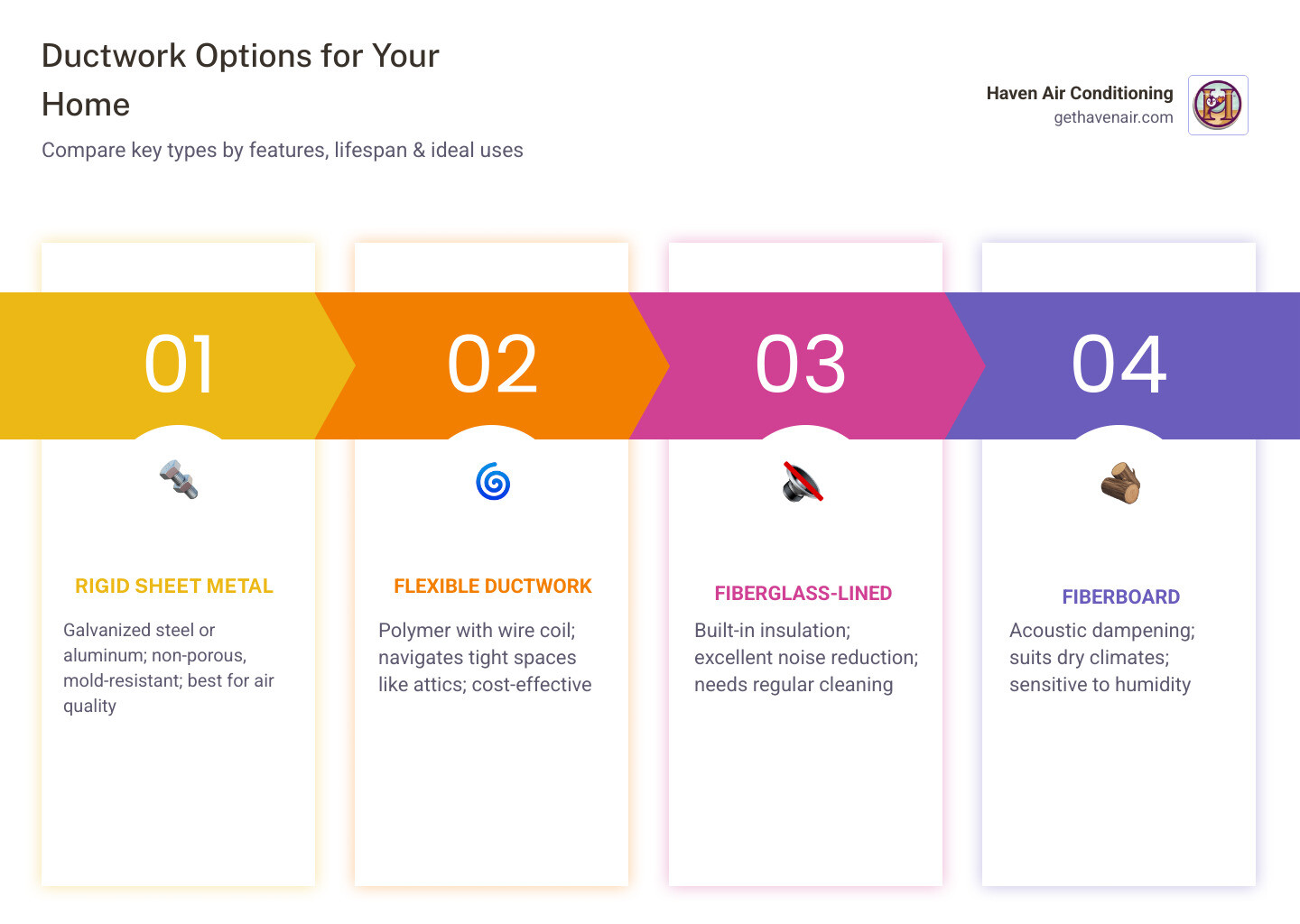
Here’s a quick look at the four main ductwork types to compare:
| Ductwork Type | Best For | Lifespan | Key Trade-off |
|---|---|---|---|
| Rigid Sheet Metal | Whole-home systems, air quality | 20-30+ years | Higher upfront cost |
| Flexible Ductwork | Tight spaces, attics, retrofits | 10-15 years | Prone to kinks and sags |
| Fiberglass-Lined | Noise reduction, insulation | 15-25 years | Requires regular cleaning |
| Fiberboard | Quiet spaces, dry climates | 15-20 years | Not ideal for humid areas |
Think of your ductwork as your home’s lungs. Every time your HVAC system runs, conditioned air travels through those ducts to reach every room. If those “lungs” are leaky, poorly sized, or made from the wrong material, your system has to work harder — and you pay more for less comfort.
The numbers back this up. The average residential duct system runs at only 57% efficiency. Leaky or poorly installed ducts can push your energy bills 20 to 30% higher than they should be. That’s real money leaving your pocket every single month.
Whether you’re building a new home, upgrading an aging system, or just noticing that one room is always too warm or too cold, understanding your duct options is the first step toward solving the problem.
Exploring the Best Ductwork Options for Your Home
When we talk about ductwork options for your home, we are looking at the infrastructure that determines your daily comfort. In May 2026, as home energy standards continue to evolve, the choice of material is more critical than ever. Most ductwork systems are designed to last between 25 to 30 years, but that longevity depends heavily on the material used and the quality of the Duct Services you receive.
One of the most important technical concepts we deal with is static pressure. Think of this as the “blood pressure” of your HVAC system. If your ducts are too small or have too many sharp turns, the air resistance increases, forcing your blower motor to work overtime. This leads to premature equipment failure and uneven thermal comfort. Choosing the right material helps maintain the perfect balance of pressure and Airflow.
Rigid Sheet Metal: The Gold Standard for Durability
If you are looking for the most reliable and long-lasting ductwork options for your home, rigid sheet metal is the undisputed champion. Typically constructed from galvanized steel or aluminum, these ducts are the “Gold Standard” for residential air distribution.
The primary benefit of sheet metal is its non-porous surface. Unlike materials with fibers or pits, sheet metal does not easily harbor mold, mildew, or allergens. This makes it the best choice for indoor air quality, especially for families in Anaheim or Fullerton who struggle with seasonal allergies. Because the surface is smooth, it also offers the least resistance to airflow.
Furthermore, sheet metal is incredibly durable. It won’t be punctured by a stray tool in the attic or chewed through by pests. While the initial investment is higher, its 30-year lifespan and ease of Duct Cleaning make it a cost-effective long-term choice. To prevent heat loss, we wrap these ducts in high-quality insulation, ensuring that the cool air stays cool even when passing through a 150-degree attic in the middle of a Southern California summer.
Flexible Ductwork Options for Your Home’s Tight Spaces
Not every home has the luxury of wide-open spaces for bulky metal trunks. This is where flexible ductwork comes in. These ducts consist of a wire coil core surrounded by a polymer plastic liner and a layer of fiberglass insulation.
Flexible ducts are among the most popular ductwork options for your home because they are versatile and cost-effective. They are ideal for navigating around tight corners, floor joists, or roof rafters in older homes in Orange or Santa Ana. Because they have fewer seams than rigid metal, they can be faster to install.
However, “flex” duct requires a skilled hand. If it isn’t pulled taut during Duct Installation, it can sag or kink. A simple 10% reduction in duct diameter due to a kink can decrease airflow by nearly 40%. While flexible ducts are great for “branch” lines, they typically have a shorter lifespan of 10-15 years and are more prone to punctures.
Fiberglass and Fiberboard Ductwork Options for Your Home
Fiberglass-lined ducts are essentially sheet metal ducts with an internal fiberglass coating. Fiberboard, on the other hand, is made from compressed inorganic glass fibers bonded with resin. Both of these ductwork options for your home are prized for their acoustic dampening properties.
If you have a high-velocity system or a unit located near a bedroom, these materials can significantly reduce the “whooshing” sound of air. They come with built-in insulation, which simplifies the installation process.
The trade-off involves maintenance and health. Because the interior surface is porous, it can trap dust and moisture over time. If the lining begins to deteriorate, fiberglass particles can potentially enter the air stream. For this reason, we recommend following a strict Duct Cleaning Services Complete Guide to ensure the fibers remain sealed and the air stays clean. In humid climates, fiberboard is less ideal as it can absorb moisture, but in our relatively dry Orange County environment, it remains a viable option for noise-sensitive homeowners.
Key Factors When Choosing Your Home’s Air Distribution System
Choosing between these ductwork options for your home isn’t just about picking a material; it’s about matching the system to your lifestyle and home layout.
| Factor | Sheet Metal | Flexible Duct | Fiberboard |
|---|---|---|---|
| Upfront Cost | Highest | Lowest | Moderate |
| Durability | Excellent | Low (Puncture prone) | Moderate |
| Air Quality | Best (Non-porous) | Good | Fair (Porous) |
| Noise Level | Moderate | Quiet | Quietest |
| Lifespan | 25-30+ Years | 10-15 Years | 15-20 Years |
Your home’s layout plays a massive role. A sprawling single-story home in Yorba Linda might benefit from a rigid trunk-and-branch system, while a compact condo in Midway City might require flexible runs to fit into dropped ceilings. We often utilize Custom HVAC System Design to create a hybrid approach—using rigid metal for the main trunks to maximize airflow and flexible ducts for the final “runs” to each room.
Budgeting is another reality. While sheet metal costs more upfront, it rarely needs replacement. If you plan on staying in your home for decades, it’s the smarter investment. If you are doing a quick renovation or adding a small room, flex duct might be the better fit for your wallet. Finally, consider HVAC Zoning. If you want different temperatures in different rooms, your ductwork must be designed with dampers that can handle the varying pressures of a zoned system.
Signs Your Current Ductwork Needs Professional Attention
How do you know if your current ductwork options for your home are failing you? In many cases, the signs are subtle until your energy bill arrives.
One of the most obvious red flags is a sudden spike in energy costs. If your bill is 20-30% higher than last year without a change in usage, you likely have air escaping into your attic or crawlspace. You are essentially paying to cool the “great outdoors.”
Other signs include:
- Uneven Temperatures: If your bedroom is a sauna while the living room is an icebox, your ducts may be undersized or leaking.
- Excessive Dust: Leaky return ducts can suck in dust from the attic and blow it straight into your living areas. If you’re constantly dusting, it’s time for Duct Repair.
- Strange Noises: Rattling, whistling, or “booming” sounds often indicate disconnected sections or pressure imbalances.
- Musty Odors: This is a specific sign of mold or mildew, often found in fiberglass-lined ducts that have trapped moisture.
For homeowners in Irvine, our Irvine Air Duct Cleaning Ultimate Guide provides a deep dive into how to spot these issues before they lead to a total system breakdown.
Maximizing Efficiency and Air Quality in Orange County
In the Greater Orange County area, we face unique challenges. From the salt air of Laguna Beach to the extreme attic heat of Corona, your ducts have a lot to contend with.
To maximize efficiency, we focus on two things: sealing and insulation. We use professional-grade mastic sealant—a thick, gooey paste that dries into a flexible, airtight permanent seal. Unlike standard “duct tape” (which ironically should never be used on ducts), mastic won’t peel off when it gets hot.
We also prioritize R-8 insulation. In our region, attic temperatures can easily exceed 150 degrees. Standard R-6 insulation often isn’t enough to prevent the air inside the ducts from heating up before it reaches your vents. By upgrading to R-8, we can save you hundreds of dollars a year.
Proper design is also non-negotiable. We use Manual D calculations to ensure every duct is sized perfectly for the room it serves. This is especially vital for Air Duct Sanitizing Orange County and wildfire smoke protection. When the Santa Ana winds blow and smoke fills the air, a perfectly sealed system prevents those pollutants from leaking into your home through gaps in the return vents. Whether you need Orange CA Air Duct Cleaning or Villa Park CA Air Duct Cleaning, ensuring a tight seal is the first step in protecting your family’s health.
Frequently Asked Questions About Residential Ducts
How long does typical residential ductwork last?
Most residential ductwork options for your home will last between 25 and 30 years. However, flexible ductwork often shows signs of wear after 10 to 15 years. Factors like pest activity, moisture levels, and whether you’ve kept up with Residential Duct Cleaning will impact this timeline. If your home was built in the 1990s or earlier, your ducts are likely approaching the end of their functional life.
Can leaky ducts really increase my energy bills by 30%?
Yes, absolutely. According to the National Comfort Institute, the average duct system loses 30-50% of its air to leaks and inefficiency. When conditioned air leaks into unconditioned spaces like attics, your HVAC unit has to run longer to reach the temperature set on your thermostat. Professional Duct Repair can often pay for itself in energy savings within just a few years.
How often should I have my home’s air ducts professionally cleaned?
The National Air Duct Cleaners Association (NADCA) generally recommends a professional cleaning every 3 to 5 years. However, if you have pets, recent home renovations, or family members with severe allergies, you might want to schedule it more frequently. For a full breakdown, check out our Air Vent Cleaning Ultimate Guide.
Your Indoor Comfort, In Expert Hands
Navigating the various ductwork options for your home can feel overwhelming, but you don’t have to do it alone. At Haven Air Conditioning, we’ve spent years helping our neighbors in Anaheim, Fullerton, Irvine, and across Orange County stay comfortable year-round.
Whether you’re dealing with a “Temperature Lottery” where some rooms are never comfortable, or you’re worried about the air quality your family is breathing, our certified, friendly professionals are here to help. We believe in transparency and detail—we won’t just sell you a new system; we’ll design the right system for your specific home layout and budget.
From precision Duct Services and repairs to full system installations and our comprehensive membership maintenance plan, we take care of the technical stuff so you can just relax.
If you’re not sure if your ducts are up to the task, or if you just want a second opinion on a recent quote, give us a call. We’re your local experts, and we’re always ready to help you breathe easier.