(714) 332-6302

Is a Heat Pump Really Cheaper Than a Traditional HVAC System?
Making a heat pump vs traditional system cost comparison is one of the most important decisions Orange County homeowners face when replacing aging HVAC equipment. And it’s not a simple answer — the right choice depends on your home, your utility bills, and how long you plan to stay.
Here’s a quick breakdown to help you compare at a glance:
| Factor | Heat Pump | Traditional (Gas Furnace + AC) |
|---|---|---|
| Handles heating AND cooling | Yes — one system | No — two separate systems |
| Upfront installed cost | Higher | Lower |
| Annual operating cost (mild climate) | Comparable to gas | Slightly lower at national averages |
| Best for replacing propane or oil heat | Yes — significant savings | No |
| Available federal rebates (2026) | Up to $8,000 (income-qualified) | None |
| Federal tax credit | Up to $2,000 | Up to $600 (AC only) |
| Typical system lifespan | 15 years | 15–25 years (furnace outlasts AC) |
| Works in Southern California climate | Exceptionally well | Yes |
| Environmental impact | ~63% lower CO2 emissions | Higher emissions |
For most Orange County homeowners — where winters are mild, electricity powers cooling year-round, and California utility rebates are generous — a heat pump is increasingly the stronger long-term investment. But there are real scenarios where a gas furnace and AC combo still makes financial sense, and we’ll walk through all of them honestly.
Most homeowners don’t think about this decision until they’re forced to. The furnace stops working, or a contractor hands you two quotes and asks which way you want to go. At that moment, you need clear numbers — not marketing. This guide gives you exactly that, using real 2026 costs, current incentive programs, and Southern California-specific context so you can make a confident, informed choice.
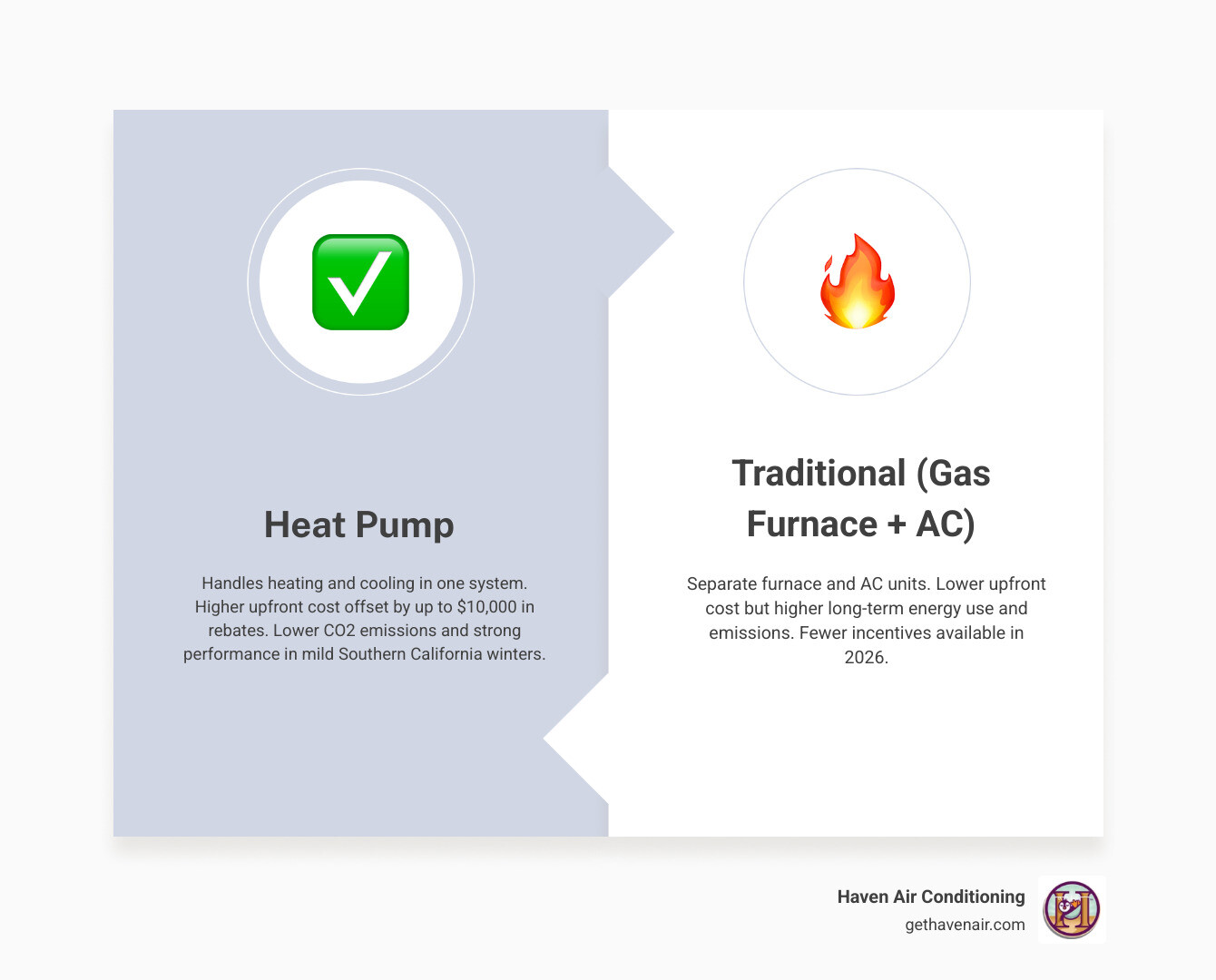
Upfront Investment: Heat Pump vs Traditional System Cost Comparison
When we talk about the “sticker price” of a new HVAC system, things can get confusing quickly. A heat pump is often compared to a central air conditioner, but that isn’t a fair fight. A heat pump does the work of both an air conditioner and a furnace. Therefore, the true heat pump vs traditional system cost comparison must weigh the price of one heat pump against the combined price of a new gas furnace and a new central AC unit.
In 2026, equipment prices have shifted due to new refrigerant regulations (like the transition to R-454B and R-32), which have added a bit to the manufacturing costs of all systems. Generally, a whole-house ducted heat pump carries a higher upfront equipment cost than a standalone furnace or AC. However, when you are replacing a full “split system” (both the heater and the cooler), the gap narrows significantly.
Labor costs in areas like Anaheim and Irvine also play a role. Installing a heat pump is often a more streamlined process because our team is only setting up one outdoor unit and one indoor air handler. You can learn more about the specific hardware differences in our guide on Heat Pumps vs Air Conditioning.
Efficiency Ratings: SEER2 and HSPF2
To understand the value, you have to look at the ratings. Cooling efficiency is measured by SEER2 (Seasonal Energy Efficiency Ratio), while heating efficiency for heat pumps is measured by HSPF2 (Heating Seasonal Performance Factor). High-efficiency heat pumps in 2026 can reach SEER2 ratings of 20+ and HSPF2 ratings over 10. While a high-efficiency gas furnace is roughly 96-98% efficient, a heat pump can be up to 300% efficient because it moves heat rather than creating it.
Installation variables in Anaheim and Irvine
Every home in Orange County is unique. When we visit a home in Fullerton or Santa Ana to provide a quote, we look at several variables that can swing the total project cost:
- Ductwork modifications: Heat pumps sometimes require slightly larger ducts to move the necessary volume of air for optimal efficiency. If your existing ducts are undersized or leaking, we may suggest modifications.
- Electrical panel upgrades: A heat pump is an all-electric system. If your home currently has a 100-amp panel that is already full, you might need an upgrade to a 200-amp panel to handle the new load.
- Refrigerant line sets: If we are switching from an old R-22 system, we often need to replace the copper lines to handle the higher pressures of modern refrigerants.
- Permit fees: Local municipalities in Orange County have varying requirements for mechanical and electrical permits.
For a deeper dive into the mechanics, check out Heat Pump 101: How It Heats and Cools Your Home.
Monthly Savings and Operating Expenses in Southern California
Once the system is installed, the conversation shifts to your monthly utility bills. This is where the heat pump vs traditional system cost comparison gets interesting for those of us living in the Inland Empire and Orange County.
Our local electricity rates are relatively high compared to the national average, but our natural gas prices have also seen volatility. The “win” for a heat pump depends on the COP (Coefficient of Performance). Because a heat pump extracts heat from the outside air — even when it’s chilly in Corona or Riverside — it uses far less energy than electric resistance heating. You can see the breakdown of this process in our article: What Is a Heat Pump & How Does It Work?

How climate impacts your heat pump vs traditional system cost comparison
Southern California has what we call a “heat pump climate.” We don’t typically see the -15°F temperatures that homeowners in the Midwest deal with. Our mild winters mean a heat pump stays in its most efficient operating range almost all year long.
In coastal areas like Laguna Beach or Newport Beach, the heat pump also acts as a superior dehumidifier during those “May Gray” and “June Gloom” months. For homeowners who want the best of both worlds, we often discuss “dual-fuel” or hybrid options. This pairs an electric heat pump with a gas furnace. The system uses the heat pump when it’s cool and only kicks over to gas on those rare, truly cold Southern California nights. This debate is covered extensively in The Great HVAC Debate: Heat Pumps vs the Rest.
Comparing annual fuel costs for Orange County homeowners
If you are currently using propane or old-fashioned electric baseboard heat, switching to a heat pump is a financial “slam dunk,” often saving homeowners over $1,000 a year. If you are switching from natural gas, the savings are more modest — usually between $300 and $600 annually — but this can be offset by the fact that you no longer have to pay the monthly “service charge” for a gas connection if you go all-electric.
As we look at 2026 utility projections, electricity is increasingly being paired with home solar panels. For our customers in places like Yorba Linda or Mission Viejo who have solar, a heat pump allows them to heat their homes using the energy they produce on their own roofs, effectively bringing heating costs down to near zero. We explore these nuances in Heat Pumps vs Furnaces: Which Is Better?
Maximizing Value with 2026 Rebates and Tax Credits
In 2026, the financial landscape for HVAC is heavily weighted in favor of electrification. Thanks to the Inflation Reduction Act and California-specific programs, the “net cost” of a heat pump can actually be lower than a traditional system.
- Federal Tax Credits (Section 25C): You can claim 30% of the project cost, up to $2,000 annually, for a qualifying heat pump. In contrast, a traditional central AC unit only qualifies for up to $600.
- HEAR Program (High-Efficiency Electric Home Rebate Act): This is a state-administered program that provides point-of-sale rebates. Income-qualified households in California can receive up to $8,000 for a heat pump installation.
- Local Utility Rebates: Utilities like Southern California Edison (SCE) often offer their own incentives to encourage high-efficiency upgrades.
Navigating these can be tricky, which is why we stay up to date on Heat Pump Rebates in California. We want to make sure you Don’t Sweat the Cost of New HVAC with These California Rebates by helping you Cash in on Local Utility Rebates for High Efficiency HVAC.
Long-Term Ownership: Maintenance, Lifespan, and Resale
A typical HVAC system is a 15-to-20-year commitment. When calculating your heat pump vs traditional system cost comparison, you have to look past the first year.
A heat pump generally has a lifespan of about 15 years. Because it works year-round (cooling in summer, heating in winter), it accumulates “mileage” faster than a furnace that sits idle for six months. However, modern inverter technology has made these systems much more durable than the models from a decade ago. You can find more details on longevity in our post: How Long Does a Heat Pump Last?
Total 15-year heat pump vs traditional system cost comparison
If you choose a traditional system, you might find that while the furnace lasts 20+ years, the AC unit still needs replacing at the 15-year mark. With a heat pump, you replace one unit and you’re done.
Maintenance is also a factor. We recommend bi-annual service for all our Orange County neighbors — once in the spring to prep for the heat and once in the fall. For a heat pump, this is critical because the same components are working in both seasons. Regular maintenance helps you avoid the “repair or replace” dilemma. If you’re wondering about your current setup, check out Is It Time for Furnace Replacement? or When to Consider Furnace Replacement.
Finally, consider resale value. In 2026, many Southern California homebuyers are looking for “green” or “smart” homes. An energy-efficient heat pump is a major selling point and can increase home value by 5% to 7% in certain markets. For more on furnace longevity, see How Long Do Furnaces Last?
Frequently Asked Questions about HVAC Costs
Is the upfront cost of a heat pump always higher than a furnace and AC?
Not necessarily. While the unit itself is more advanced, you are only buying one system instead of two. When you factor in the $2,000 federal tax credit and potential state rebates of up to $8,000, the “out-of-pocket” cost for a heat pump in 2026 is often lower than a mid-range gas furnace and AC combo.
How much can I save on my monthly bills by switching to a heat pump in Orange County?
For most of our customers in Anaheim and Irvine, annual savings range from $300 to $700. If you are currently using an older 10-SEER air conditioner, you’ll see a massive drop in your summer cooling bills immediately. The heating savings depend on how much you use your heater during our mild winters.
Do I need to upgrade my electrical panel to install a new heat pump?
It depends on your current panel’s capacity. Many homes in older parts of Orange County have 100-amp panels that may require an upgrade to safely handle an all-electric heating and cooling system. We always perform a thorough electrical assessment during our initial consultation to ensure there are no surprises.
Conclusion
At Haven Air Conditioning, we believe in giving our neighbors in the Greater Orange County Area the straight facts. Whether you’re in Huntington Beach or Riverside, we want you to have “Your Indoor Comfort, In Expert Hands.”
Choosing between a heat pump and a traditional system isn’t just about the equipment; it’s about your long-term peace of mind. We offer expert second opinions and comprehensive Orange County HVAC Services to help you navigate these choices. Plus, our membership maintenance plan ensures that whatever system you choose, it stays running at peak efficiency for years to come.
If you’re ready to see how the numbers look for your specific home, reach out to us. We’ll take care of your comfort so you can relax in your home.