(714) 332-6302

Is It Time to Repair or Replace Your HVAC System in Orange County?
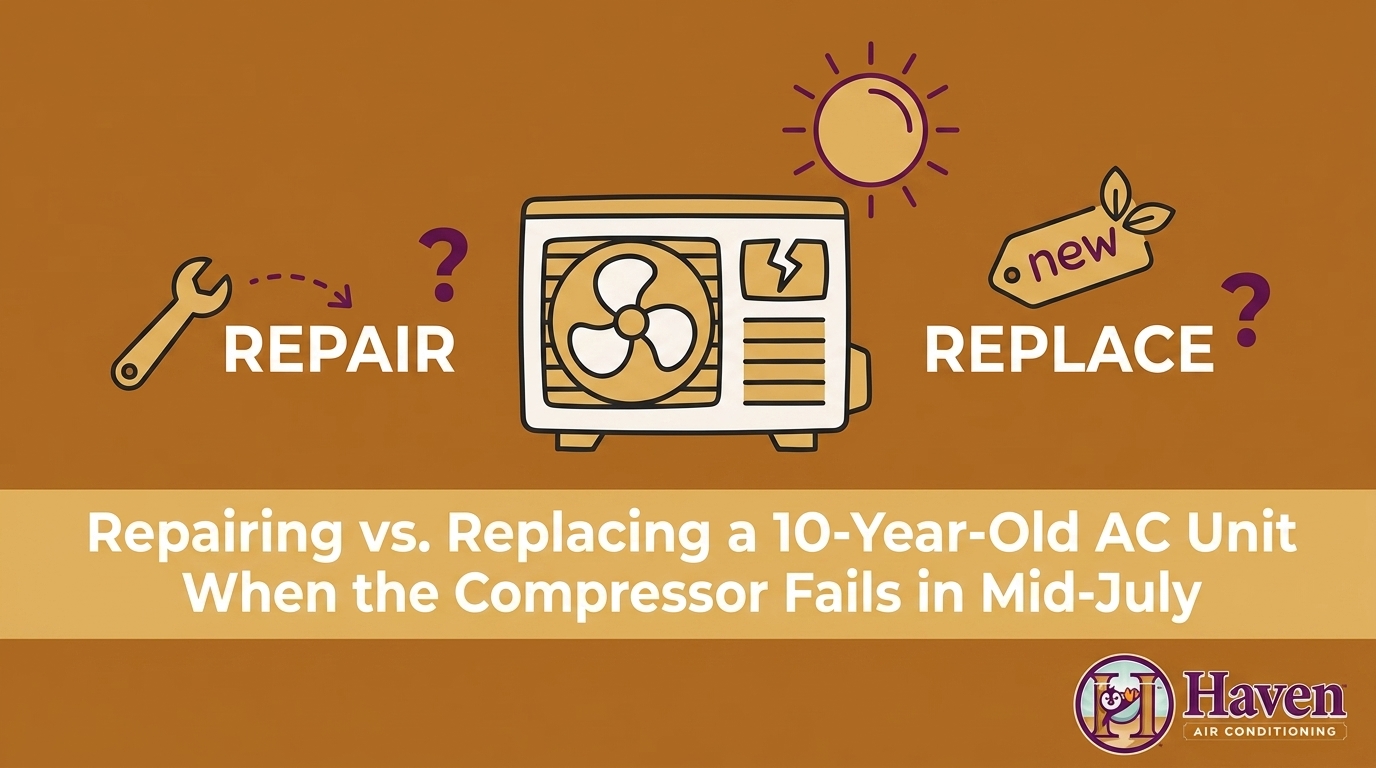
Knowing how to decide between repair and replacement can save you hundreds — sometimes thousands — of dollars. Here’s a quick framework to guide your decision:
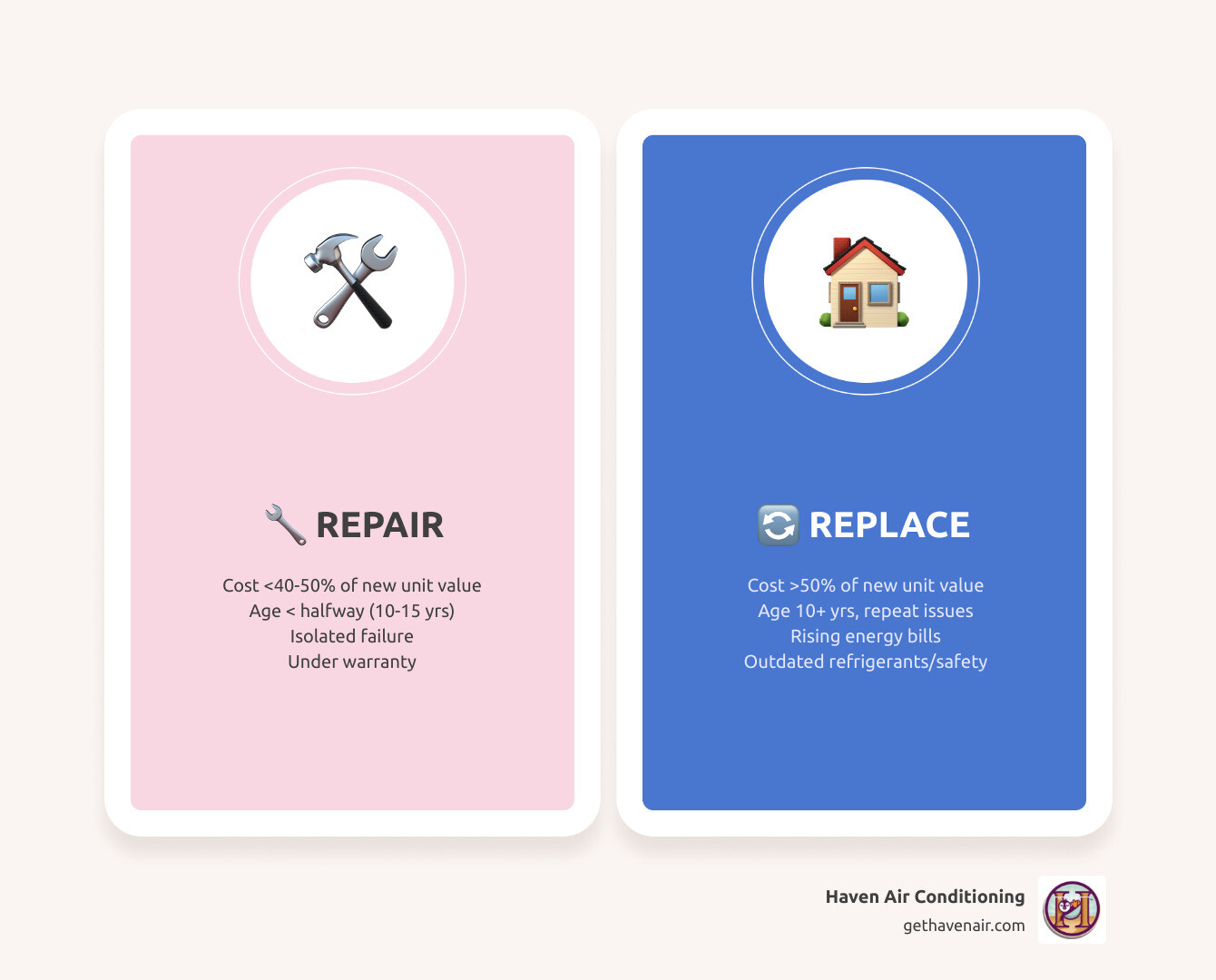
Repair your HVAC system if:
- The repair cost is below 40–50% of the unit’s current replacement value
- The system is less than halfway through its expected lifespan (typically 10–15 years)
- The failure is isolated, not a sign of broader system decline
- The unit is under warranty
Replace your HVAC system if:
- Repair costs exceed 50% of what a comparable new unit would cost
- The system is 10+ years old and breaking down repeatedly
- Energy bills keep climbing despite repairs
- The unit uses outdated refrigerants or fails to meet current safety standards
Every Orange County homeowner eventually faces that sinking feeling — the AC stops cooling on a 95-degree Anaheim afternoon, or the furnace sputters out on a cold January night. The repair technician gives you a quote, and suddenly you’re wondering: is it worth fixing again, or is it finally time to let go?
It’s a question with real financial stakes. A repair that buys you one more season can feel like a win — until the next breakdown arrives two months later. On the other hand, rushing into a full replacement when a straightforward fix would do the job just as well is an unnecessary expense most households don’t need.
The truth is, there’s no single magic answer. But there is a clear, logical way to think it through — one that goes beyond gut feeling and looks at the actual numbers, the age of your system, and the bigger picture of what you’re getting for your money.
This guide walks you through exactly that process, with a focus on HVAC systems in the Southern California climate — where your air conditioner works harder and longer than almost anywhere else in the country.
The Golden Rule: How to Decide Between Repair and Replacement
When we visit homes in Fullerton or Santa Ana, we often see homeowners agonizing over a repair estimate. To simplify things, we use what the industry calls the “50% Rule.” It’s a straightforward benchmark: if the cost of the repair is more than 50% of the value of a brand-new system, it’s usually time to stop patching and start replacing.
However, the “value” part of that equation can be tricky. You shouldn’t just look at the sticker price of a new unit. You have to account for labor costs, the availability of parts for your current model, and the likelihood of another component failing next month. If your system is showing signs your system needs hvac repair services, such as strange grinding noises or frequent cycling, a single repair might just be the first of many.

Financial Benchmarks: How to Decide Between Repair and Replacement
To get a true sense of the economics, we look at the market value and depreciation. Much like a car, an HVAC system loses value every year. By April 2026, many systems installed a decade ago are technically worth very little on the open market.
A “Value-Added Repair” calculation helps here. Ask yourself: will this $800 repair actually increase the lifespan of the unit by a meaningful amount, or is it just a “zombie repair” keeping a terminal system on life support? If the repair-to-value ratio is skewed—meaning you’re spending $1,000 to fix a unit that would only sell for $300—replacement is the more rational financial move.
Evaluating Lifespan: How to Decide Between Repair and Replacement
In the Greater Orange County area, the average service life for a central AC or furnace is between 10 and 15 years. If your unit is 12 years old and needs a major component like a compressor or heat exchanger, you are already in the “red zone.”
Even if you fix it today, the other aging components—the blower motor, the capacitors, the sensors—are all nearing their expiration dates. We often see homeowners in Corona or Norco spend money on a major fix only to call us back three weeks later for a different issue. If you are seeing signs you need expert 24 hour ac repair, it’s a strong indicator that the internal wear has reached a critical point.
Beyond the Invoice: Factors That Tip the Scales
Sometimes the decision isn’t just about the repair bill in front of you. It’s about the monthly bills that follow. Technology has moved fast. If your system was manufactured before 2015, it likely consumes 20–30% more energy than a modern ENERGY STAR-certified equivalent.
When you look at when to consider hvac replacement, efficiency is a huge factor. Upgrading from an old SEER 10 unit to a new SEER2-compliant system can slash your utility bills significantly. Over five years, those savings can actually pay for a large chunk of the new unit’s cost.
Operational Reliability and Frequency
Is your HVAC system becoming a “lemon”? If you’ve had the technician out three times in the last two years, you aren’t just paying for parts and labor—you’re paying in “downtime costs.” For a family in Irvine or Huntington Beach, a weekend without AC in August isn’t just an inconvenience; it’s a safety issue for seniors and pets. If you’re constantly asking is it time for furnace replacement, the lack of reliability is often the loudest sign that it’s time to move on.
Safety, Compliance, and Environmental Impact
Safety is a non-negotiable boundary. If a furnace has a cracked heat exchanger, it can leak carbon monoxide into your home. In these cases, the cost of repair is irrelevant—your family’s safety comes first.
Furthermore, environmental regulations have changed. Older units using R-22 refrigerant (Freon) are now obsolete. Since R-22 is no longer produced, the cost to recharge an old system is astronomical. Choosing when to consider furnace replacement or AC replacement often comes down to moving toward safer, more compliant, and eco-friendly refrigerants that are easier and cheaper to maintain.
When a Professional Repair is Your Best Bet
We don’t always recommend replacement. In fact, many times a high-quality repair is the smartest move. If your system is only five or six years old, it’s likely still under a manufacturer’s parts warranty. In these cases, you’re usually only responsible for the labor.
If the failure is isolated—like a blown capacitor or a faulty contactor—and the rest of the system is in good health, a repair is a great investment. You can find signs you need expert furnace repair that are often simple fixes, such as a dirty flame sensor or a faulty igniter, which don’t require a whole new system.
Indicators for Choosing Repair
We recommend repair when:
- The unit is under 10 years old: Most systems have plenty of life left at this stage.
- The repair cost is low: If the fix is under $500 and the unit has been reliable, go for it.
- Good maintenance history: If you’ve kept up with annual tune-ups, your components are likely in better shape than an neglected unit of the same age.
- Parts are readily available: If we can get the part today and have you running in an hour, repair is often the way to go.
The Role of Preventative Maintenance
The best way to avoid the “repair vs. replace” dilemma is to extend the lifespan of what you already have. In the Orange County climate, salt air (near Newport or Laguna Beach) and high summer heat put immense strain on equipment.
Our membership maintenance plans offer priority scheduling and regular check-ups that catch small issues before they become $2,000 disasters. Think of it like changing the oil in your car—it’s the only way to reach that 200,000-mile (or 15-year) milestone.
Calculating the Real Cost of “One More Year”
To truly understand how to decide between repair and replacement, you have to look at the “Total Cost of Ownership.”
| Factor | Continuing to Repair (5-Year Outlook) | Replacing Now (5-Year Outlook) |
|---|---|---|
| Repair Costs | High (Likely $1,500+) | $0 (Under Warranty) |
| Energy Bills | Increasing (Lower Efficiency) | Decreasing (20-30% Savings) |
| Reliability | Low (Potential Breakdowns) | High (Peace of Mind) |
| Utility Rebates | None | Potential Tax Credits/Rebates |
| Inflation | Repair parts/labor prices rising | Locked-in current purchase price |
Technology and Data in Asset Management
In 2026, we use more than just a flashlight and a wrench to diagnose your system. Smart diagnostics and IoT (Internet of Things) sensors allow us to track the performance of your system in real-time. This data helps us move from “reactive” maintenance (fixing it when it breaks) to “predictive” maintenance. If our sensors show your compressor is drawing too much amperage, we can warn you months before it actually fails, giving you time to budget for a replacement rather than making an emergency decision.
Avoiding Common Decision Mistakes
The most common mistake we see is the “Sunk Cost Fallacy.” This is when a homeowner thinks, “Well, I just spent $600 on it last year, I might as well spend another $800 now.” Don’t throw good money after bad.
Another mistake is ignoring efficiency. A “cheap” repair on an old, inefficient unit might cost you an extra $50 a month in electricity. Over three years, that’s $1,800 you’ve essentially thrown away. Finally, never make a decision under extreme pressure. If a technician tells you that you must replace your system right this second without explaining why, get a second opinion.
Frequently Asked Questions about How to Decide Between Repair and Replacement
What is the 50% rule for HVAC systems?
The 50% rule suggests that if the cost of a single repair exceeds 50% of the cost of a new system, replacement is the more economical choice. We also suggest factoring in age—if the repair is 30% of the cost but the unit is 12 years old, replacement is still often the better move.
How long do air conditioners typically last in Anaheim and Irvine?
In our local area, you can expect 10 to 15 years. Units closer to the coast (like in Laguna Niguel or Huntington Beach) may face shorter lifespans due to salt-air corrosion unless they are specifically treated and maintained.
Will a new HVAC system significantly lower my April 2026 energy bills?
Yes! Modern systems are significantly more efficient than those built just a decade ago. With current SEER2 standards, most homeowners see a noticeable drop in their monthly Southern California Edison or SDG&E bills immediately after installation.
Conclusion
At Haven Air Conditioning, we understand that your home is your sanctuary. Whether you are in Orange, Riverside, or Aliso Viejo, our goal is to provide the transparency you need to make the right choice for your family. We aren’t here to push a sale; we’re here to be your trusted neighbor and expert advisor.
If you’re staring at a big repair bill and feeling unsure, reach out to us for an expert second opinion. We’ll look at the data, the age of your system, and your budget to help you find the best path forward. Let us take care of the technical details so you can get back to relaxing in a comfortable home.