(714) 332-6302

How Ductless Heating and Cooling Work Together: A Quick Answer for Orange County Homeowners
Understanding how ductless heating and cooling work together comes down to one elegant piece of technology: the heat pump. Unlike a furnace that burns fuel or a window unit that only cools, a ductless mini-split does both jobs through a single system — and it does it without a single inch of ductwork.
Here’s the short version:
| Mode | What Happens |
|---|---|
| Cooling | Refrigerant absorbs heat from your indoor air and carries it outside |
| Heating | The cycle reverses — refrigerant pulls heat from outdoor air and moves it inside |
| The switch | A component called a reversing valve changes the direction of refrigerant flow |
| Year-round use | One outdoor unit and one or more indoor air handlers handle both seasons |
That reversible refrigerant cycle is what makes ductless systems so efficient. Instead of generating heat through combustion or resistance coils, the system simply moves heat from one place to another — using far less energy in the process. According to ENERGY STAR, certified mini-splits can use up to 60% less energy than standard electric resistance heating.
If you’ve been dealing with hot spots in your Anaheim or Irvine home, rooms that never quite reach the right temperature, or an older property without ductwork, this is exactly the kind of system that was designed for you. Ductless heating and cooling isn’t complicated once you understand the basics — and knowing how it works helps you make smarter decisions about your home’s comfort.
In this guide, Haven Air Conditioning walks you through everything: how the system operates in both modes, what the key components do, and what to expect from installation and maintenance here in Orange County.
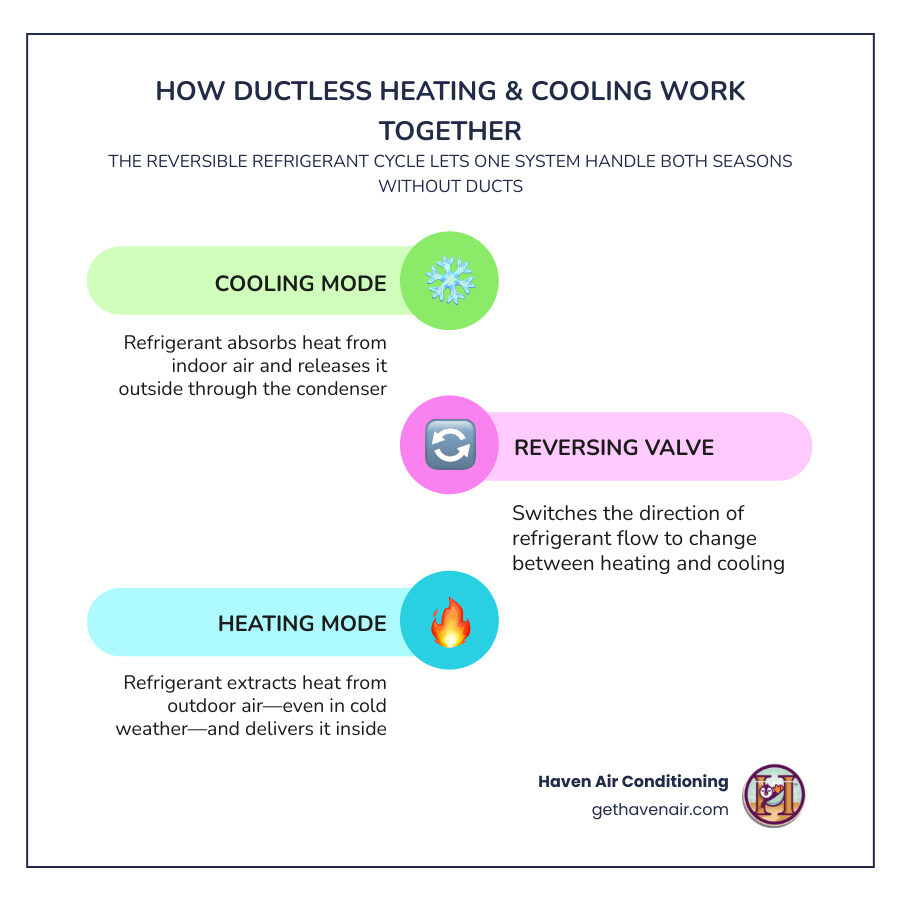
Quick how ductless heating and cooling work together definitions:
Understanding the Basics of Mini-Split Systems

When we talk about ductless mini-split systems, we are describing an HVAC setup that bypasses the traditional central air handler and the labyrinth of metal ducts hidden in your attic or crawlspace. In a standard ducted system, air is conditioned in one central location and then forced through ducts, often losing up to 30% of its energy through leaks or poorly insulated spaces before it even reaches your living room.
Ductless systems are different. They consist of two primary parts: an outdoor condensing unit and one or more indoor air handlers. These are connected by a small conduit housing the power cable, refrigerant tubing, and a suction line. Because they deliver air directly into the room where they are installed, they are incredibly Space-Saving Ductless AC in Modern Homes.
There are two main configurations we typically install for our neighbors in Orange County:
- Single-Zone Systems: One outdoor unit powers exactly one indoor air handler. This is perfect for a sunroom, a garage conversion in Fullerton, or a master suite that’s always too warm.
- Multi-Zone Systems: One outdoor unit can power up to eight indoor air handlers. This allows for total Ductless Cooling across your entire home, with each room having its own thermostat.
How Ductless Heating and Cooling Work Together
The magic of how ductless heating and cooling work together lies in the “heat pump” technology. Most people think of air conditioners as “creating” cold air, but science tells us you can’t actually create cold—you can only remove heat.
In the summer, the indoor unit’s evaporator coil absorbs the heat from your indoor air. The refrigerant carries that heat through the line set to the outdoor unit, where it is released into the atmosphere. In the winter, the process simply runs in reverse. Even when it feels chilly outside in places like Aliso Viejo, there is still thermal energy in the air. The system extracts that heat and brings it indoors.
This shared infrastructure is exactly How Heating and AC Systems Work Together to provide year-round comfort. By using the same compressor, refrigerant lines, and indoor fans for both tasks, you save space and reduce the number of mechanical systems that require maintenance. This efficiency is why many Ductless Heating in Aliso Viejo CA installations see such a dramatic drop in utility bills.
The Role of the Reversing Valve: How Ductless Heating and Cooling Work Together
If the compressor is the heart of the system, the reversing valve is the brain. This four-way valve is the specific component that dictates the direction of the refrigerant flow.
When you set your thermostat to “Cool” on a hot day in Anaheim, the reversing valve directs the refrigerant so the indoor coil acts as an evaporator (absorbing heat). When the Santa Ana winds die down and a winter chill sets in, and you switch to “Heat,” the reversing valve physically slides to a different position. This changes the flow so the outdoor coil becomes the evaporator (absorbing heat from the outside air) and the indoor coil becomes the condenser (releasing heat into your home).
This seamless transition is a hallmark of Ductless Heating in Anaheim CA, allowing homeowners to flip a switch and go from cooling to heating in a matter of minutes.
Year-Round Efficiency: How Ductless Heating and Cooling Work Together
One of the biggest advantages of these systems is Inverter Technology. Traditional HVAC systems are either “on” or “off”—think of it like a light switch. They blast at 100% capacity until the room reaches the target temperature, then shut off, leading to uncomfortable temperature swings.
Ductless systems use variable-speed compressors that act more like a dimmer switch. They ramp up to reach the desired temperature and then “cruise” at a low-power state to maintain it. This technology is a primary reason why these systems achieve such high SEER2 (Seasonal Energy Efficiency Ratio) and HSPF2 (Heating Seasonal Performance Factor) ratings.
For residents looking for Ductless Heating in Buena Park CA, this means the system isn’t just working together to keep you comfortable; it’s working together to save you money. Because the system doesn’t have to restart constantly, it uses significantly less electricity.
Key Components and System Configurations
To understand the hardware involved, let’s look at the “anatomy” of a typical multi-zone setup:
| Component | Function |
|---|---|
| Outdoor Condenser | Houses the compressor and the reversing valve; the “engine” of the system. |
| Indoor Air Handlers | Wall-mounted, floor-mounted, or ceiling-recessed units that distribute air. |
| Refrigerant Lines | Copper tubing that carries the heat-transfer medium between units. |
| Condensate Drain | A small pipe that carries away the moisture removed from the air during cooling. |
| Conduit | A protective covering that holds the electrical and refrigerant lines together. |
When we perform a Ductless AC Installation Guide style setup, we carefully match the BTU (British Thermal Unit) capacity of the outdoor unit to the combined needs of the indoor units. It’s a delicate balance; if the outdoor unit is too small, it won’t keep up on a 100-degree August afternoon. If it’s too large, it may “short cycle,” which wears out the parts and fails to properly dehumidify your home.
Why Orange County Homeowners Choose Ductless Solutions
In our experience serving cities like Irvine, Costa Mesa, and Santa Ana, we’ve found that homeowners appreciate the zoned control more than almost any other feature. In a traditional home, the thermostat is usually in the hallway. If you’re sleeping in a bedroom with a west-facing window, you might be sweltering while the hallway is freezing.
With a ductless system, each room is its own zone. You can keep the living room at 72 degrees while the guest room stays at 78 to save energy. This is a common reason people search for a Ductless Heating Company in Irvine CA.
Beyond comfort, there is a financial incentive. Research shows that installing a high-efficiency heat pump system can boost home resale values by 3% to 5%. Buyers in May 2026 are increasingly looking for “green” homes with low carbon footprints. Because these systems avoid the 30% energy loss associated with leaky ducts, they are a major selling point.
Furthermore, these units are whisper-quiet. While an old central AC might sound like a jet engine taking off in your backyard, a modern ductless outdoor unit operates at around 46 decibels—about the level of a quiet conversation. Indoor units are even quieter, often running at 19-32 decibels, which is barely louder than a whisper. If you need a Ductless Heating Company in Anaheim CA, noise reduction is often one of the first benefits our customers notice.
Installation and Maintenance for Peak Performance
While the technology is advanced, the installation process is surprisingly non-invasive. Instead of tearing out walls to install bulky ducts, we only need to drill a small, three-inch hole to pass the conduit through.
However, “simple” doesn’t mean “DIY.” We always start with a Manual J load calculation. This is a professional assessment of your home’s square footage, insulation quality, window orientation, and local climate. This ensures we size the system perfectly for your specific needs. This level of precision is covered in our Ductless Heating Service Anaheim Guide.
To keep your system running for its full 15-20 year lifespan, maintenance is key:
- Clean the Filters: You should pop open the front panel of your indoor units and rinse the mesh filters every two weeks. Dust buildup is the #1 enemy of efficiency.
- Keep the Outdoor Unit Clear: Ensure there are at least two feet of clearance around your outdoor condenser. Trim back any bushes or plants that might block airflow.
- Annual Professional Tune-ups: Once a year, have a certified technician check refrigerant levels, inspect electrical connections, and deep-clean the coils.
Proper care ensures that your Ductless Heating in Anaheim CA remains reliable for decades to come.
Frequently Asked Questions About Ductless HVAC
Do ductless systems work in freezing temperatures?
Yes! While older heat pumps struggled when the temperature dropped below 40°F, modern “Cold Climate” models are incredible. Many premium systems can provide 100% heating capacity at 5°F and continue to operate efficiently down to -13°F. While we rarely see those extremes in Orange County, it’s comforting to know the system is more than capable of handling a chilly night in the Inland Empire or Riverside.
Are ductless systems more expensive than central air?
The upfront cost can be higher than a standard central AC replacement if you already have functional ducts. However, if you are building an addition or your current ducts are in poor condition, ductless is often more cost-effective. When you factor in the $1,000+ annual savings on utility bills and the federal tax credits (up to $2,000 for qualifying systems), the return on investment is very strong.
Can I install a mini-split system myself?
We strongly advise against it. Handling refrigerant requires EPA certification by law. Additionally, improper installation can lead to refrigerant leaks, electrical fires, and voided manufacturer warranties. A professional installation ensures the system is vacuum-tested and charged correctly, which is vital for how ductless heating and cooling work together efficiently.
Conclusion
At Haven Air Conditioning, we believe that your indoor comfort should be in expert hands. Whether you’re in Anaheim, Fullerton, or anywhere else in the Greater Orange County and Riverside areas, we are here to help you navigate the transition to ductless technology.
Our team of certified, friendly professionals is dedicated to transparency and reliability. We don’t just install equipment; we provide long-term comfort solutions. This includes our membership maintenance plans, which offer priority scheduling and regular check-ups to keep your system in peak condition.
If you’re tired of high energy bills or rooms that just won’t stay comfortable, it might be time to see how ductless heating and cooling work together for your home. We invite you to reach out to us for a second opinion or to schedule an initial consultation. Let us take care of the technical details so you can simply relax in your home.