(714) 332-6302

Are Heat Pumps Ideal for Warm Dry Climates? Here’s What Orange County Homeowners Need to Know
Are heat pumps ideal for warm dry climates like Southern California? Yes — in fact, warm and dry conditions are among the best environments for heat pump performance. With mild winters, long cooling seasons, and low humidity, regions like Orange County let heat pumps do exactly what they’re designed to do: move heat efficiently rather than generate it.
Quick answer for Orange County homeowners:
| Factor | Heat Pump Performance in Warm Dry Climates |
|---|---|
| Summer cooling (up to 115°F+) | Excellent — premium models maintain full capacity |
| Winter heating (cool, dry nights) | Very good — efficient heat extraction from mild air |
| Low humidity impact | Minimal — dry air does not directly reduce efficiency |
| Energy efficiency (COP) | 3.0–7.0 (up to 500% average efficiency) |
| Best system type | Inverter-driven, variable-speed or ductless mini-split |
| Lifespan in desert conditions | 18–22 years with proper maintenance |
If you’ve been wondering whether a heat pump can keep up with triple-digit Orange County summers while also handling those crisp winter nights in Anaheim, Irvine, or Fullerton — the short answer is yes, and often better than a traditional AC and furnace combo.
There’s a common misconception that heat pumps are only a smart choice in cold or humid climates. The reality? Modern heat pumps thrive in warm, arid conditions. They don’t generate heat — they transfer it. And in a climate where outdoor air stays relatively warm even in December, that process becomes remarkably efficient.
In this guide, we’ll break down exactly how heat pumps perform in warm dry climates, what the science says about humidity and temperature, and why more Southern California homeowners are making the switch.
Are Heat Pumps Ideal for Warm Dry Climates Like Southern California?
When we talk about the “perfect” climate for a heat pump, Southern California is at the top of the list. In cities like Anaheim, Irvine, and Riverside, we experience long, hot summers and relatively mild winters. This “cooling-dominant” climate is where heat pumps truly shine.
Many homeowners ask if these systems can handle the intense desert-like heat we occasionally see in the Inland Empire or during Santa Ana wind events. The answer is a resounding yes. Modern, premium heat pumps are engineered to maintain full cooling capacity even when outdoor temperatures soar to 115°F or 125°F. Unlike older systems that might struggle and “choke” in extreme heat, newer units equipped with inverter-driven technology adjust their speed to provide precise cooling without overworking the compressor.
When comparing Heat Pumps vs Air Conditioning, it is important to remember that a heat pump is an air conditioner that has the added ability to reverse its cycle. In the summer, it works exactly like a high-end AC, extracting heat from your home and dumping it outside. In the winter, it simply flips a valve and pulls heat from the outdoor air to bring it inside.
Comparison: Heat Pump vs. Traditional AC + Furnace in Arid Regions
| Feature | Modern Heat Pump System | Traditional AC + Gas Furnace |
|---|---|---|
| Cooling Efficiency | Up to 24+ SEER2 | Typically 14-18 SEER2 |
| Heating Method | Heat Transfer (200-500% efficient) | Fuel Combustion (80-96% efficient) |
| Summer Performance | Maintains capacity up to 125°F | Can struggle above 110°F |
| Energy Source | 100% Electric (Solar compatible) | Electric + Natural Gas |
| Maintenance | One system to maintain | Two separate systems to service |
How Low Humidity and High Temperatures Affect Performance
One of the most persistent myths is that heat pumps need humidity to work. While it’s true that humid air carries “latent heat” (energy stored in water vapor), dry air is actually excellent for heat pump longevity. In a dry climate, your outdoor coils stay cleaner and are far less prone to the corrosion and “freezing up” issues that plague units in swampy, humid environments.
In terms of pure physics, the air temperature is a much bigger factor than humidity for a heat pump. Even in “dry” air, there is an abundance of heat energy to be moved. Think of it this way: Norway has become a world leader in heat pump adoption, with over 600 units per 1,000 households. If a heat pump can efficiently pull heat out of -20°C (-4°F) air in a freezing Norwegian winter, it will have no trouble finding plenty of heat in a 45°F Orange County night.
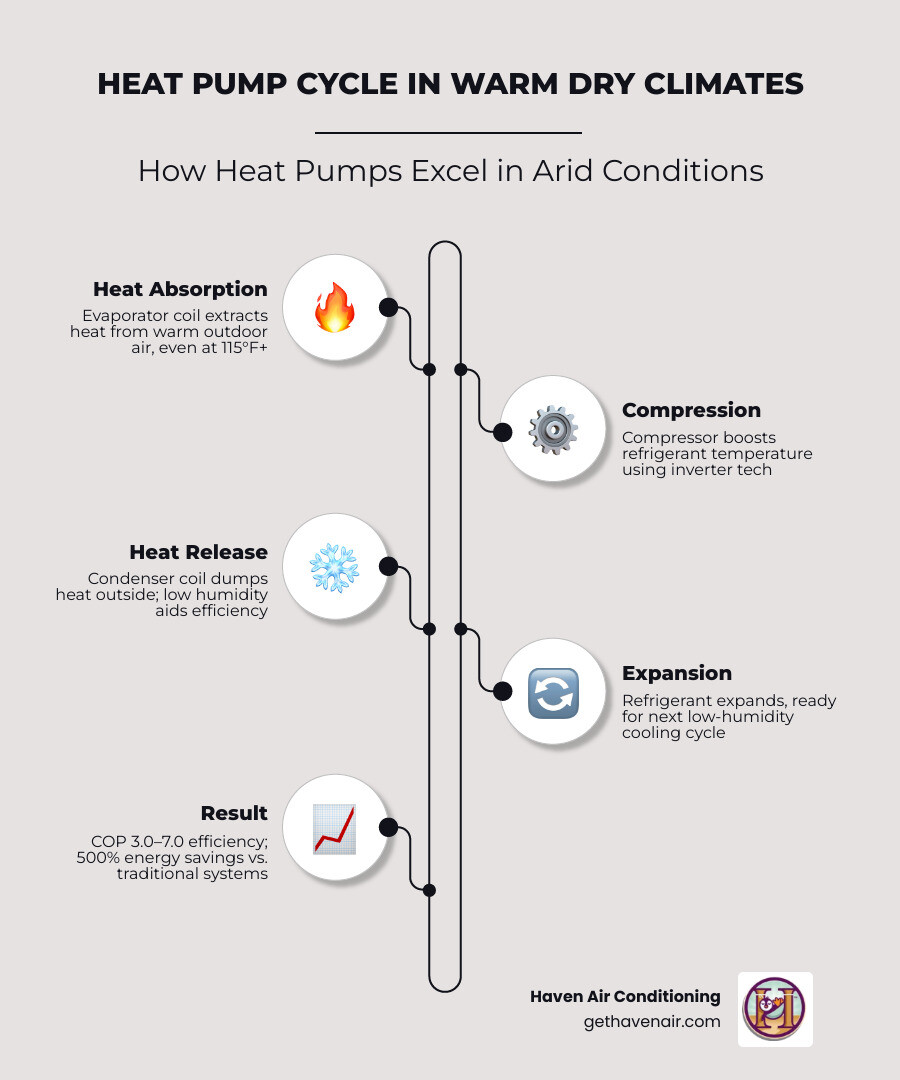
To understand the “how,” we look at What is a Heat Pump & How Does it Work?. The system uses a refrigerant cycle to absorb heat. In a dry climate, the Coefficient of Performance (COP)—the ratio of energy out versus energy in—stays high, typically between 3.0 and 7.0. This means for every unit of electricity you pay for, you get 3 to 7 units of heat. That’s an average efficiency of 500%, compared to a gas furnace which maxes out at about 96-98%.
Maximizing Efficiency: Why Modern Systems Are the Best Choice
If you are looking to upgrade in 2026, the technology has never been better. We consistently recommend systems with variable-speed compressors. Unlike older “single-stage” units that are either 100% ON or 100% OFF, variable-speed systems (also called inverters) can scale their output anywhere from 25% to 100%.
This is a game-changer for Heat Pump Zoning. Instead of cooling the whole house to satisfy one warm room, you can direct comfort exactly where it’s needed, using 30-40% less energy than a traditional system.
Why Inverter-Driven Heat Pumps Are Ideal for Warm Dry Climates
Inverter technology is like cruise control for your home comfort. In the dry heat of Fullerton or La Habra, an inverter system doesn’t “blast” cold air and then shut off. It sips electricity to maintain a perfectly steady temperature. This “load matching” reduces wear and tear on the compressor, which is vital when you’re facing a week-long July heatwave. Our Heat Pump Installation Guide details how these systems are sized to handle these specific local loads.
Ductless Solutions: Why Mini-Splits Are Ideal for Warm Dry Climates
For homes in older neighborhoods like Santa Ana or Orange that might not have existing ductwork, ductless mini-splits are the gold standard. These systems can reach a staggering 30 SEER2 efficiency rating. Why? Because they eliminate “duct loss.” In a typical ducted system, you can lose 20-30% of your energy through leaks or heat transfer in the attic. A Single Zone Ductless Heat Pump Installation delivers air directly to the room, making it the most efficient way to stay cool in a dry climate.
Maintenance and Longevity in Dusty Desert Environments
While dry climates are great for preventing rust, they do bring one specific challenge: dust. In areas like Riverside or Corona, dust and sand can accumulate on the outdoor coils. If those coils get “blanketed” in dust, the heat pump can’t “breathe,” and efficiency can drop by 15-30%.
This is why regular maintenance is non-negotiable. For our neighbors in the Inland Empire, we often perform Heat Pump Repair Riverside CA that could have been avoided with a simple coil cleaning.
However, there is a major upside to our dry air. Because we don’t deal with constant salt spray or high humidity, a premium heat pump in Southern California can last significantly longer than in other parts of the country. While a budget system might fail in 8-10 years due to UV degradation and heat stress, a high-quality, professionally maintained unit can last 18 to 22 years. You can read more about what influences these timelines in our guide on How Long Does a Heat Pump Last?.
Pro-tip for Orange County homeowners: Look for units with powder-coated metal cabinets and UV-resistant components. The intense 300+ days of sunlight we get in Anaheim and Irvine can “cook” cheap plastic components in just a few seasons.
Frequently Asked Questions About Heat Pumps in Arid Regions
Can heat pumps handle 110°F+ summer days in the desert?
Yes. Premium heat pumps are specifically tested for extreme “desert” conditions. While older heat pumps might have lost efficiency once the mercury hit triple digits, 2026-standard inverter systems maintain their cooling capacity up to 125°F. They are designed to handle the “thermal cycling” (the massive swing between a 105°F day and a 65°F night) without breaking a sweat. If you’re curious about the technical specs, check out our AC-Heat Pump breakdown.
Do heat pumps provide enough heat during cool desert nights?
Absolutely. This is actually where heat pumps are most efficient. Because our winter nights rarely drop below freezing (and almost never stay there), a heat pump has an easy job pulling residual heat from the 40°F or 50°F outdoor air. If you ever feel like the air coming out of the vents isn’t “hot” like a furnace, don’t worry—it’s just delivering air at a consistent, comfortable temperature rather than a scorching blast. If you do notice a problem, see our guide on Why is My Heat Pump Blowing Cold Air?.
How much can I save by switching to a heat pump in a dry climate?
Homeowners in dry, cooling-heavy climates like ours see some of the highest ROIs in the country. Switching from an older 12 SEER AC and gas furnace to a high-efficiency heat pump can save you upwards of $1,000 per year in combined energy costs. When you factor in federal tax credits (up to $2,000) and local Heat Pump Rebates in California, the system often pays for itself much faster than you’d think.
Conclusion
At Haven Air Conditioning, we’ve seen how the right technology can transform a home’s comfort. Whether you’re in Anaheim, Fullerton, or Irvine, we know the local climate challenges—from the dusty Santa Ana winds to the 110-degree August afternoons.
We pride ourselves on being your neighborly HVAC experts. We don’t just “sell boxes”; we design comfort solutions that fit the unique needs of Southern California homes. Our team of certified, friendly professionals is here to ensure your peace of mind with transparent service and attention to detail. From our 24/7 emergency availability to our dedicated maintenance plans that keep your system running for two decades, we’ve got you covered.
Ready to see if a heat pump is the right fit for your home? We’d love to provide a second opinion or a free consultation. Let us take care of your comfort so you can relax and enjoy the California sun.