(714) 332-6302

How to Apply for Energy Rebates in California (And Actually Get the Money)
How to apply for energy rebates in California is simpler than most homeowners expect — but only if you know which programs to look for and follow the right steps in the right order.
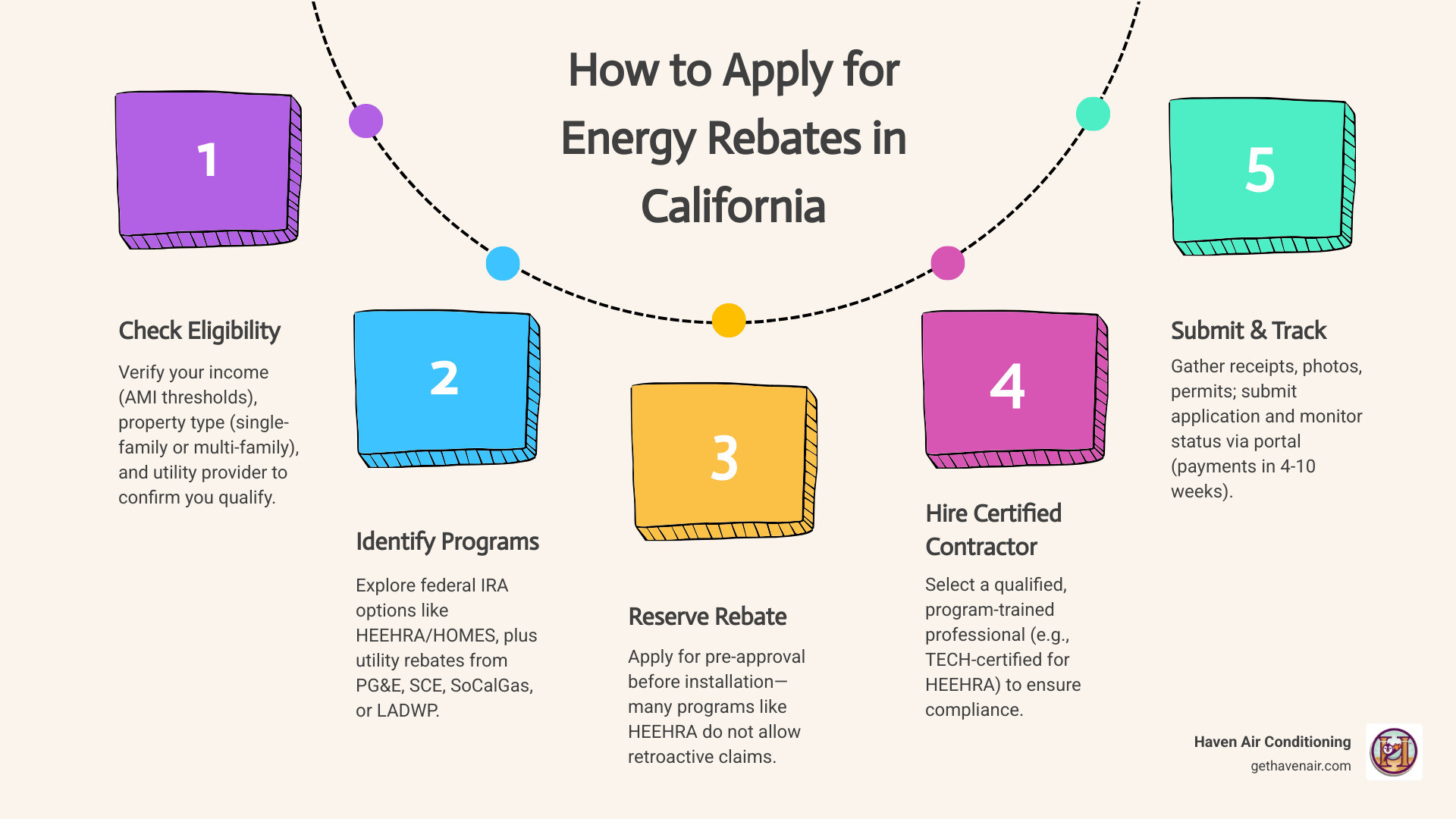
Here’s a quick overview of the process:
- Check your eligibility — Determine your income level (AMI), property type, and which utility serves your home.
- Identify available programs — Look at federal IRA programs (HEEHRA, HOMES), your utility’s rebates (SoCalGas, PG&E, LADWP, SCE), and any local programs in your city.
- Reserve your rebate before installation — Many programs, especially SVCE and HEEHRA, require pre-approval before work begins. No retroactive rebates.
- Hire a certified contractor — For programs like HEEHRA, you must use a TECH-certified, HEEHRA-trained contractor.
- Gather your documentation — Receipts, installation photos, permits, and income verification are typically required.
- Submit your application — Online, by mail, or through your contractor depending on the program.
- Track your application — Use the enrollment number or program portal to check status and expect payment in 4–10 weeks depending on the program.
If you’re a homeowner in Orange County — in Anaheim, Irvine, Fullerton, or anywhere across the region — there’s a real opportunity to recover thousands of dollars on energy-efficient upgrades like heat pumps, water heaters, and EV chargers. California has been allocated $590 million in federal Inflation Reduction Act funds for home energy rebates alone, and that’s on top of what local utilities like SoCalGas and LADWP already offer year-round.
The catch? Rebate programs have specific rules, deadlines, and eligibility requirements — and some of the best programs, like HEEHRA single-family rebates, are already fully reserved as of early 2026. Knowing where to look and what steps to take before you buy or install anything can mean the difference between getting your rebate and missing out entirely.
This guide walks you through every layer of California’s rebate landscape — from federal programs to utility-specific incentives — so you can stack savings confidently and avoid the most common mistakes.
Understanding the Landscape of California Energy Incentives
Navigating energy efficiency can feel like a full-time job. In California, incentives aren’t just one big pot of money; they are a collection of overlapping programs managed by federal, state, and local utility agencies.

When we talk about how to apply for energy rebates in California, we are looking at four main “buckets”:
- Federal Tax Credits (25C): These allow you to deduct a percentage of your project costs directly from your federal taxes. The current 25C credit offers significant savings for heat pumps and weatherization, but it is a tax credit, not a check in the mail.
- Federal IRA Rebates (HEEHRA & HOMES): These are the high-dollar rebates funded by the Inflation Reduction Act. They are point-of-sale or post-purchase rebates specifically for income-qualified households.
- State-Level Incentives: Programs like TECH Clean California provide the infrastructure for heat pump adoption across the state, often working in tandem with other programs to lower the barrier for all-electric upgrades.
- Utility Rebates: Companies like SoCalGas, Southern California Edison (SCE), and LADWP offer their own specific incentives for everything from smart thermostats to high-efficiency furnaces and water heaters.
| Feature | Federal IRA Rebates (HEEHRA) | Local Utility Rebates (e.g., SoCalGas/LADWP) |
|---|---|---|
| Primary Goal | Electrification & Income Equity | Energy Conservation & Load Management |
| Max Amount | Up to $8,000 (HVAC) | Varies (e.g., $75 – $1,500) |
| Income Limits | Strict AMI Requirements | Often open to all (with “Cool LA” extras) |
| Contractor | Must be TECH-certified/HEEHRA-trained | Often DIY-friendly for small appliances |
| Status (April 2026) | Single-family reserved (Waitlist) | Ongoing/Available |
Checking Eligibility for how to apply for energy rebates in California
Before you get your heart set on a specific rebate, you need to verify three things: your Area Median Income (AMI), your property type, and your utility provider.
The how to apply for energy rebates in California process starts with the “AMI” calculation. For federal programs like HEEHRA, rebates are tiered:
- Low-income: Households earning less than 80% of the AMI can receive up to 100% of project costs (capped at specific amounts like $8,000 for HVAC).
- Moderate-income: Households earning 80% to 150% of the AMI can receive up to 50% of project costs (capped at $4,000 for HVAC).
- Above 150% AMI: These households generally do not qualify for HEEHRA but can still access federal tax credits and utility-specific rebates.
Property type also matters. Most rebates apply to single-family homes, but there are specific tranches of funding for multi-family buildings and even renters. Renters in cities like Anaheim or Santa Ana can often access rebates for portable units like window air conditioners or air purifiers through programs like LADWP’s Efficient Product Marketplace or PG&E’s Golden State Rebates.
How to apply for energy rebates in California: A Step-by-Step Guide
If you are planning an upgrade in the Greater Orange County area, following a structured path is the only way to ensure you don’t leave money on the table.
- Find Your Program: Use a tool like “The Switch Is On” and enter your zip code (e.g., 92801 for Anaheim or 92701 for Santa Ana). This will show you every available incentive in your specific neighborhood.
- Verify Equipment Standards: Not every “efficient” AC or heater qualifies. Most programs require ENERGY STAR certification, or specific SEER2/HSPF2 ratings for heat pumps. For example, SoCalGas requires furnaces to have a minimum 92% AFUE.
- Check Heat Pump Rebates In California: If you are switching from a gas furnace to an electric heat pump, this is often the largest single rebate you can get.
- Select a Certified Contractor: This is the “make or break” step for state and federal rebates. For HEEHRA, you must work with a TECH-certified contractor who has completed HEEHRA-specific training. They will handle the “Reservation Request,” which secures your funds before the work starts.
- Get Pre-Approval: For many Silicon Valley or state-wide programs, if you install the unit before you have an approved reservation, you are disqualified. Always wait for the “thumbs up” from the program administrator.
Required Documentation for how to apply for energy rebates in California
Once the installation is complete, the paperwork begins. To successfully finish the how to apply for energy rebates in California process, you’ll usually need to upload:
- Final Itemized Invoice: This must show the model number, serial number, and the date of installation.
- Proof of Purchase: A receipt showing you paid for the unit.
- Photos: Most applications now require a photo of the installed unit and a clear photo of the “Make/Model” tag on the side of the equipment.
- Permit Copies: For major installs like HVAC or water heaters, a closed city permit (from Anaheim, Fullerton, etc.) is often required to prove the install meets safety codes.
- Income Verification: If applying for HEEHRA, you’ll need to provide tax returns or pay stubs through a secure state portal.
Federal IRA Programs: HEEHRA and HOMES Status in 2026
As of April 2026, the landscape for Inflation Reduction Act (IRA) funds has shifted significantly. California received a total of $590 million, but demand has been record-breaking.
HEEHRA (Home Electrification and Appliance Rebates):
Phase I, which launched in late 2024, focused on single-family heat pump HVAC systems. As of February 24, 2026, single-family HEEHRA rebates are fully reserved statewide. This means new applicants are currently placed on a waitlist. However, HEEHRA Phase II is under development, with $152 million allocated to expand these rebates to more appliances and households.
HOMES (Home Efficiency Rebates):
The HOMES program works differently. It doesn’t care which specific appliance you buy; it cares about how much energy you save.
- Equitable Building Decarbonization (EBD): 60% of HOMES funding ($130.3 million) goes toward no-cost retrofits for low-income households.
- Pay for Performance (P4P): 40% ($90.8 million) is for “measured” savings. You get paid based on the actual energy reduction tracked by your smart meter after the upgrades are done.
Maximizing Savings with Utility-Specific Programs and Stacking
While the big federal rebates are on a waitlist, local utility programs in Orange County and Riverside are still very active. One of the best strategies for how to apply for energy rebates in California is “stacking.” This means combining a utility rebate with a federal tax credit.
- SoCalGas: If you’re staying with gas, you can get up to $1,500 for high-efficiency tankless water heaters or $5,000 for solar thermal systems. They even offer smaller rebates for ENERGY STAR dryers ($70) and ovens.
- LADWP: Their Efficient Product Marketplace (EPM) is fantastic for smaller items. You can get $100 for a window AC or $75 for a high-efficiency refrigerator. For those in the “Cool LA” program (income-qualified), these AC rebates can jump as high as $275.
- SCE & PG&E: Both offer “Golden State Rebates,” which provide instant coupons for smart thermostats (up to $75) and air purifiers. PG&E also offers a Pre-Owned EV Rebate of up to $4,000 and up to $5,000 for EV charging equipment for income-eligible households.
The “Stacking” Rule: You generally cannot use two different rebates for the same piece of equipment if they come from the same funding source. However, you can usually combine a utility rebate (like SoCalGas) with a federal tax credit (25C). Always ask your contractor to verify which “stacks” are legal in your zip code.
Avoiding Common Pitfalls and Rebate Scams
Whenever there is a lot of government money involved, scammers follow. We want our neighbors in Anaheim and Orange County to stay safe.
Watch out for these red flags:
- “Free” Equipment Offers: If someone knocks on your door promising a “free” heat pump from the government, be cautious. Real rebates require an application process and often an upfront cost or a certified contractor.
- Requests for Financial Info: Never share your social security number or bank details with someone claiming they can “reserve” your rebate for a fee.
- Unlicensed Contractors: To get a rebate, the contractor must have a valid CSLB (California State License Board) license. If they ask to do the work “under the table” without a permit, you will lose your rebate eligibility.
Tracking Your Application:
Once you submit, keep your “Enrollment Number.” Most utility portals (like SoCalGas or LADWP) have a status check tool. Processing usually takes 6–8 weeks. If your application is selected for “verification,” a program representative might visit your home to ensure the equipment was actually installed. Don’t worry—this is a standard part of the quality control process.
Frequently Asked Questions
How do I track the status of my rebate application?
Most programs provide an online portal. For utility rebates, log into your account (SoCalGas, SCE, or LADWP) and look for the “Rebate Status” or “Marketplace” tab. You will need your application or enrollment number. Expect a 4-week window for local checks and up to 10 weeks for federal tranches.
Can renters apply for energy rebates in California?
Yes! While major HVAC installs usually require the property owner’s permission, renters can apply for “point-of-purchase” rebates on appliances like refrigerators, window AC units, air purifiers, and LED lighting. Programs like the Green Tariff can also give renters a 20% discount on clean energy bills if they live in disadvantaged communities.
What appliances qualify for the highest rebate amounts?
Heat pump HVAC systems and heat pump water heaters (HPWH) offer the highest payouts. Under HEEHRA, these can reach $8,000. Even under local utility programs, switching to a heat pump often triggers “fuel switching” bonuses that can add several thousand dollars to your total savings.
Conclusion
At Haven Air Conditioning, we’ve seen how a well-planned upgrade can transform a home’s comfort while slashing monthly bills. Whether you’re in Anaheim, Fullerton, or Irvine, understanding how to apply for energy rebates in California is the key to making these high-tech upgrades affordable.
We know the paperwork can be a headache, but you don’t have to do it alone. From choosing the right ENERGY STAR equipment to ensuring your installation meets the strict standards required for rebate approval, our team is here to help. We pride ourselves on transparency and neighborly service—we’ll take care of your comfort so you can relax in your home.
If you’re considering a new system or just want a second opinion on your current setup, reach out to us. We offer expert maintenance plans to keep your new investments running efficiently for years to come, and we’re always available for 24/7 emergency support.
Ready to start your energy-saving journey? Visit our residential HVAC services page to see how we can help you upgrade your Orange County home.