(714) 332-6302

Is a Heat Pump or Traditional AC the Right Choice for Your Orange County Home?
Heat pump vs traditional ac for orange county homes is one of the most common HVAC questions we hear from homeowners across Anaheim, Irvine, Fullerton, and beyond — and the answer matters more now than ever.
Here’s a quick comparison to help you decide:
| Factor | Heat Pump | Traditional AC + Furnace |
|---|---|---|
| Heating included? | Yes — one system does both | No — needs a separate furnace |
| Energy efficiency | 300%–400% (moves heat) | AC cools well; furnace tops out ~95% |
| Best for OC’s mild winters? | Yes — works well to 35°F | Furnace is more than most OC homes need |
| Upfront cost | Higher | Lower |
| Long-term savings | Up to 30%–50% on heating costs | Moderate |
| Refrigerant future-proofing | New systems use R-454B | Older R-410A units face rising repair costs |
| Ductless option? | Yes — mini-splits available | Limited |
| Environmental impact | No combustion, lower emissions | Gas furnace burns fuel |
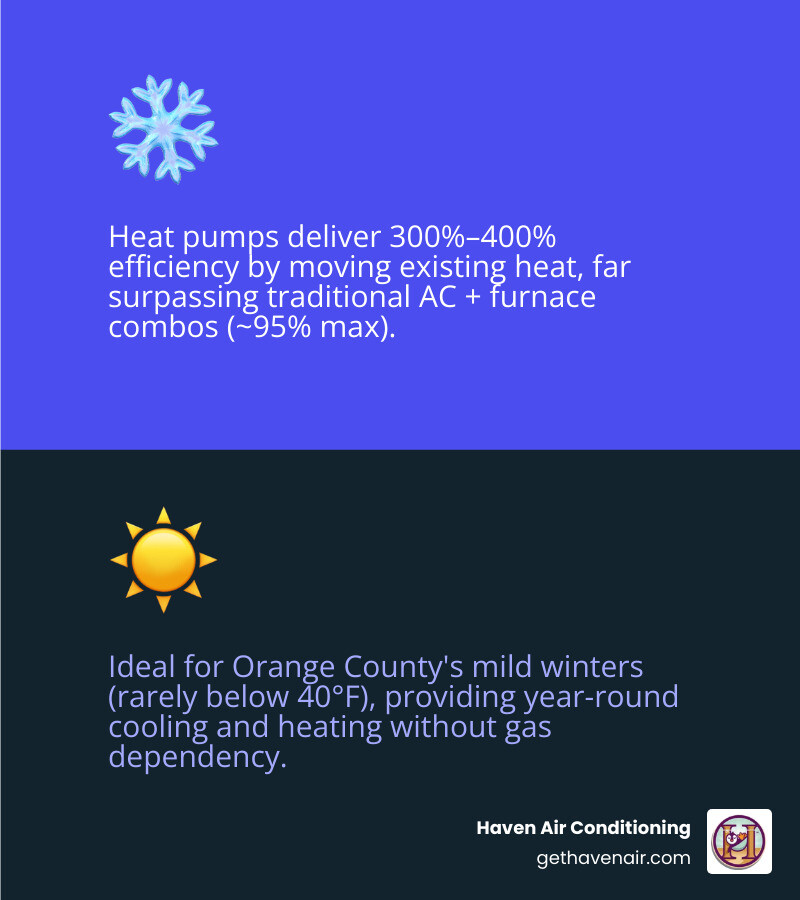
The short answer: for most Orange County homes, a heat pump is the smarter long-term choice — especially if you’re replacing an aging AC or furnace. OC’s mild winters rarely push temperatures below 40°F, which is exactly the kind of climate where heat pumps run at peak efficiency year-round.
That said, traditional AC and furnace setups still make sense in certain situations — like when you have a newer furnace, prefer gas heat, or are working with a tighter budget right now.
The rest of this guide breaks down everything you need to know: how each system works, what they cost in 2026, which rebates are still available, and how to figure out what’s right for your specific home.
Understanding the Tech: Heat Pump vs Traditional AC for Orange County Homes
To make the best choice for your home in Anaheim or Huntington Beach, it helps to understand what’s actually happening inside those metal boxes in your backyard or attic. While they look remarkably similar from the outside, the way they handle your comfort is fundamentally different.
A traditional central AC is a “one-way street.” Its job is to pull heat out of your home and dump it outside. When the weather turns chilly in December, that AC sits idle while a separate gas furnace burns fuel to create new heat.
A heat pump, however, is a master of relocation. Instead of burning fuel to create heat, it uses electricity to move heat from one place to another. In the summer, it works exactly like an AC, moving heat from your living room to the outdoors. In the winter, it uses a reversing valve to flip the script, pulling ambient heat from the outdoor air and pumping it into your home. Even when it feels “cold” to us, there is still usable heat energy in the air that a modern heat pump can harvest.

If you’ve ever wondered what is a heat pump and how does it work, think of it like a refrigerator that can also run in reverse to warm up your kitchen. Because it moves heat rather than creating it, the efficiency levels are off the charts compared to old-school systems. When looking at an AC heat pump, you’re essentially getting a two-in-one system that manages your climate 365 days a year.
How Heat Pumps Differ from Central AC
The primary difference when weighing heat pump vs traditional ac for orange county homes is the dependency on fossil fuels. A traditional AC is part of a “split system” that relies on a furnace blower and a gas line. If you want heat, you have to burn gas.
Heat pumps offer all-electric operation. This is a game-changer for homeowners in areas like Costa Mesa or Irvine who are looking to “decarbonize” or eliminate their monthly gas connection fees. Since a heat pump handles both cooling and heating, you no longer need a separate furnace taking up space in your closet or attic. It’s a streamlined, dual-functionality approach to home comfort.
For more details on these differences, you can explore our deep dive into heat pumps vs air conditioning.
The Impact of the 2025 Refrigerant Transition
As of April 2026, we are now fully immersed in the post-R-410A era. Starting January 1, 2025, the manufacturing of new HVAC equipment using R-410A refrigerant became illegal due to environmental regulations.
What does this mean for you? If you have an older AC system using R-410A, repair costs are likely exploding. As the supply of old refrigerant dwindles, the cost to fix a simple leak can become prohibitively expensive. New systems now use A2L refrigerants, such as R-454B or R-32, which have a much lower Global Warming Potential (GWP).
Switching to a heat pump now is a form of future-proofing. Whether you need heat pump repair in Riverside, CA or a full replacement in Fullerton, choosing a modern system ensures you won’t be left hunting for obsolete parts or expensive, phased-out refrigerants in a few years.
Performance and Efficiency in the Southern California Climate
Orange County is arguably the best place in America to own a heat pump. Our Mediterranean climate, characterized by mild winters and warm (but rarely sustained “death-valley” hot) summers, allows these systems to shine.
| Performance Metric | Heat Pump | Traditional Furnace |
|---|---|---|
| Efficiency Rating | 300% to 400% | 80% to 95% |
| Energy Source | Electricity | Natural Gas |
| OC Climate Fit | Ideal (High COP) | Overkill for mild winters |
Traditional furnaces are designed for places like Chicago or New York, where temperatures stay below freezing for weeks. In Orange County, our average winter lows are in the 40s and 50s. A heat pump can deliver 100% of its rated heating capacity down to 35°F, making it the perfect match for our local weather.
When comparing heat pumps vs furnaces: which is better, the heat pump almost always wins on efficiency. While a high-end gas furnace might reach 95% efficiency (meaning 5% of the energy is wasted), a heat pump’s efficiency is often cited at 300% or more because it isn’t “creating” energy—it’s just moving it.
Operating Costs: Heat Pump vs Traditional AC for Orange County Homes
Let’s talk numbers. Research shows that California households upgrading to a heat pump save an average of $670 per year on energy bills. In Orange County specifically, families often see their heating costs drop by 30% to 50% after making the switch.
Why the big drop?
- Eliminating the Gas Hookup: By switching to an all-electric heat pump, many homeowners can eventually cap their gas lines, eliminating the monthly service fees (which can add up to over $200 a year just for the “privilege” of being connected).
- Efficiency Gains: Because heat pumps use 30% to 50% less energy than traditional furnaces for heating, your SCE bill won’t spike nearly as much as a SoCalGas bill during a winter cold snap.
- Coastal Humidity: Interestingly, the coastal humidity in areas like Newport Beach and Laguna Beach actually helps heat pumps operate more efficiently by providing more thermal mass in the air to extract heat from.
If you ever find yourself saying, “my heat pump is not heating,” it’s usually a simple maintenance issue or a thermostat setting, rather than a failure of the technology itself in our mild climate.
Indoor Air Quality and Environmental Impact
Beyond the wallet, there’s the “breathability” factor. Traditional furnaces involve combustion—burning gas inside your home. This carries a small but real risk of carbon monoxide leaks and produces combustion by-products that can affect indoor air quality, especially for those with asthma or allergies.
Heat pumps are entirely emission-free at the point of use. There is no flame, no gas, and no carbon monoxide risk. Furthermore, modern heat pump systems often come with superior filtration options that are essential during Southern California’s wildfire seasons.
If you’re looking for a company for heat pump repair in Riverside or maintenance in Anaheim, we can show you how these systems integrate with high-MERV filters to keep your indoor air pristine.
Installation Costs, Rebates, and the 2026 Financial Outlook
We’ll be honest: the upfront cost of a heat pump is generally higher than a basic AC-only replacement. An average full heat pump replacement in Orange County typically ranges from $11,000 to $16,000 before incentives. However, once you factor in the massive rebates available in 2026, the “net” cost often drops significantly.
Installation: Heat Pump vs Traditional AC for Orange County Homes
When we perform an AC heat pump installation, we look at your home’s entire ecosystem. If you’re sticking with traditional AC, you still have to account for the cost of the furnace. If your furnace is also old, replacing both at once can cost just as much as a single high-efficiency heat pump.
In some older homes in Whittier or Fullerton, a heat pump might require an electrical panel upgrade (moving from a 100-amp to a 200-amp service). While this adds to the initial cost, it also adds value to your home and prepares you for other future upgrades like EV chargers. Whether you need heat pump installation in Whittier or a Fullerton area specialist, we ensure the sizing is perfect for your square footage to avoid “short-cycling” and high bills.
Maximizing California Rebates and Tax Credits
This is where the math gets exciting for Orange County homeowners. In 2026, several programs make the switch to a heat pump incredibly affordable:
- Federal 25C Tax Credit: Homeowners can claim 30% of the project cost, up to $2,000, every year for heat pump installations.
- TECH Clean California: This state program offers rebates ranging from $3,000 to $7,400 depending on your utility provider and the type of system installed.
- Utility Rebates: SCE and SDG&E often provide additional “on-bill” credits or rebates between $1,000 and $3,500.
In one real-world example, a homeowner in a 2,100 sq ft Tustin home had a gross quote of $15,000 but ended up paying only $7,600 out of pocket after all heat pump rebates in California were applied. That’s comparable to, or even cheaper than, a basic traditional AC and furnace replacement!
Choosing the Right System for Your Home’s Layout
Your home’s architecture plays a big role in the heat pump vs traditional ac for orange county homes debate.
If your home already has a well-maintained network of ducts, a central heat pump is a “drop-in” replacement for your AC and furnace. We simply swap the units and use your existing vents. You can find more on this in our heat pump installation guide.
However, many older homes in Orange County or room additions (like a converted garage in Anaheim Hills) don’t have ductwork. In these cases, ductless mini-split heat pumps are the gold standard. They allow for heat pump zoning, meaning you can cool the living room to 72°F while keeping an unused guest room at 78°F, saving even more on your energy bills.
When Traditional AC and Furnaces Still Make Sense
Despite the benefits of heat pumps, we still recommend traditional setups in specific cases:
- The Budget-First Scenario: If you are on a very tight budget and your furnace is only a few years old, replacing just the AC unit is the most affordable way to restore cooling.
- Existing Gas Infrastructure: If you recently invested in a high-efficiency gas furnace and it has 15 years of life left, it doesn’t always make sense to rip it out.
- Personal Preference: Some people simply prefer the “blast” of hot air that comes from a gas furnace compared to the gentler, more consistent warmth of a heat pump.
We also consider the lifespan of a heat pump (typically 15-20 years) versus traditional systems. If you plan on moving in two years, the long-term ROI of a heat pump might not be your primary concern.
Frequently Asked Questions
Can a heat pump really replace my furnace in Newport Beach?
Absolutely. In fact, Newport Beach is the perfect climate for it. Because it rarely drops below freezing, a heat pump will operate at its most efficient level almost every day of the year. You will get the same level of comfort while likely seeing a significant drop in your total utility spend.
Why is my heat pump blowing cold air?
This is a common concern for new owners! A gas furnace blows air that is roughly 120°F–140°F, which feels “hot” to the touch. A heat pump blows air that is closer to 90°F–100°F. Since your body temperature is 98.6°F, that air might feel “cool” or “lukewarm” if you put your hand right in front of the vent, but it is still effectively heating your room. If the air is truly cold, it might be in a brief “defrost cycle,” which is a normal part of operation. For more help, check out why is my heat pump blowing cold air.
What is the expected lifespan of these systems?
With proper maintenance, you can expect 15 to 20 years from a modern heat pump. In coastal Orange County, the main “enemy” is salt air, which can corrode outdoor coils. We recommend our membership maintenance plan to ensure your coils are cleaned and your system is protected from the elements. You can read more about how long a heat pump lasts here.
Your Indoor Comfort, In Expert Hands
Choosing between a heat pump vs traditional ac for orange county homes shouldn’t be a stressful decision. At Haven Air Conditioning, we’re your neighbors in Anaheim, and we’ve spent years helping families from Huntington Beach to Riverside find the perfect balance of comfort and cost.
Our team of certified, friendly professionals is here to provide more than just a quote; we provide a comprehensive comfort audit. We’ll look at your ductwork, your electrical panel, and your energy goals to give you a transparent recommendation. Whether you need a second opinion on a repair or you’re ready to explore high-efficiency heat pumps, we’re here to help.
Don’t forget to ask about our membership maintenance plan! Our members enjoy priority scheduling and regular tune-ups that keep their warranties valid and their bills low.
Ready to find out which system is right for your home? Schedule your Orange County HVAC consultation with Haven Air Conditioning today. We’ll take care of your comfort so you can relax and enjoy the OC sunshine.