(714) 332-6302

How Santa Ana Winds and Heat Waves Drive Up Your Cooling Costs in Orange County
How Santa Ana winds and heat waves drive up your cooling costs is something every homeowner in Orange County, Anaheim, Irvine, and Fullerton eventually feels — not just in the heat, but in their electricity bill. Here is a quick breakdown of the main ways these events hit your wallet:
- Extreme outdoor temps exceed your AC’s design limit, forcing it to run nonstop without ever reaching your set temperature
- Humidity drops to single digits, making the air feel hotter and your system work harder
- Hot desert air blasts the outdoor condenser, reducing its ability to shed heat efficiently
- Attic temperatures can spike above 140°F, pushing heat down through ceilings and into living spaces
- Dust and debris clog filters and coils, cutting airflow and driving up energy use
- Leaky ducts lose 20 to 30% of cooled air, making every dollar spent on cooling less effective
- Nighttime temps stay elevated, removing the natural overnight recovery your home normally gets
Southern California sees 10 to 25 of these wind events every year. Most last around three days. And during that window, continuous AC operation can add a significant amount to your electricity bill — especially under Southern California Edison’s higher-tier rates.
These are not just uncomfortable days. They are a predictable, recurring strain on your cooling system and your budget. Understanding exactly what happens during a Santa Ana event — and why your AC responds the way it does — is the first step to protecting both your comfort and your finances.
Understanding the “Devil Winds”: How Santa Ana Winds and Heat Waves Drive Up Your Cooling Costs
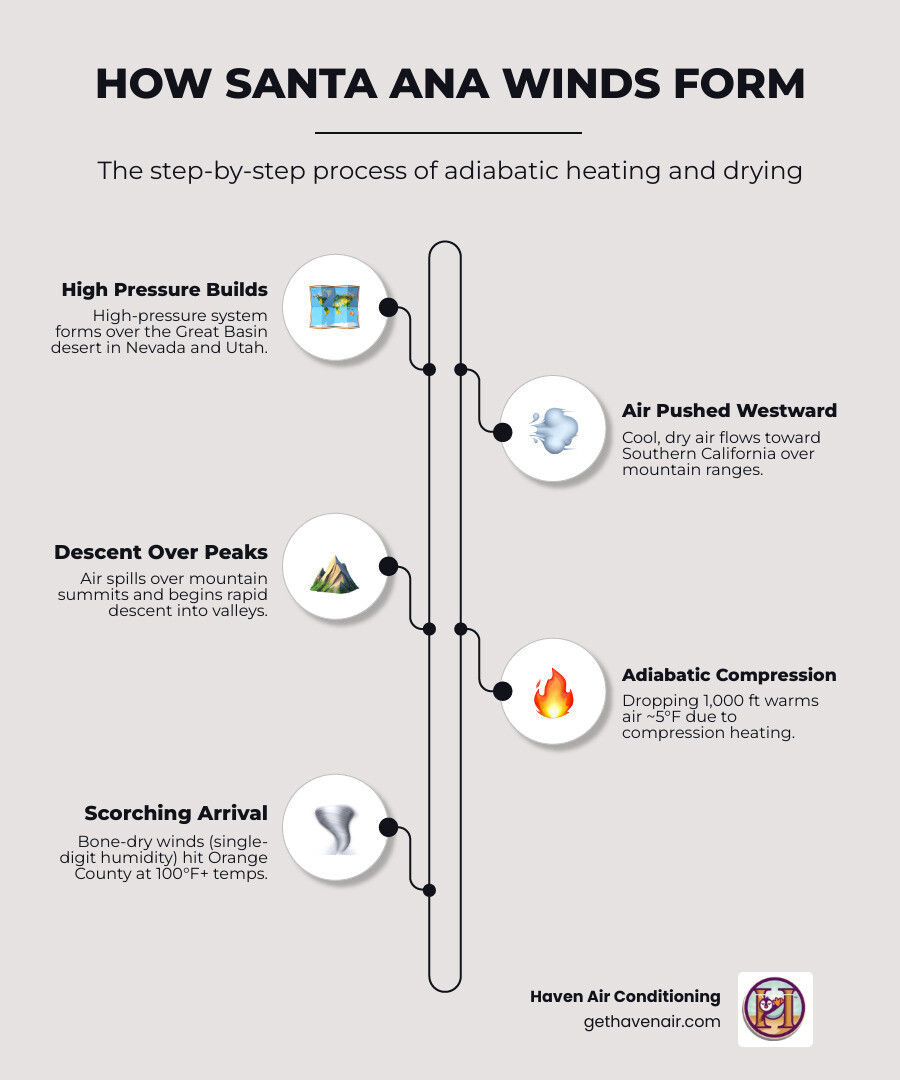
To understand why your wallet takes a hit, we first have to look at the science behind the “Devil Winds.” Santa Ana winds aren’t just “strong breezes”; they are a specific meteorological phenomenon. They form when a high-pressure system builds over the Great Basin—the high-altitude desert region covering Nevada and parts of Utah.
As this air is pushed toward the lower-pressure coastal areas of Southern California, it has to move over our mountain ranges. As the air spills over the peaks and rushes down into the valleys toward cities like Santa Ana and Anaheim, it undergoes a process called adiabatic heating. For every 1,000 feet the air drops in elevation, it warms up by roughly 5°F due to compression. By the time that air hits your backyard, it has transformed from cool desert air into a scorching, bone-dry blast.
These are “katabatic winds,” meaning they carry heat through compression rather than just sun exposure. This is why Do Air Conditioners Use a Lot of Electricity? is such a common question during these months. Your system isn’t just fighting the sun; it’s fighting air that has been physically squeezed into a higher temperature.
The “Oven Door” Effect in Orange County
Stepping outside during a Santa Ana event in Irvine or Orange feels like someone just opened a giant oven door. The air is often hotter than the ambient temperature should be for that time of year. Furthermore, the humidity can drop into the single digits—levels drier than the Sahara Desert.
This extreme dryness causes moisture to evaporate off your skin instantly, which might keep you feeling somewhat cool if you’re outside, but it plays havoc with your home’s thermodynamics. Wood floors and furniture can shrink, and more importantly, your AC unit has to work much harder to maintain a comfortable environment when the outdoor air is a relentless 100°F with 5% humidity. If you find your AC Not Cooling Extreme Heat HVAC Inspection is the best way to ensure your system hasn’t reached its breaking point.
Frequency and Timing of Wind Events
While we often associate heat with July and August, Santa Ana winds typically peak during the fall months—September through November—though they can occur well into the winter. In fact, as of May 2026, we are seeing shifts in these patterns, with winter peaks becoming more common.
Southern California averages between 10 and 25 of these events annually. Each event usually lasts about three days. That means for up to 75 days a year, your AC is potentially operating under “emergency” conditions. Keeping up with Spring AC Tune-Ups and System Inspection ensures that when October rolls around and the winds kick up, your system is ready for the “marathon” it’s about to run.
Why Your AC Struggles When the Winds Howl

Most homeowners assume that if the AC is running but the house is still 78°F, the unit must be broken. However, during a Santa Ana event, the physics of cooling are working against you.
Every air conditioner has a “design temperature.” In most of Orange County, systems are engineered to handle outdoor temperatures up to about 95°F or 100°F. These systems are designed to maintain a 20-degree differential between the outside and inside air. If it’s 105°F in Fullerton, your AC is doing its job perfectly if it keeps your living room at 85°F. Asking it to hit 70°F in those conditions is like asking a four-cylinder car to tow a boat up a mountain at 90 miles per hour—it’s simply exceeding its mechanical capability.
When you see Your AC Running But Not Cooling, it’s often because the heat load on the house is entering faster than the AC can pump it out.
Exceeding the Design Temperature in Irvine and Fullerton
In cities like Irvine and Fullerton, where modern homes often have large windows, the “design temperature” is frequently exceeded during wind events. When the outdoor temperature stays in the high 90s or low 100s for three days straight, your compressor never gets a break.
Continuous operation leads to overheating. The electrical components inside your outdoor unit, such as the capacitor and the fan motor, are under immense thermal stress. If your unit is older or hasn’t been serviced, this is when it will likely fail. If you’re stuck in the heat, Anaheim AC Repair: Keeping Your Home Cool and Comfortable can help get things back on track, but prevention is always cheaper than an emergency call.
The Impact of Dust and Debris on System Efficiency
Santa Ana winds are notorious for carrying fine desert dust, pollen, and, unfortunately, wildfire smoke. Your outdoor condenser unit works by pulling air through metal fins to cool the refrigerant. When the winds blow at 60 MPH, they sandblast your unit with dirt.
This debris clogs the fins, creating a “blanket” that traps heat inside the unit. This forces the compressor to work even harder to shed heat, driving up your electricity bill. Inside the home, your air filters are also working overtime. We recommend using MERV 13 filters during these events to catch fine particles, but a clogged filter is the #1 cause of airflow restriction. Regular HVAC Maintenance Anaheim CA includes cleaning these coils and checking filters to keep efficiency high.
The Financial Toll: Calculating the Cost of Extreme Heat
How exactly does this translate to your bank account? During a standard summer day, your AC might cycle on and off every 15–20 minutes. During a Santa Ana event, it likely runs 24/7.
| Condition | Avg. Daily Run Time | SCE Tier 2/3 Rate (Est) | Daily Cost | 3-Day Event Total |
|---|---|---|---|---|
| Standard Day (82°F) | 6-8 Hours | $0.28/kWh | $12 – $16 | $36 – $48 |
| Santa Ana Event (102°F) | 18-24 Hours | $0.40/kWh | $35 – $50 | $105 – $150 |
As shown, a single three-day wind event can easily add $100 to your monthly bill. If you have multiple events in a month, you could see your bill double or triple. Learning How to Save Money on Air Conditioning becomes a survival skill in Southern California.
The “One-Two Punch” of Humidity and Heat
Sometimes, the dry Santa Ana winds are followed by a “one-two punch” of humid air moving up from Baja. This is particularly dangerous for your budget. While dry heat is hard on the AC, humid heat is worse because the system has to spend energy removing moisture from the air (latent heat) before it can actually lower the temperature (sensible heat).
Furthermore, these humid events often lead to warmer nights. If the temperature doesn’t drop below 75°F at night, your home’s structure (the walls, the slab, the furniture) never gets a chance to cool down. This “cumulative heat load” means your AC starts every morning at a disadvantage. A Summer AC System Inspection What to Look For can help identify if your system is effectively dehumidifying your home.
Climate Change and Future Cost Projections
Since 1896, average summer temperatures in California have risen by about 3°F. While that might not sound like much, it has led to a massive increase in “extreme heat days.” Projections for the coming decades suggest that inland areas like Riverside and the San Bernardino valleys could see ten times more extreme heat days than they did in the 1960s.
This means the “standard” cooling season is expanding, and the intensity of Santa Ana events is likely to increase. As utility companies spend billions on grid maintenance and wildfire prevention, those costs are passed down to you in the form of higher rates. Knowing Don’t Sweat the Cost of New HVAC with These California Rebates is essential for planning long-term home upgrades that can weather these changes.
Immediate Steps to Protect Your Home and Budget
You don’t have to just sit there and watch the meter spin. There are immediate actions you can take to mitigate how Santa ana winds and heat waves drive up your cooling costs.
- The 78-Degree Rule: Set your thermostat to 78°F. We know it sounds warm, but every degree you raise it reduces your AC’s workload by roughly 3%.
- Block the Sun: Close all blinds and drapes, especially on south- and west-facing windows. This can reduce solar heat gain by up to 45%.
- Give the AC a Break: Avoid using the oven, dryer, or dishwasher between 2 PM and 9 PM. These appliances add heat to your home that the AC then has to pay to remove.
- Check the Condenser: Once the wind dies down, gently rinse your outdoor unit with a garden hose to remove the desert dust.
Performing an End of Summer AC System Check is a great way to assess how much damage the season’s winds did to your equipment.
How Santa Ana Winds and Heat Waves Drive Up Your Cooling Costs Through Air Leaks
Your home is like a bucket. If the bucket has holes, it doesn’t matter how much water (cool air) you pour in; it will never stay full. Santa Ana winds create pressure differentials that “push” hot air into your home through tiny gaps.
Leaky or poorly insulated ducts are the biggest culprits, often causing homes to lose 20 to 30% of their cooled air before it even reaches the rooms. During a wind event, your attic can reach 150°F. If your ducts are leaking in that attic, you are essentially cooling the crawlspace while your family sweats downstairs. Expert Heating Installation in Irvine: A Guide to Professional Service often involves sealing these ducts to ensure year-round efficiency.
Managing Indoor Air Quality During Wind Events
The dust isn’t just an efficiency problem; it’s a health problem. Santa Ana winds carry fine particulate matter that can trigger asthma and allergies. Because the winds create negative pressure in the home, they actually “suck” dust in through window frames and electrical outlets.
Using a high-quality HEPA filter or an indoor air quality system can help. If you are considering a Heating System Installation Irvine, it’s the perfect time to ask about integrated air purification that works during both the heating and cooling seasons.
Future-Proofing Your Home Against Extreme Weather
If you’re tired of the “bill shock” every fall, it’s time to look at long-term solutions. California’s Title 24 energy codes have become much stricter for a reason—they save homeowners a fortune.
Upgrading your attic insulation from the older R-19 standard to the modern R-38 can reduce your cooling costs by 15% to 25%. In the middle of a Santa Ana event, that insulation acts as a thermal barrier, keeping that 150°F attic heat from radiating through your ceiling. You can often offset these costs by Navigating the California Energy Rebate Application Process.
Long-Term Strategies for Managing How Santa Ana Winds and Heat Waves Drive Up Your Cooling Costs
Beyond insulation, the type of cooling system you use makes a massive difference. Modern heat pumps are incredibly efficient at managing the specific temperature swings we see in Orange County. They can provide precise cooling in the summer and efficient heating when the desert air turns cold at night.
Looking into Heat Pump Rebates in California can make this upgrade much more affordable. A high SEER2-rated system is designed to maintain efficiency even when outdoor temperatures climb, whereas an old 10-SEER unit will simply guzzle electricity to produce minimal cooling.
Upgrading to Resilient HVAC Technology
The future of HVAC is in variable-speed technology. Unlike traditional systems that are either “on” or “off,” variable-speed compressors can slow down or speed up to match the exact cooling needs of the home. This prevents the “short cycling” that often kills compressors during heat waves.
For larger homes in cities like Irvine, Variable Refrigerant Flow (VRF) systems or smart zoning allow you to cool only the rooms you are using. This targeted cooling is the ultimate way to fight back against rising energy rates. For a deep dive into your options, check out our AC Installation Irvine Complete Guide.
Frequently Asked Questions about Santa Ana Winds
How often do Santa Ana winds occur in Southern California?
Southern California typically experiences between 10 and 25 Santa Ana events per year. While they can happen at any time, they are most frequent between September and March. They are caused by high-pressure systems in the Great Basin pushing air toward the Pacific coast, and each event usually lasts about three days.
Can Santa Ana winds damage my outdoor AC unit?
Yes. The primary threats are wind-blown debris (like palm fronds or trash) getting stuck in the fan and fine desert dust clogging the condenser coils. High gusts (up to 60 MPH) can also vibrate loose electrical connections. We recommend a professional inspection after a particularly heavy wind season to ensure no hidden damage occurred.
Why does my house feel so dusty after a wind event?
The high-speed winds create a pressure imbalance. As wind rushes past your home, it creates a “vacuum” effect that pulls air (and dust) out of your attic and walls through light fixtures, outlets, and baseboards. This is often a sign that your home needs better air sealing or that your ductwork has leaks. Using MERV 13 filters can help mitigate the dust that enters through the HVAC system itself.
Conclusion
At Haven Air Conditioning, we’ve lived through enough Orange County wind seasons to know exactly the kind of stress they put on your home and your peace of mind. Whether you’re in Anaheim, Fullerton, or Irvine, our team of certified, friendly professionals is here to ensure your “Indoor Comfort is in Expert Hands.”
We don’t just fix ACs; we help you future-proof your home against the unique challenges of the Southern California climate. From high-efficiency installations to our comprehensive maintenance plans that give you priority scheduling, we treat you like the neighbor you are.
If your electricity bill was a shock last month, or if your system struggled to keep up during the last heat wave, don’t wait for the next “Devil Wind” to blow in. Reach out to us for a second opinion or a system check-up. We’ll take care of the technical stuff so you can just relax and stay cool.
If you are worried about your system, don’t wait—check out our guide on AC Not Cooling Extreme Heat HVAC Inspection and give us a call today!