(714) 332-6302

Why Your AC Running But Not Cooling Your Home Is a Problem You Shouldn’t Ignore
If your ac running but not cooling your home is your reality right now, you’re not alone — and there’s a good chance the fix is simpler than you think. Whether you’re in Irvine, Anaheim, Fullerton, or anywhere else in Orange County, a system that runs but delivers warm air is one of the most common calls Haven Air Conditioning receives every summer.
Here are the most likely reasons your AC is running but not cooling:
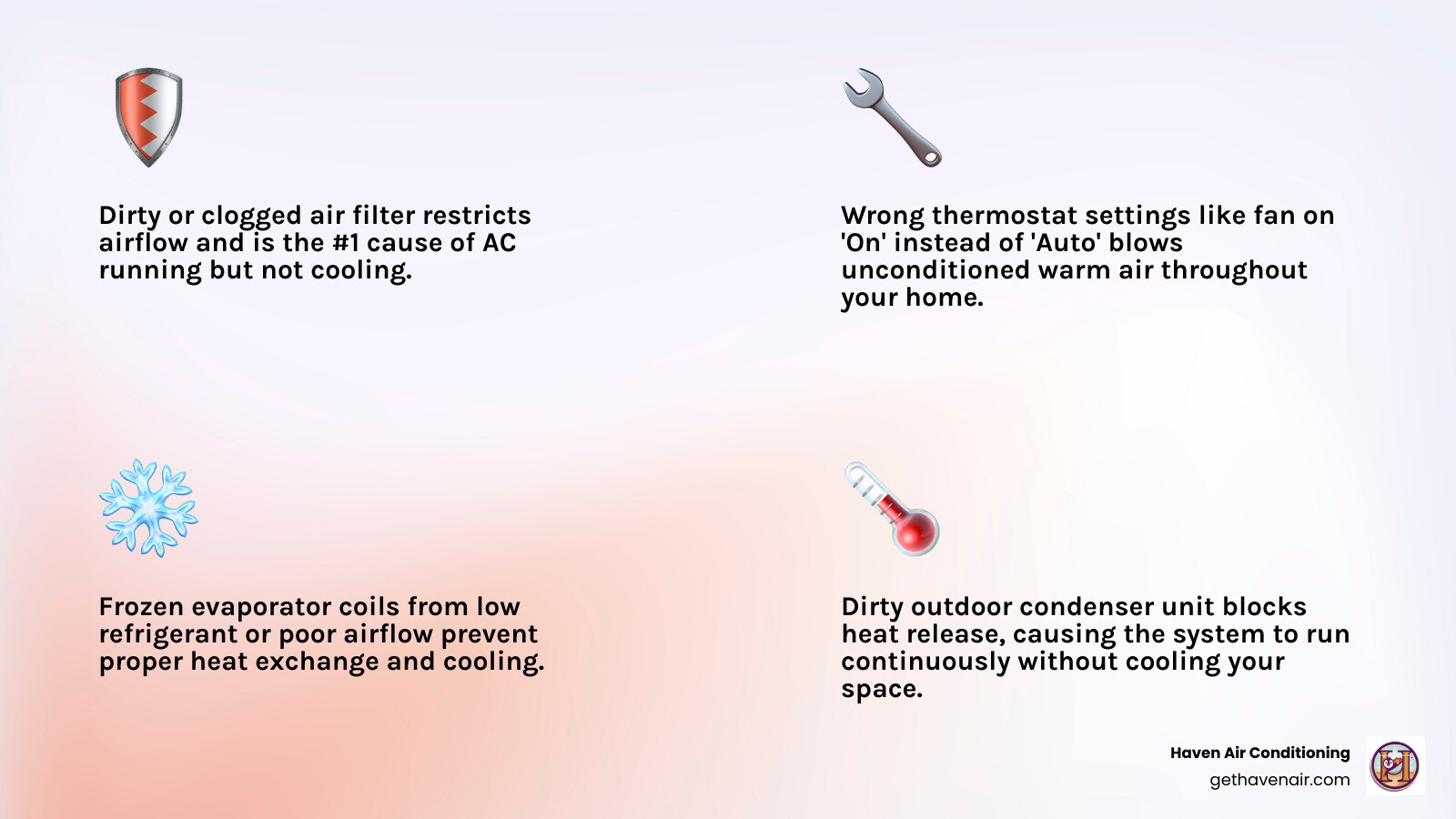
- Dirty or clogged air filter — restricts airflow and is the single most common cause
- Wrong thermostat settings — fan set to “On” instead of “Auto” blows unconditioned air
- Frozen evaporator coils — caused by restricted airflow or low refrigerant
- Low refrigerant / refrigerant leak — the system can’t transfer heat without the right charge
- Dirty or blocked outdoor condenser unit — prevents heat from escaping outside
- Tripped circuit breaker or failed capacitor — outdoor unit stops running while indoor fan continues
- Leaky ductwork — up to 20-30% of cooled air can escape before reaching your rooms
- Undersized or aging system — struggles on the hottest days or after years of wear
Some of these you can check and fix yourself in minutes. Others need a certified HVAC technician. This guide walks you through both — so you know exactly what to do right now.
Troubleshooting Airflow and Thermostat Settings
When your ac running but not cooling your home, the first place we always recommend looking is your thermostat. It serves as the “brain” of your HVAC system. If the brain is confused, the body won’t work right.
Start by checking your thermostat calibration and power. If the screen is blank or flickering, it might just need a fresh set of batteries. A thermostat that isn’t communicating correctly can’t tell your outdoor unit to kick in the cooling cycle. For a deeper dive into these initial steps, check out our guide on Air Conditioner Not Cooling What to Check.
One of the most frequent “oops” moments we see in the field involves the fan setting. On your thermostat, you’ll see “Auto” and “On.” If it’s set to “On,” the indoor blower fan runs 24/7, regardless of whether the air is actually being cooled. This means that between cooling cycles, your vents are just blowing room-temperature (or even warm) air throughout the house. Always keep it set to “Auto” so the fan only blows when the cooling mechanism is active.
Immediate DIY Checks for an AC Running But Not Cooling Your Home
If the thermostat looks good, it’s time to play detective with your airflow. Airflow restriction is the silent killer of home comfort.
The Dirty Air Filter
A clogged air filter is the number one reason for cooling failures. In the dusty, pollen-heavy environments of Southern California, filters can fill up faster than you’d think. A filter covered in what looks like a “gray felt blanket” forces your blower motor to work overtime, which can eventually lead to a total system shutdown. We recommend checking your filters every 30 to 90 days. For residential systems, a MERV rating between 8 and 11 is usually the “sweet spot” for balancing air filtration with healthy airflow.
Register Obstructions
Take a quick walk through your home. Are there any rugs, curtains, or pieces of furniture blocking your supply or return vents? Even if your AC is working perfectly, it can’t cool your home if the air is trapped behind a sofa. If your system seems to be struggling to even start up, you might find our resource on Why Your AC Is Not Turning On How to Fix It helpful.
Identifying Mechanical Failures and Frozen Coils
If your airflow is clear but you’re still sweating, we need to look at the mechanics of heat exchange. Your AC doesn’t actually “create” cold; it removes heat from your indoor air and dumps it outside.
When this process is interrupted, your evaporator coils (the part inside your home) can actually drop below freezing. This sounds like it would make the house colder, but ice is actually an insulator. Once those coils are encased in ice, they can no longer absorb heat from your home. This leads to the frustrating scenario of an ac running but not cooling your home.
If you see ice on the copper lines or near the indoor unit, turn the system off at the thermostat immediately. Running it will only cause more damage. You can set the fan to “On” to help the ice melt naturally, but you’ll likely need an AC Not Cooling Extreme Heat HVAC Inspection to find out why it froze in the first place.
Another common culprit is a clogged condensate drain line. As your AC cools the air, it removes moisture. That water has to go somewhere. If the drain line gets blocked by mold, algae, or debris, a safety float switch will trigger, shutting down the cooling cycle to prevent a flood in your home.
DIY Maintenance vs. Professional Repairs
| Issue | Can I Fix It? | Action Required |
|---|---|---|
| Dirty Air Filter | Yes | Replace with a new filter |
| Thermostat Settings | Yes | Set to “Cool” and fan to “Auto” |
| Blocked Vents | Yes | Move furniture or obstructions |
| Frozen Coils | No | Turn off system and call a pro |
| Low Refrigerant | No | Requires EPA-certified technician |
| Electrical Failure | No | Professional diagnostic needed |
Common Mechanical Reasons for an AC Running But Not Cooling Your Home
If you hear hissing or bubbling noises coming from your unit, you likely have a refrigerant leak. Refrigerant is a closed-loop chemical; it isn’t “used up” like gasoline in a car. If it’s low, there is a hole somewhere. Simply “topping it off” is like trying to fill a bucket with a hole in the bottom. Because handling refrigerant requires EPA Section 608 certification, this is strictly a job for the pros. You can learn more about the Low Refrigerant in AC Signs and Solutions on our blog.
In the worst-case scenario, your compressor — the “heart” of your system — may have failed. If the indoor fan is blowing but the outdoor unit is silent or making a loud grinding noise, the compressor might be the issue. This is often the most expensive part to replace, and in older units, it sometimes makes more sense to upgrade to a newer, more efficient system. For a comprehensive look at these issues, see Your AC Running But Not Cooling.
Electrical Issues and Outdoor Unit Maintenance
Sometimes the problem isn’t inside the house at all. Your outdoor condenser unit needs to breathe.
In cities like Anaheim or Fullerton, we often find units “choked” by overgrown shrubs, grass clippings, or spider webs. Your outdoor unit needs at least 2 feet of clear space on all sides to release heat effectively. You can gently rinse the metal fins with a garden hose (low pressure only!) to remove dirt and grime. Never use a pressure washer, as it will bend the delicate aluminum fins and permanently restrict airflow.
If the outdoor unit isn’t running at all, check your home’s breaker panel. A power surge during a Southern California heatwave can trip the breaker for your AC. If you reset it and it trips again immediately, do not try a third time — this indicates a serious electrical short or a failing component like a capacitor or contactor. Capacitors act like large batteries that give the compressor the “kick” it needs to start. When they bulge or fail, your system will hum but won’t actually start cooling. For residents in our area, our AC Repair Orange County Complete Guide covers these local challenges in detail.
Why You Shouldn’t Ignore an AC Running But Not Cooling Your Home
It might be tempting to just let the AC keep running in hopes that it eventually “catches up.” Please, don’t do this! Running a malfunctioning system puts immense strain on the compressor. What might have been a simple capacitor fix can quickly turn into a total system replacement if the compressor overheats or experiences “slugging” (when liquid refrigerant returns to the compressor).
Beyond the risk of damage, an ac running but not cooling your home is a massive drain on your wallet. Your energy bills will skyrocket as the system works 24/7 without ever reaching the set temperature. Furthermore, a struggling AC fails to manage humidity. In more humid areas or during “May Gray” and “June Gloom,” your home can quickly start to feel like a sauna.
If you are in the Inland Empire area, we also provide specialized AC Repair Riverside services to handle the unique heat demands of that region. The average AC system lasts 10 to 15 years. If yours is approaching that age and losing 20-30% of its air through leaky ductwork, it might be time to consider a more reliable, energy-efficient upgrade.
Frequently Asked Questions
How long does it take for an AC to cool a house?
Under normal conditions, you should feel a noticeable difference within 15 to 30 minutes. However, most AC units are designed to handle outdoor temperatures up to about 92-95°F. When Orange County hits triple digits, your system will take much longer to cool down, especially if your home has poor insulation or leaky ducts.
Is it safe to keep running the AC if it’s not cooling?
No. If the air coming out of your vents isn’t cold, turn the system off. Continuing to run it can cause the compressor to overheat or lead to “slugging,” where liquid refrigerant enters the compressor and causes permanent mechanical failure. It’s better to be warm for a few hours while waiting for a technician than to face an emergency full-system replacement.
Why does my home feel humid even when the AC is running?
Your AC has two jobs: lowering the temperature and removing moisture (the “latent load”). If your system is undersized or the evaporator coils are dirty, it may lower the temperature slightly but fail to remove enough moisture. This leaves you with “cold and clammy” air rather than true comfort.
Conclusion
At Haven Air Conditioning, we know that a broken AC is more than just an inconvenience — it’s a matter of your family’s comfort and safety. Whether you’re dealing with a simple thermostat glitch or a complex refrigerant leak, our team of certified professionals is here to help throughout the Greater Orange County area.
From Anaheim to Laguna Beach, we pride ourselves on transparent service and attention to detail. We highly recommend our membership maintenance plans, which include regular tune-ups to catch these “running but not cooling” issues before they become emergencies. Plus, members get priority scheduling!
Don’t spend another minute in a hot house. If you’ve gone through this checklist and your home is still warm, give us a call. We’ll take care of your comfort so you can relax. For more information on keeping your home cool, visit our AC Repair Orange County Complete Guide.