(714) 332-6302

How to Know When an HVAC Failure Is a True Emergency
When an HVAC failure is a true emergency depends on one simple question: does it put your health, safety, or home at risk right now?
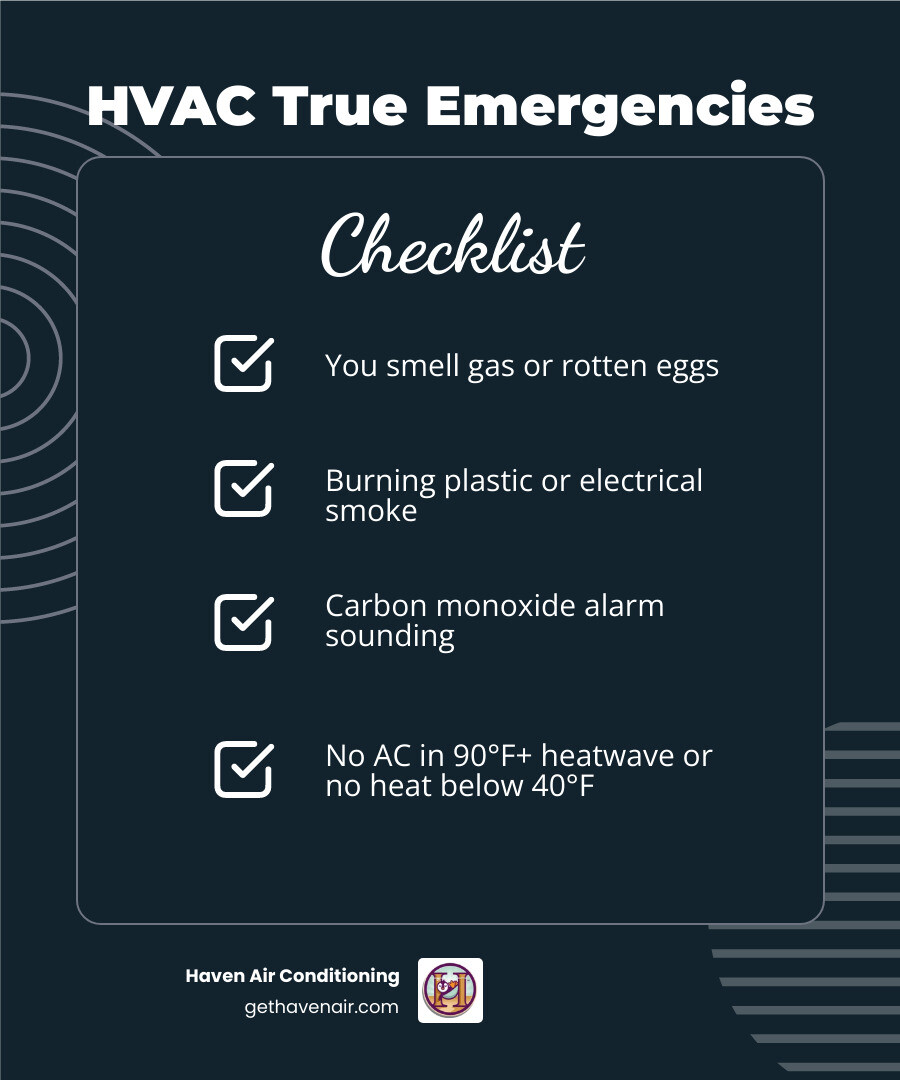
Here are the situations that qualify as true HVAC emergencies:
- You smell gas or rotten eggs — evacuate immediately and call your gas utility
- You smell burning plastic or see electrical smoke — shut off the system and call for help
- Your carbon monoxide detector is going off — get out of the house and call 911
- You have no AC during a heatwave above 90°F — especially urgent for children, seniors, or anyone with a health condition
- You have no heat when it’s below 40°F outside — frozen pipes can burst within hours
- You hear loud banging, grinding, or screeching — a mechanical failure may be seconds away
- You see significant water leaking from your system — flooding and mold can follow fast
- You hear hissing sounds near your unit — likely a refrigerant leak requiring an EPA-certified technician
- Your system is rapidly short cycling and shutting off — electrical stress and component damage are building up
If none of those apply, your issue may be urgent but can likely wait for a scheduled appointment.
Everything else — a dirty filter, mild temperature drift, or a minor noise — can usually be handled during normal business hours.
For Orange County homeowners, knowing the difference can save you from unnecessary stress, costly damage, and real safety risks. Haven Air Conditioning is available around the clock to help you figure out exactly where your situation falls.
Understanding When an HVAC Failure Is a True Emergency
It is April 2026, and as we head into another beautiful but unpredictable spring in the Greater Orange County area, the last thing any of us wants to deal with is a sudden HVAC breakdown. We often hear from homeowners in Anaheim, Fullerton, and Santa Ana who aren’t quite sure if their system’s “hiccup” warrants a midnight phone call to a technician or if it can wait until the morning.
The reality is that while every HVAC issue feels like an emergency when it’s your comfort on the line, true emergencies are defined by safety, health, and property integrity. If a failure leaves your home vulnerable to fire, toxic gas, or structural damage, it is a priority. Similarly, if the failure occurs during extreme weather—like a Santa Ana wind-driven heatwave or a rare Southern California cold snap—the risk of heat exhaustion or hypothermia turns a repair into a rescue mission.
We pay special attention to vulnerable populations. If you have infants, seniors, or family members with chronic health conditions in your home, a loss of climate control becomes an emergency much faster than it would for a healthy adult. High humidity (above 70%) can also be an emergency for those with respiratory issues, as it promotes rapid mold growth and poor air quality.
To help you decide, we’ve put together a quick comparison table:
| Scenario | Emergency? | Why? |
|---|---|---|
| Smell of rotten eggs | YES | Possible gas leak; explosion risk. |
| Total loss of AC at 95°F | YES | Risk of heatstroke and dehydration. |
| System won’t turn on (mild weather) | NO | Discomfort, but no immediate health risk. |
| Loud metal-on-metal screeching | YES | Imminent mechanical failure and motor damage. |
| Water dripping slowly from a pipe | NO | Needs repair soon, but not an immediate crisis. |
| CO Detector sounding | YES | Life-threatening toxic exposure. |
Knowing Signs Your System Needs HVAC Repair Services can help you catch these issues before they escalate into a middle-of-the-night crisis.
When an HVAC failure is a true emergency vs. a DIY fix
Before you hit the panic button, there are a few “human error” issues that we can often troubleshoot over the phone. About 40% of HVAC emergencies actually begin with thermostat malfunctions. Before calling for emergency service, we recommend checking these three things:
- The Thermostat Batteries: If the screen is blank, your system can’t communicate. Fresh batteries might be all you need.
- The Circuit Breaker: Sometimes a power surge trips the breaker. Flip it all the way off and then back on once. If it trips again immediately, do not try a second time—that is an electrical emergency.
- The Air Filter: A clogged filter can cause the system to overheat and shut down as a safety precaution. If you haven’t changed yours in three months, try a fresh one and see if the system restarts after cooling down.
If you’ve checked these and the system still won’t budge, it’s time to look into Quick and Reliable AC Repair Services to get your home back to normal.
Safety Hazards: Gas, Smoke, and Carbon Monoxide
In HVAC, safety always trumps comfort. When we talk about safety hazards, we aren’t just talking about being a little sweaty; we are talking about life-threatening situations. If you suspect a gas leak or carbon monoxide exposure, your first move should never be to call an HVAC company—it should be to get every person and pet out of the house immediately.
Once you are safely outside, call the fire department or your gas utility. Only after they have cleared the scene should you reach out for Emergency Heating Anaheim services to repair the underlying mechanical fault.
1. You Smell Gas or Rotten Eggs (Mercaptan)
Natural gas is naturally odorless, but utility companies add a chemical called mercaptan to give it a distinct “rotten egg” or sulfur scent. If you catch a whiff of this near your furnace or coming through your vents, treat it as a top-tier emergency.
Gas leaks often stem from cracked heat exchangers or Heater Ignition Problems in Older Homes. Because gas is highly flammable, even a small spark from a light switch or a cell phone could trigger an explosion. Do not turn any lights on or off, do not use your phone inside the house, and do not attempt to shut off the gas yourself if you aren’t already familiar with the valve. Just get out.
2. The Scent of Burning Plastic or Electrical Smoke
Modern HVAC systems are packed with complex wiring, capacitors, and motors. If you smell something like burning plastic, ozone, or electrical smoke, it usually means a component is overheating or a wire has shorted out.
This is a true emergency because electrical fires can smolder inside your walls or the unit itself long after the system has shut down. If you notice a smoky scent or see actual smoke coming from your vents, turn off the system at the thermostat and the circuit breaker immediately. This is often linked to Furnace Won’t Start: Electrical Problems or issues Why Furnace Keeps Tripping Circuit Breaker. Ignoring that “burnt” smell can lead to a total motor burnout or, worse, a house fire.
3. Carbon Monoxide Alarms Are Sounding
Carbon monoxide (CO) is often called the “silent killer” because it is colorless, odorless, and tasteless. It is a byproduct of incomplete combustion in gas furnaces. According to the CDC, unintentional carbon monoxide poisoning sends over 100,000 Americans to emergency departments every year.
If your CO detector sounds, do not assume it is a false alarm or a low battery. Symptoms of CO poisoning include headache, dizziness, weakness, upset stomach, and confusion. If anyone in the house feels “flu-like” without a fever, evacuate immediately. The most common cause is a cracked heat exchanger, which allows deadly gases to leak into your home’s air supply. Ensuring you follow Safety steps for when an HVAC failure is a true emergency can literally save lives.
Performance Failures in Extreme Weather
In Orange County and Riverside, our weather is usually the envy of the world. However, when the mercury climbs toward 100°F in July or drops toward freezing in January, our homes become our primary defense against the elements.

4. Complete Loss of Air Conditioning During a Heatwave
While a broken AC on a 75-degree day is a nuisance, a broken AC when it’s 90°F or higher is a health hazard. In these temperatures, indoor environments can quickly reach dangerous levels, leading to heat exhaustion or dehydration.
This is particularly critical for infants, whose bodies cannot regulate temperature as well as adults, and seniors with respiratory or cardiovascular issues. If your system has failed entirely during a heat advisory, don’t wait. You likely need Yorba Linda CA 24-Hour AC Repair or Signs You Need Expert 24-Hour AC Repair to restore safety to your home.
5. No Heat When Temperatures Drop Below 40°F
We don’t get many “hard freezes” in the Greater Orange County area, but when temperatures dip below 40°F, a lack of heat becomes a property risk. Insulation in the average home only retains heat for about 8 to 12 hours. After that, internal temperatures can drop low enough to threaten your plumbing.
Frozen pipes that burst can cause tens of thousands of dollars in water damage. If your furnace fails during a cold snap, it makes your home uninhabitable and puts your structure at risk. Check out Don’t Get Left in the Cold: Your Guide to Expert Heating Repair in Santa Ana for tips on keeping your system running when the temperature drops.
Mechanical Red Flags: Noises, Leaks, and Short Cycling
Sometimes a system is still technically “working”—in that it’s blowing air—but it’s screaming for help. Mechanical red flags are the system’s way of telling you that a total breakdown is imminent. If you catch these early, we can often save the major components like the compressor or the blower motor.
6. Loud Banging, Screeching, or Grinding Noises
Your HVAC system should operate with a gentle hum and the sound of rushing air. If it starts sounding like a “bag of rocks” in a dryer, you have a problem.
- Banging: Usually indicates a loose part, like a connecting rod or a blower fan blade that has come untethered.
- Screeching: Often a sign of a failing bearing in the motor or a slipped belt.
- Grinding: This typically means the motor bearings are shot and the motor is about to seize.
Turning the system off immediately when you hear these sounds can prevent a $200 repair from turning into a $2,000 replacement. If you’re hearing these sounds late at night, don’t ignore them—consult our guide on Late Night AC Problems: When to Call Experts or call for After Hours AC Problems: Call for Emergency service.
7. Significant Water Leaks or Flooding
AC units produce a lot of condensation. Normally, this water flows out through a drain line. However, if that line clogs, the water has nowhere to go but into your home. A significant leak can destroy drywall, warp hardwood floors, and encourage mold growth within 24 to 48 hours.
If you see a “river” coming from your indoor unit or notice water dripping from your ceiling, shut the system off. This stops the production of new condensation while we clear the blockage. Ignoring a “small” leak often leads to a collapsed ceiling—a much bigger emergency than a clogged drain.
8. Hissing Sounds Indicating Refrigerant Leaks
If you hear a persistent hissing or bubbling sound coming from your AC unit, it’s likely a refrigerant leak. Refrigerant is the “blood” of your AC system; without it, the compressor will overheat and eventually die.
Refrigerant leaks are emergencies for three reasons:
- Health: Refrigerants are toxic chemicals that can cause respiratory distress if inhaled in high concentrations.
- Environment: Most refrigerants are potent greenhouse gases.
- Cost: Running a system low on refrigerant will kill your compressor, which is the most expensive part of the unit.
Refrigerant handling requires EPA-certified technicians. If your system is hissing and blowing warm air, turn it off and call us.
9. Rapid Short Cycling and System Instability
Short cycling is when your HVAC system turns on and off every few minutes without ever completing a full cooling or heating cycle. This puts massive electrical stress on the system and is often caused by safety switches repeatedly tripping to prevent a fire or a total mechanical collapse.
Short cycling can be caused by anything from a faulty thermostat to a failing control board or an iced-over evaporator coil. Because it causes rapid wear on the compressor, it needs to be addressed immediately to avoid a complete system failure. If your unit is struggling to stay on, check these Signs You Need Expert 24-Hour AC Repair.
Frequently Asked Questions about HVAC Emergencies
How do I know when an HVAC failure is a true emergency?
Ask yourself: Is anyone’s health at risk? Is the home’s structure at risk (fire or water damage)? If the answer is yes, or if the weather outside is extreme (over 90°F or under 40°F), it is a true emergency. If it’s just a bit uncomfortable but the house is safe, it can likely wait until business hours.
Are emergency HVAC repairs more expensive than regular service?
Generally, yes. Emergency services often involve after-hours labor, priority dispatch, and the immediate procurement of parts. However, the cost of an emergency call is almost always lower than the cost of replacing a whole system that was destroyed because a small problem was ignored, or repairing water damage from a burst pipe.
Can I wait until morning for a loud AC noise?
We don’t recommend it. If the noise is mechanical (grinding or screeching), continuing to run the system will cause more damage. It’s better to shut it off and call for an expert opinion. If it’s 2 AM and you can comfortably go without AC for a few hours, shut it down and call us first thing in the morning to save on after-hours fees.
Conclusion
At Haven Air Conditioning, we’ve spent years serving our neighbors across Anaheim, Irvine, Fullerton, and the entire Greater Orange County area. We know that your home is your sanctuary, and when an HVAC failure is a true emergency, you need more than just a repairman—you need a team you can trust.
Our certified, friendly professionals are dedicated to providing exceptional customer service and attention to detail. Whether you’re in Corona, Costa Mesa, or Huntington Beach, we are here to ensure your indoor comfort is in expert hands.
To prevent these emergencies from happening in the first place, we highly recommend our membership maintenance plan. Members receive twice-yearly tune-ups, which can make you 50% less likely to experience an emergency breakdown. Plus, if a problem does arise, our members get priority scheduling.
Don’t wait until you’re sweating in a heatwave or shivering in the dark. If you’re worried about a strange sound or a sudden change in your system’s performance, reach out to us for a second opinion or to schedule a check-up. We’ll take care of your comfort so you can relax in your home.