(714) 332-6302

What It Really Means When Your Heat Pump Is Running But Not Heating or Cooling
heat pump running but not heating or cooling what it means is often simpler than you might think — and in many cases, you can fix it yourself in minutes.
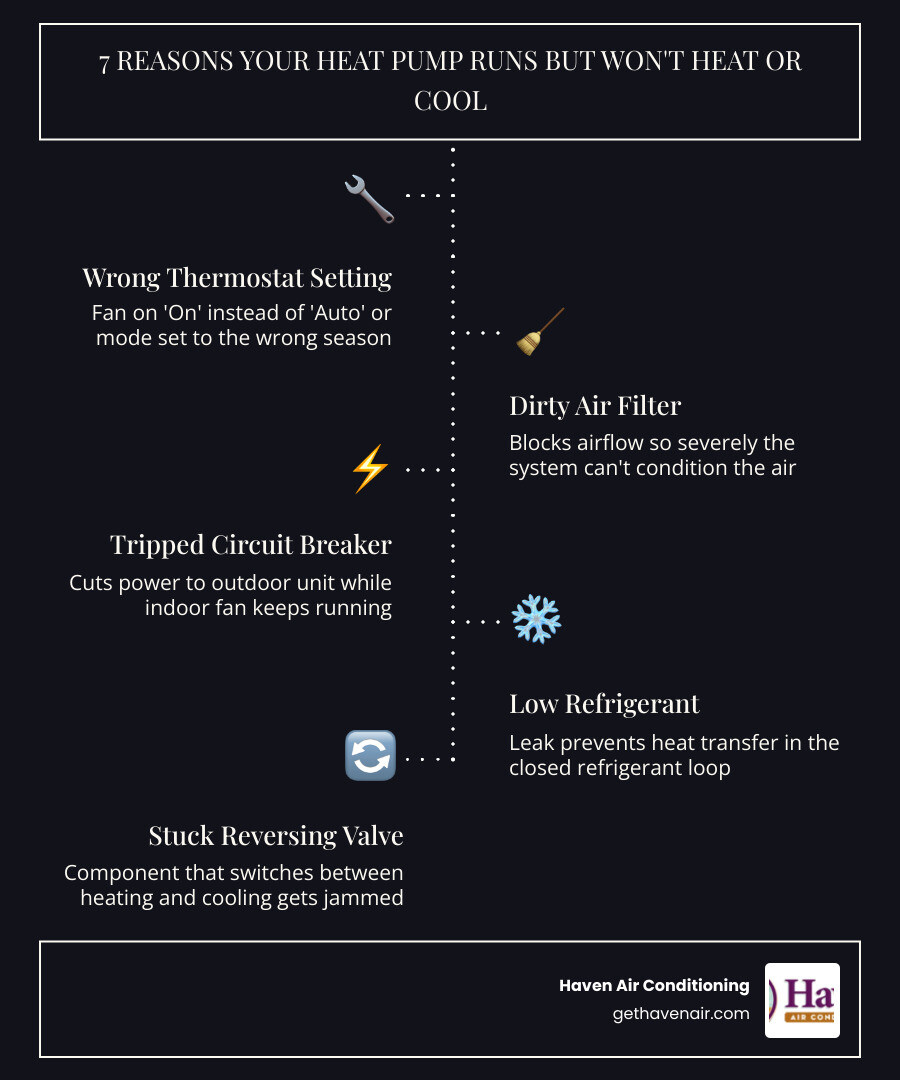
Here are the most common reasons your heat pump runs but doesn’t heat or cool:
- Wrong thermostat setting — Fan set to “On” instead of “Auto,” or mode set to the wrong season
- Dirty air filter — Blocks airflow so severely the system can’t condition the air
- Tripped circuit breaker — Cuts power to the outdoor unit while the indoor fan keeps running
- Defrost cycle — A normal, temporary state where the system briefly blows cool air in heat mode
- Low refrigerant — A leak in the closed refrigerant loop prevents heat transfer entirely
- Stuck reversing valve — The component that switches between heating and cooling gets jammed
- Frozen outdoor coils — Ice buildup blocks heat absorption from the outside air
If you’re an Orange County homeowner — in Anaheim, Irvine, Fullerton, or anywhere nearby — and your heat pump sounds like it’s working but your home isn’t getting comfortable, you’re in the right place. This guide walks you through exactly what’s happening, what you can check right now, and when it’s time to call a certified HVAC technician.
Heat pumps are different from furnaces. They move heat rather than create it, which means a running system isn’t always a working system. A fan can spin, the unit can hum, and air can blow through your vents — all while zero actual heating or cooling is happening inside your home. That gap between “running” and “working” is what this guide is all about.
Understanding Heat Pump Running But Not Heating or Cooling What It Means
To get to the bottom of why your system is acting up, it helps to understand how these highly efficient systems operate. If you’ve ever wondered, What Is a Heat Pump? How Does It Work?, the answer lies in the science of heat transfer.
Unlike traditional furnaces that burn fuel to generate heat, a heat pump acts as a heat transporter. It uses refrigerant to absorb heat from one place and release it in another. In the summer, it gathers heat from inside your home and dumps it outside. In the winter, it reverses this cycle, pulling heat from the outdoor air (even when it feels chilly to us) and bringing it indoors.
When comparing Heat Pumps vs Air Conditioning, you’ll find that they use almost identical technology. In fact, a heat pump is essentially an air conditioner equipped with a special reversing valve that allows it to run in both directions.
However, because they rely on a delicate balance of airflow, electrical signals, and refrigerant pressure, a failure in any single component can cause the system to run constantly without changing the indoor temperature. When this occurs, you are experiencing a system failure rather than normal operation. Recognizing the difference between a minor seasonal transition and a mechanical breakdown is the first step toward restoring your home’s comfort.
Heat Pump Running But Not Heating or Cooling What It Means in Heating Mode
When your system is set to heat but fails to deliver, you might feel lukewarm or flat-out cool air blowing from your supply vents. If you find yourself thinking, “My Heat Pump Is Not Heating,” the issue often traces back to either a system restriction or a temporary operational cycle.
First, consider the defrost cycle. During cold, damp nights in places like Corona or Riverside, frost can accumulate on the outdoor coils. To melt this ice, your heat pump will temporarily switch back into cooling mode. When this happens, the outdoor fan stops, and the indoor vents may blow cool air for 5 to 15 minutes. This is completely normal behavior.
However, if the cool air persists, your auxiliary heat strips may have failed, or the system might be struggling with a deeper mechanical issue. Auxiliary heat strips act as a backup heating source when outdoor temperatures drop too low for the heat pump to keep up. If these electric coils burn out, your system will run continuously, blowing unconditioned air that fails to warm your living room.
Heat Pump Running But Not Heating or Cooling What It Means in Cooling Mode
During a hot afternoon in Costa Mesa or Garden Grove, a failing heat pump is the last thing you want. If your system is running but blowing warm air, it means the heat transfer process has broken down entirely.
If your indoor fan is blowing but the outdoor unit isn’t running properly, you might wonder, Why Is My Heat Pump Blowing Cold Air? (or in this case, failing to blow cold air when you need it). Often, a failed compressor is the culprit. The compressor is the “heart” of your system; it pumps refrigerant through the coils. If the compressor fails to start up, the refrigerant cannot circulate, leaving your indoor fan to blow nothing but unconditioned, warm indoor air.
Another common cooling mode failure point is the outdoor fan. If the outdoor fan motor dies or loses power, the outdoor unit cannot dump the heat it collected from your home. To protect your equipment, Don’t Let Your Heat Pump Fan Lose Its Cool. If you notice the outdoor fan isn’t spinning while the indoor system is running, shut the system down immediately to prevent compressor damage.
Common Mechanical Causes Behind No Heat or No Cooling
When simple troubleshooting steps don’t resolve the issue, the problem is likely a mechanical or electrical failure inside the cabinet.

Stuck Reversing Valve
The reversing valve is the magic component that sets a heat pump apart from a standard air conditioner. It physically slides back and forth to reverse the flow of refrigerant, changing your system from heating to cooling mode.
Sometimes, a heat pump experiences “mode confusion” because the reversing valve gets physically stuck, or its electrical solenoid coil fails. If your system When Your Heat Pump Forgets How to Reverse, it will remain locked in one mode. If it’s stuck in cooling mode, it will blow cold air all winter; if it’s stuck in heating mode, it will blow hot air all summer, regardless of what you set on your thermostat.
Low Refrigerant and Leaks
Your heat pump relies on a precise charge of refrigerant contained within a completely closed loop. Refrigerant is not “used up” or consumed like fuel. If your system is low on refrigerant, it means you have a leak.
Low refrigerant is a major cause of heat pump heating problems, contributing to up to 95% of heating failures. When refrigerant levels drop, the system loses its ability to absorb and transfer heat. This often leads to:
- Hissing or bubbling sounds near the indoor or outdoor units
- Frozen evaporator coils (even during a hot summer day)
- The system running non-stop while failing to reach your thermostat’s setpoint
Electrical and Capacitor Failures
Heat pumps rely on several electrical components to start and run their motors. One of the most common failure points is the capacitor.
Think of the capacitor as a temporary battery that gives your compressor and outdoor fan motor the electrical “push” they need to start spinning. If you suspect Why Your Heat Pump Capacitor Is Losing Its Spark, you might hear a faint humming sound coming from your outdoor unit, but the fan and compressor will fail to start. Running a system with a dead capacitor can quickly overheat the motors, leading to tripped circuit breakers or permanent equipment damage.
Step-by-Step Troubleshooting for Orange County Homeowners
Before you pick up the phone to call us for a professional repair, there are several simple, safe checks you can perform yourself.
To help you understand Why Your Heat Pump Is Acting Up and How to Fix It, use the table below to determine whether your heat pump’s issue is a quick DIY fix or requires professional expertise.
| Symptom | Potential Cause | Troubleshooting / Action | Fix Type |
|---|---|---|---|
| System blowing unconditioned air | Thermostat set incorrectly | Verify mode is set to Heat/Cool and Fan is on Auto | DIY |
| Indoor fan runs, outdoor unit is silent | Tripped circuit breaker | Check your main electrical panel and reset the HVAC breaker | DIY |
| Weak airflow, lukewarm air | Clogged air filter | Inspect filter; replace if dirty or clogged | DIY |
| Outdoor unit covered in thick ice | Defrost control failure or low charge | Turn system off, let ice melt, call a technician | Professional |
| Hissing noises, frozen indoor coils | Refrigerant leak | Shut down system immediately to protect compressor | Professional |
| Outdoor unit hums but fan doesn’t spin | Failed capacitor or fan motor | Shut down system; do not attempt DIY electrical work | Professional |
Check Thermostat Settings and Power Sources
It might sound obvious, but thermostat mistakes happen to the best of us. First, make sure your thermostat is actually set to the correct mode (either “Heat” or “Cool”) and not just “Fan Only.” When the fan is set to “On,” the indoor blower will run continuously, blowing unconditioned, room-temperature air even when the heating or cooling cycles are resting. Always set your fan to “Auto.”
Next, check your power sources. Heat pumps use two separate circuit breakers: one for the indoor air handler and one for the outdoor condenser unit. If the outdoor breaker trips, your indoor fan will continue to blow air, but because the outdoor compressor is off, that air won’t be heated or cooled. Locate your home’s electrical panel, find the breakers labeled “AC” or “Heat Pump,” and ensure they are fully switched to the “On” position.
Inspect Airflow and Replace Dirty Filters
A clogged air filter is the number one cause of heating and cooling performance issues. When a filter becomes loaded with dust, pet dander, and debris, it restricts airflow across your system’s coils.
Without sufficient airflow, your heat pump cannot transfer heat efficiently. In the summer, restricted airflow causes the indoor evaporator coil to drop below freezing, encasing it in a block of ice. In the winter, it can cause the heat exchanger to overheat, triggering a safety shutdown. We recommend inspecting your air filters monthly and replacing them every 1 to 3 months to keep your system breathing easily.
Clear the Outdoor Condenser Unit
Your outdoor unit needs plenty of breathing room to do its job. Go outside and inspect the area surrounding your condenser. Ensure there is at least two feet of clear space around the entire unit, free of overgrown bushes, weeds, fallen leaves, or stored items.
If you notice a light layer of frost on the coils during a cold winter morning, don’t panic — your system’s defrost cycle should take care of it shortly. However, if the unit is completely encased in a thick block of ice, turn the system off at the thermostat immediately. Running an iced-over heat pump can cause severe, permanent damage to your compressor. Let the ice melt naturally before scheduling a professional inspection.
Frequently Asked Questions About Heat Pump Failures
Why is my heat pump blowing cool air when set to heat?
This is one of the most common concerns we hear from homeowners transitioning from a traditional gas furnace to a heat pump.
First, consider human body temperature, which sits around 98.6°F. A traditional gas furnace blasts air out of your registers at a scorching 110°F to 120°F, which feels hot to the touch. A properly operating heat pump, however, delivers a steady stream of warm air between 85°F and 93°F. While this air is absolutely warm enough to heat your home to your desired temperature, it can feel cool or lukewarm when it blows across your skin.
If the air coming from your vents is genuinely cold (matching the outdoor temperature), your system may be stuck in its defrost mode, or you may be dealing with a failed reversing valve or low refrigerant charge.
Should I use emergency heat if my heat pump is not heating?
Your thermostat’s “Emergency Heat” (Aux Heat) setting should only be used as a temporary backup when your primary heat pump has suffered a complete mechanical failure.
Emergency heat activates electric resistance strips inside your indoor air handler. While these strips will keep your home warm, they bypass the high-efficiency heat pump cycle entirely. Emergency heat can use 2 to 3 times more electricity than normal heat pump operation, leading to a massive spike in your utility bills if left on. Use it only to keep your family comfortable while you wait for an HVAC technician to arrive.
How much do common heat pump repairs typically cost in 2026?
While we avoid quoting exact prices without diagnosing a system in person, repair costs generally depend on the complexity of the failed component.
A simple diagnostic visit or a basic electrical repair, such as replacing a failed capacitor, is highly affordable and can be completed quickly by a certified technician. Medium-range repairs include replacing a failed defrost control board or repairing a minor refrigerant leak and recharging the system.
The most expensive repairs involve replacing major mechanical components like the reversing valve or the compressor. If your system is reaching the end of its lifespan, we will always provide an honest, transparent recommendation on whether a repair or a full system replacement makes the most financial sense for your home.
Conclusion
If your heat pump is running but failing to keep your home comfortable, don’t spend another day shivering or sweating. While simple steps like replacing a dirty filter or resetting a tripped breaker can sometimes save the day, complex electrical and refrigerant issues require the hands of a certified professional.
At Haven Air Conditioning, we are proud to serve families across Anaheim, Fullerton, Costa Mesa, Corona, and the greater Orange County and Riverside areas. Our certified, friendly technicians work with complete transparency, ensuring your system gets back up and running efficiently. Whether you need a quick repair, a seasonal tune-up, or a second opinion on a system replacement, we are here to help.
Most heat pumps last 12-15 years with proper care, after which replacement often makes more financial sense than continued repairs. To maximize your system’s lifespan and prevent unexpected breakdowns, ask us about our preventative maintenance plans. We’ll take care of your comfort so you can relax in your home.
Ready to get your indoor comfort back in expert hands? Contact us today to schedule your professional Heat Pump Repair Services!