(714) 332-6302

What “AC Circuit Breaker Keeps Tripping” Means — and Why It Matters
Understanding ac circuit breaker keeps tripping what it means is simpler than it sounds: your home’s electrical system detected more current than it could safely carry and shut itself off to protect you.
Quick answer — here’s what a tripping AC breaker usually signals:
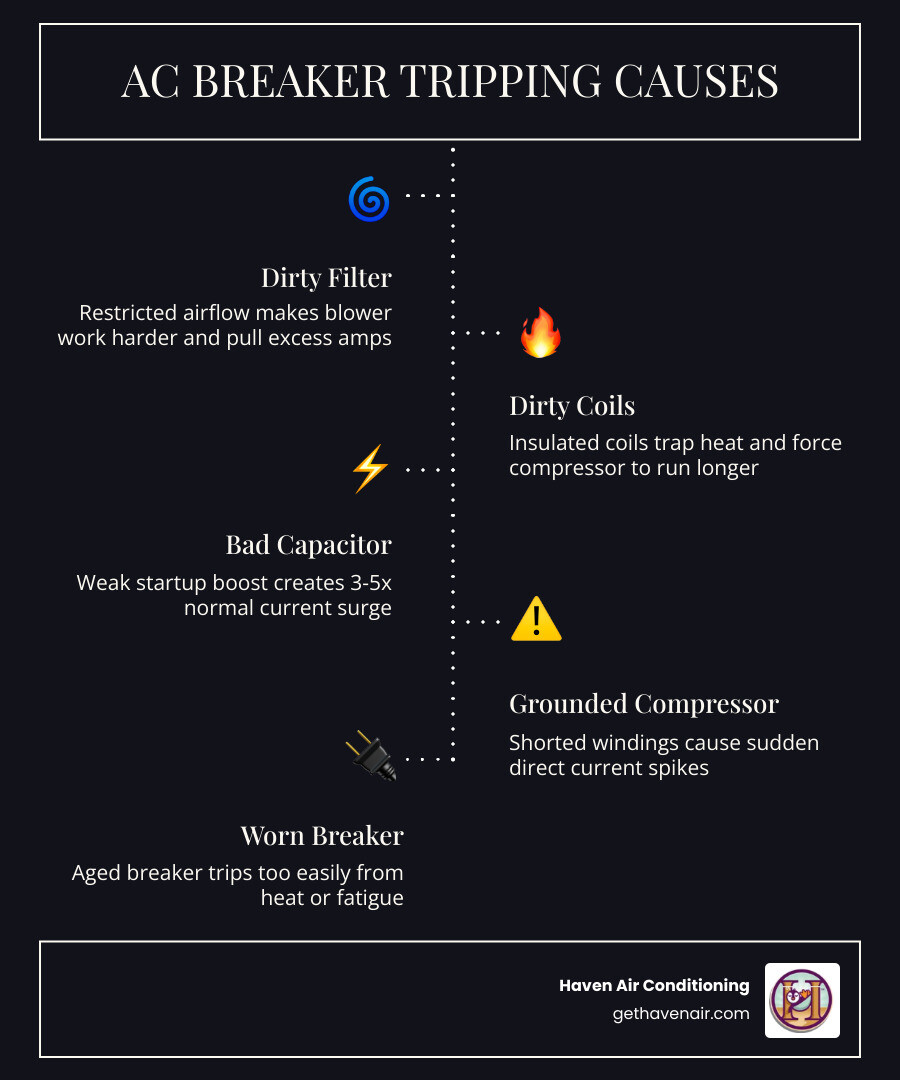
- Overloaded circuit — the AC is drawing more power than the breaker’s rated limit
- Short circuit — two wires have made contact they shouldn’t, causing a sudden current spike
- Ground fault — electricity is leaking to ground, often through a failing component
- Failing component — a bad capacitor, struggling compressor, or shorted motor winding is pulling excess amperage
- Dirty filter or coils — restricted airflow forces the system to work harder, increasing electrical draw
- Worn-out breaker — the breaker itself may trip too easily after years of use
The breaker is not the problem — it is the warning. Think of it as a smoke alarm for your wiring. When it trips once, that can happen. When it keeps tripping, something inside your AC system or your electrical circuit needs attention, and ignoring it can turn a straightforward repair into a serious safety risk.
Orange County summers push AC systems hard. If your breaker is tripping during a hot afternoon in Anaheim, Irvine, or Fullerton, your system is telling you it is under more stress than it can handle. The sections below will walk you through exactly why that happens and what to do about it — safely.
What AC Circuit Breaker Keeps Tripping What It Means for Your Home
When we talk about your AC tripping the breaker, we are discussing a critical safety mechanism. A circuit breaker is essentially a gatekeeper. It monitors the flow of electricity (amperage) to your air conditioner. If that flow exceeds a specific threshold, the breaker “trips,” or flips to the “off” position, instantly cutting power.
This is a protective measure designed to prevent fires and electrical surges from damaging your home. If the breaker didn’t trip, the excess current would generate intense heat, potentially melting the insulation on your wires and starting an electrical fire behind your walls. Similar issues can occur with other high-draw appliances, which is Why Furnace Keeps Tripping Circuit Breaker in some homes during the winter.
Understanding the AC Circuit Breaker Keeps Tripping What It Means for Safety
Every circuit in your home has a specific amperage limit. Most central air conditioners in the Greater Orange County area run on a dedicated 240-volt double-pole breaker. If your unit is rated for 30 amps but starts pulling 45 amps, the breaker detects this overcurrent and shuts down.
This protects the wire insulation. When wires carry more current than they are designed for, they get hot. This heat can degrade the wiring over time, leading to arcing—where electricity jumps across a gap—which is a leading cause of residential fires. By tripping, the breaker is doing exactly what it was designed to do: keeping your family safe.
Why Your AC Circuit Breaker Keeps Tripping What It Means for System Longevity
While the breaker protects your home, the act of “tripping” is a sign of mechanical or electrical strain on the AC itself. If you keep resetting the breaker without fixing the root cause, you are forcing the system to operate under conditions that cause rapid wear and tear.
Repeatedly pushing high levels of current through a struggling motor or compressor can lead to total equipment failure. Instead of a simple part replacement, you might find yourself looking at the Signs Your System Needs HVAC Repair Services for a full system overhaul. In the long run, addressing the trip immediately saves you from the high cost of a premature system replacement.
Common Causes of a Tripping AC Breaker

It is easy to assume a tripping breaker means a massive electrical failure, but often, the cause is environmental or maintenance-related. In our experience servicing homes from Anaheim to Newport Beach, we find that simple neglect is the most common culprit.
Dirty Air Filters and Airflow Blockage
A dirty air filter is arguably the number one reason for an AC breaker trip. When the filter is clogged with dust, pet dander, and Orange County pollen, the blower motor has to work significantly harder to pull air through the blockage.
This creates “static pressure” in your ducts. To overcome this resistance, the motor draws more electricity. If the filter is restricted enough, the motor will eventually exceed its amperage limit and trip the breaker. This is also one of the first things to look into when you’re wondering Air Conditioner Not Cooling What to Check. We recommend checking your filters every month, especially during May and the peak summer months when the system runs almost 24/7.
Dirty Condenser Coils and Heat Dispersion
The outdoor unit (the condenser) is responsible for releasing the heat collected from inside your home. If the condenser coils are covered in dirt, salt air (especially in coastal cities like Laguna Beach), or garden debris, they act like an insulator.
Because the heat can’t escape, the system pressure rises. The compressor then has to work much harder to move the refrigerant, causing it to pull more power. This “high head pressure” is a common cause of trips on those 95-degree afternoons in Riverside and Corona. For a deeper look at how to maintain these components, check out our AC Repair Irvine Complete Guide.
Electrical Component Failures and Safety Risks
Sometimes the issue is deeper than a dirty filter. Electrical components within the AC can fail over time due to heat, age, or power surges.
Failing Capacitors and Hard Starting
The capacitor is like a large battery that gives your compressor and fan motors the “boost” they need to start up. When a capacitor begins to fail, it can’t provide that initial surge of power efficiently. This causes the compressor to “hard start,” pulling 3 to 5 times its normal running amperage just to get moving.
If you hear a loud humming or clicking sound followed by the breaker tripping, a bad capacitor is the likely suspect. This is a very common reason Why Your AC Is Not Turning On How to Fix It. Replacing a capacitor is a routine repair for our certified technicians, but it’s not a DIY job due to the high voltage stored in the part.
Grounded Compressors and Direct Shorts
A “grounded” compressor is a more serious issue. This happens when the electrical windings inside the compressor break down and hit the metal side of the unit. This creates a direct short to ground, causing a massive, instantaneous surge of electricity that trips the breaker immediately.
In some cases, a grounded compressor can even ignite the oil inside the unit, leading to a “burnout.” This is a major failure that often requires a compressor replacement or a new outdoor unit. If your breaker trips the very millisecond the AC tries to kick on, do not attempt to reset it.
How to Safely Troubleshoot Your AC Breaker
If your AC trips the breaker, we recommend a “safety first” approach. Use the table below to understand what you can check and when you should put the tools down.
| Task | Homeowner (DIY) | Professional Technician |
|---|---|---|
| Check Air Filter | Yes – Replace if dirty | N/A |
| Inspect Outdoor Unit | Yes – Clear leaves/debris | N/A |
| Reset Breaker | Yes – Once only | N/A |
| Check Thermostat | Yes – Ensure settings are correct | N/A |
| Test Capacitors | No – High voltage risk | Yes – Using Multimeter |
| Clean Coils | No – Delicate fins | Yes – Chemical wash |
| Check Amperage Draw | No – Electrical risk | Yes – Using Amp Clamp |
| Inspect Wiring | No – Fire hazard | Yes – Full diagnostic |
Step-by-Step Homeowner Protocol
If your breaker trips, follow this protocol:
- Turn off the AC at the thermostat. This prevents the unit from trying to start as soon as you flip the breaker.
- Go to your electrical panel. Find the breaker labeled “AC” or “HVAC.” It will be a large, double-pole switch.
- Flip it fully “Off” and then back “On.”
- Check your filter. If it’s gray or dusty, replace it.
- Wait 30 minutes. This allows the system to cool down in case it tripped due to thermal overload.
- Turn the thermostat back to “Cool.”
If the system runs normally, keep a close eye on it. If it trips again, stop. You have a persistent issue that needs a professional.
When to Stop DIY and Call a Professional
There are several “red flags” that mean you should stop troubleshooting immediately. If you notice any of the following, keep the breaker off and give us a call:
- Burning smells coming from the vents or the outdoor unit.
- A buzzing or hissing sound coming from the electrical panel.
- The breaker trips immediately every time you try to reset it.
- Visible smoke or sparks.
- The breaker feels hot to the touch.
These are Signs You Need Expert Furnace Repair or AC repair that involve dangerous electrical faults.
Frequently Asked Questions about AC Breaker Trips
Is it safe to keep resetting my AC breaker?
No, it is not safe to repeatedly reset a tripped breaker. Circuit breakers are safety devices, not on/off switches. Every time a breaker trips, it is because of an overcurrent event that generates heat. Repeatedly forcing that current back into a faulty system can damage the breaker’s internal mechanism, melt wire insulation, and eventually lead to an electrical fire. Follow our “One-Reset Rule”: if it trips a second time, call a pro.
Why does my ac circuit breaker keeps tripping what it means during a heatwave?
During an Orange County heatwave, your AC works much harder. High outdoor temperatures mean the system has to operate at higher pressures to move heat out of your home. This naturally increases the amperage draw. If your system is already strained by a dirty coil or a weakening capacitor, the extra heat is often the “tipping point” that pushes the electrical draw over the breaker’s limit.
Can a refrigerant leak cause the breaker to trip?
Yes, but indirectly. When refrigerant is low, the system has to run much longer to reach the temperature set on your thermostat. This causes the compressor to run hot. As it overheats, the internal friction increases, and the motor draws more current to keep spinning. Eventually, this thermal overload will trip the breaker to prevent the compressor from burning out.
Conclusion
At Haven Air Conditioning, we know how stressful it is when your cooling fails during a Santa Ana wind event or a humid August afternoon. If you’re struggling with an ac circuit breaker keeps tripping what it means for your home, the breaker is doing its job to protect you.
Whether you are in Anaheim, Fullerton, Irvine, or anywhere in the Greater Orange County and Riverside areas, our team of certified professionals is ready to help. We pride ourselves on transparent, neighborly service and expert diagnostics. We don’t just flip the switch back on—we find out why it flipped in the first place to ensure your family’s safety and comfort.
To avoid these issues entirely, consider our membership maintenance plan, which includes regular coil cleanings and electrical inspections to catch failing capacitors before they leave you in the heat. We offer priority scheduling for our members and 24/7 emergency availability for those moments when you just can’t wait.
Take the guesswork out of your home comfort. We’ll take care of your AC so you can relax.