(714) 332-6302

Why Your AC Bill Spikes During Heat Events — and What You Can Do About It
Why your ac bill spikes during heat events comes down to a few core reasons that stack up fast when temperatures climb:
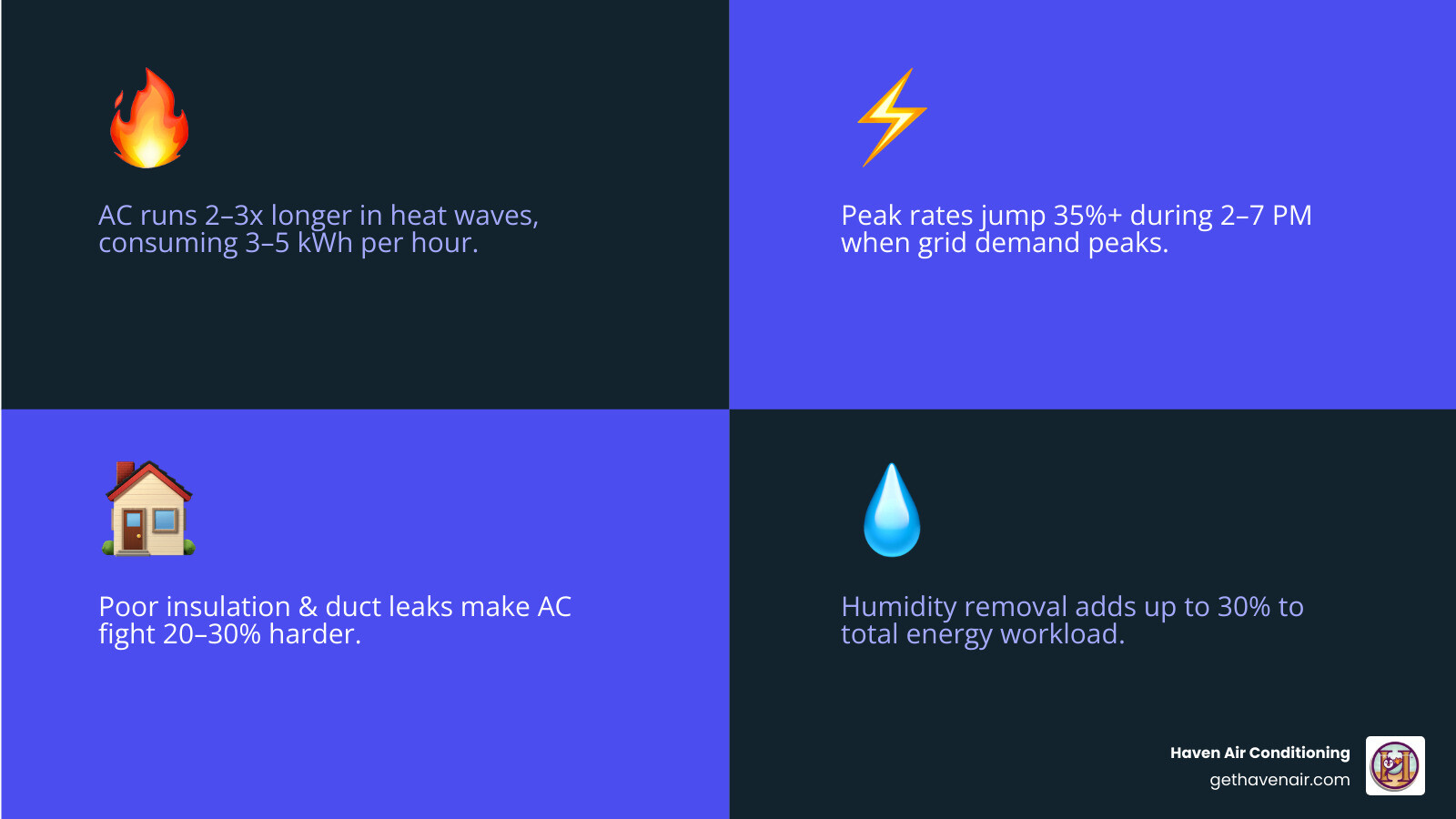
- Your AC runs much longer. During a heat wave, your system can run 2–3 times more than it does in mild weather, consuming 3–5 kWh every hour it operates.
- Electricity gets more expensive at peak times. Rates in Southern California can jump 35% or more during afternoon peak hours (roughly 2 PM to 7 PM) when grid demand is highest.
- Your home absorbs more heat. Poor insulation, duct leaks, and air gaps force your AC to fight harder just to hold a steady temperature.
- Humidity adds hidden workload. Moisture removal can account for up to 30% of your system’s total energy use, even when it doesn’t feel that humid inside.
- An aging or poorly maintained system is less efficient. Dirty filters, low refrigerant, and worn components push energy consumption even higher under heat stress.
If you’ve opened your electricity bill after a stretch of 95°F-plus days here in Orange County and felt your stomach drop, you’re not imagining it. Summer cooling already accounts for 40–60% of a home’s total electricity use during hot months — and that share climbs even higher during heat waves. According to recent projections, average summer electricity bills are expected to reach around $719 for the June–September period, up significantly from $527 in 2019. That’s a real and growing strain on household budgets.
The good news? Most of the causes behind those spikes are understandable, and many are fixable. This guide walks you through exactly what’s happening to your bill — from the physics of heat removal to the way your utility charges you — and what Orange County homeowners can do about it.
The Science of the Surge: Why your ac bill spikes during heat events
To understand your bill, we first have to understand the physics of your home. Your air conditioner isn’t actually “creating cold”; it is a heat removal machine. It works by absorbing heat from inside your house and dumping it outside.
Most HVAC systems are designed to maintain an indoor temperature that is about 20 degrees cooler than the outside air. When it’s a beautiful 80-degree day in Anaheim, your AC has an easy job. But when May 2026 brings a 105-degree heat wave to Fullerton or Riverside, that “20-degree rule” is pushed to the limit. Your system has to work exponentially harder to move that massive amount of heat out of your living space.
This is where the distinction between sensible heat (the temperature you see on the thermometer) and latent heat (the moisture in the air) becomes vital. If your system is struggling, you might notice Your AC Running But Not Cooling effectively, which is a primary sign that the heat load has exceeded the system’s capacity.
Increased Runtime and System Strain
During a typical spring day, your AC might cycle on and off a few times an hour. During an extreme heat event, it often switches to continuous cycling. Because air conditioners are “binary” systems—meaning they are either 100% on or 100% off—they don’t have a “low gear” for heat waves.
If your unit uses 3–5 kWh per hour and runs for 18 hours a day during a heat wave instead of its usual 6, you are looking at a massive jump in consumption. This constant operation leads to compressor fatigue and can even cause the unit to overheat and shut down entirely. If you’re worried about your system’s ability to handle the load, check out our guide on AC Not Cooling Extreme Heat – HVAC Inspection.
The Humidity Tax: Latent Heat in Southern California
Even in our relatively dry climate, humidity plays a major role in why your ac bill spikes during heat events. Your AC has to turn water vapor into liquid to lower the humidity, a process called a phase change. This requires a significant amount of energy.
In fact, moisture removal can account for 30% of your system’s total energy workload. When the humidity rises along with the temperature, your evaporator coil has to work double duty. If the air is too humid, you’ll feel “sticky,” leading you to lower the thermostat even further, which only compounds the energy cost.
Mechanical and Structural Factors That Amplify Costs
Sometimes the reason for a high bill isn’t just the weather; it’s the house itself. Think of your home as a “thermal battery.” It stores heat in the walls, the roof, and the furniture. If your home’s “envelope” is leaky, that battery drains its “coolness” almost instantly.
We often see homeowners puzzled as to Why Your AC Running But Not Cooling even when the unit is brand new. Often, the culprit is the structure, not the machine. This is why a Summer AC System Inspection – What to Look For is so important before the peak of summer hits.
Dirty Filters and Clogged Coils: The Efficiency Killers
A dirty air filter is like trying to run a marathon while breathing through a straw. It restricts airflow, which increases “static pressure” and forces the blower motor to work much harder. This alone can cause a 15–25% increase in energy consumption.
Similarly, if the outdoor condenser coils are clogged with dust or Orange County lawn debris, the system can’t release heat efficiently. The compressor then has to run 15–25% longer just to achieve the same cooling effect. Regular Spring AC Tune-Ups and System Inspection are the best way to prevent these “hidden” costs.
Duct Leaks and Poor Insulation: Why your ac bill spikes during heat events even with a new unit
If your ducts are leaking, you are essentially paying to air condition your attic or crawlspace. Duct leaks can waste 20–30% of your conditioned air. In the extreme heat of a Corona or Chino summer, an unconditioned attic can reach 150°F. If your insulation R-value is too low, that heat radiates straight through your ceiling.
| Feature | Energy Loss (Standard Home) | Energy Loss (Optimized Home) |
|---|---|---|
| Duct Sealing | 25% Loss | <5% Loss |
| Attic Insulation | R-19 (Poor) | R-38+ (Excellent) |
| Air Leaks | High (Stack Effect) | Sealed (Weatherized) |
Utility Pricing and Grid Strain: The Hidden Costs of Peak Demand
It isn’t just how much energy you use; it’s when you use it. Southern California utilities deal with massive grid strain during heat waves. To manage this, they use complex pricing structures that can catch homeowners off guard. If you’ve ever wondered, Do Air Conditioners Use a Lot of Electricity?, the answer is a resounding yes—especially between 2 PM and 7 PM.
Time-of-Use (TOU) Rates and Peak Pricing
Most residents in areas like Irvine and Huntington Beach are now on Time-of-Use (TOU) plans. During “Peak” hours—typically 2 PM to 7 PM—the price per kilowatt-hour can jump by 35% or more.
Because the hottest part of the day coincides with these peak rates, your AC is running at its maximum capacity exactly when electricity is most expensive. This “perfect storm” is a major reason why your ac bill spikes during heat events.
Understanding Peak Pricing: Why your ac bill spikes during heat events in Orange County
The grid in 2026 is under more pressure than ever. Between the rise of AI data centers and the transition to clean energy, demand is at an all-time high. When a heat wave hits, the utility must buy expensive “peak” power to keep the lights on. These costs are passed down to you through “demand charges” and adjusted base rates. Understanding Local Weather Wisdom and Your Home Comfort can help you anticipate these shifts.
Practical Steps to Flatten the Spike and Build Resilience
You don’t have to be a victim of the heat wave. There are several proactive steps you can take to lower your bill without sacrificing comfort. For a deeper dive, see our tips on How to Save Money on Air Conditioning.
Smart Thermostats and Pre-Cooling Strategies
The “sweet spot” for efficiency is 78°F. For every degree you set the thermostat below 78°F, your costs can rise by 6–8%.
One of the most effective strategies is pre-cooling. By lowering your home’s temperature by a few degrees in the early morning (when rates are low and the air is cool), you use your home’s “thermal mass” to stay cool during the expensive afternoon peak. Using a smart thermostat with geofencing ensures you aren’t cooling an empty house. Regular AC Tune-Ups Prevent Mid-Season Breakdowns ensure these smart features actually work as intended.
Long-Term Investments: SEER2 and Heat Pumps
If your system is more than 10–12 years old, it’s likely operating at a SEER (Seasonal Energy Efficiency Ratio) of 10 or 13. Modern SEER2 standards require a minimum of 14.3, but high-efficiency units can reach 20+. Upgrading can cut your cooling costs by 30–50%.
Many Orange County homeowners are also switching to high-efficiency heat pumps, which provide both heating and cooling with incredible precision. To see if your current system is up to par, consider a Summer AC Performance Check in Orange.
Frequently Asked Questions about Summer Bill Spikes
Does setting my AC to 60°F cool my house faster?
No. Your AC is a binary system—it’s either on or off. Setting it to 60°F won’t make the air coming out of the vents any colder; it just tells the system to run for a much longer (and more expensive) duration. It’s better to set it to your desired temperature and let it work steadily.
Why is my bill high even if I keep the thermostat at 78°F?
Even at 78°F, the outdoor-indoor temperature differential during a 100-degree day is huge. Your system still has to run longer to fight the heat radiating through your roof and windows. Additionally, high humidity or peak-hour utility rate increases can drive the bill up even if your usage habits haven’t changed.
How much can a dirty air filter actually cost me?
A clogged filter can easily add 10–20% to your monthly cooling costs. By restricting airflow, it forces the entire system to run longer to achieve the same cooling. Changing your filter every 30–60 days is the simplest and cheapest way to lower your bill.
Conclusion
At Haven Air Conditioning, we’ve spent years helping our neighbors in Anaheim, Fullerton, Irvine, and across Riverside stay cool without breaking the bank. We know that a spiking energy bill is more than just a nuisance—it’s a stressor for your family.
Our team of certified, friendly technicians is here to provide the transparency and peace of mind you deserve. Whether you need a quick tune-up, a second opinion on a high bill, or a full system upgrade, we treat your home like our own. Don’t let the next heat wave catch you off guard. Consider joining our membership maintenance plan for priority scheduling and year-round protection.
Schedule your extreme heat HVAC inspection today and let us put your indoor comfort in expert hands.