(714) 332-6302

Why Acting Now on Spring Maintenance to Prevent Summer Breakdowns Saves You This Summer
Spring maintenance to prevent summer breakdowns is the single most effective step Orange County homeowners can take before the summer heat hits. When temperatures in Anaheim, Fullerton, and Irvine climb into the 90s and beyond, your AC doesn’t get a day off — and neither does the stress of a system that wasn’t ready.
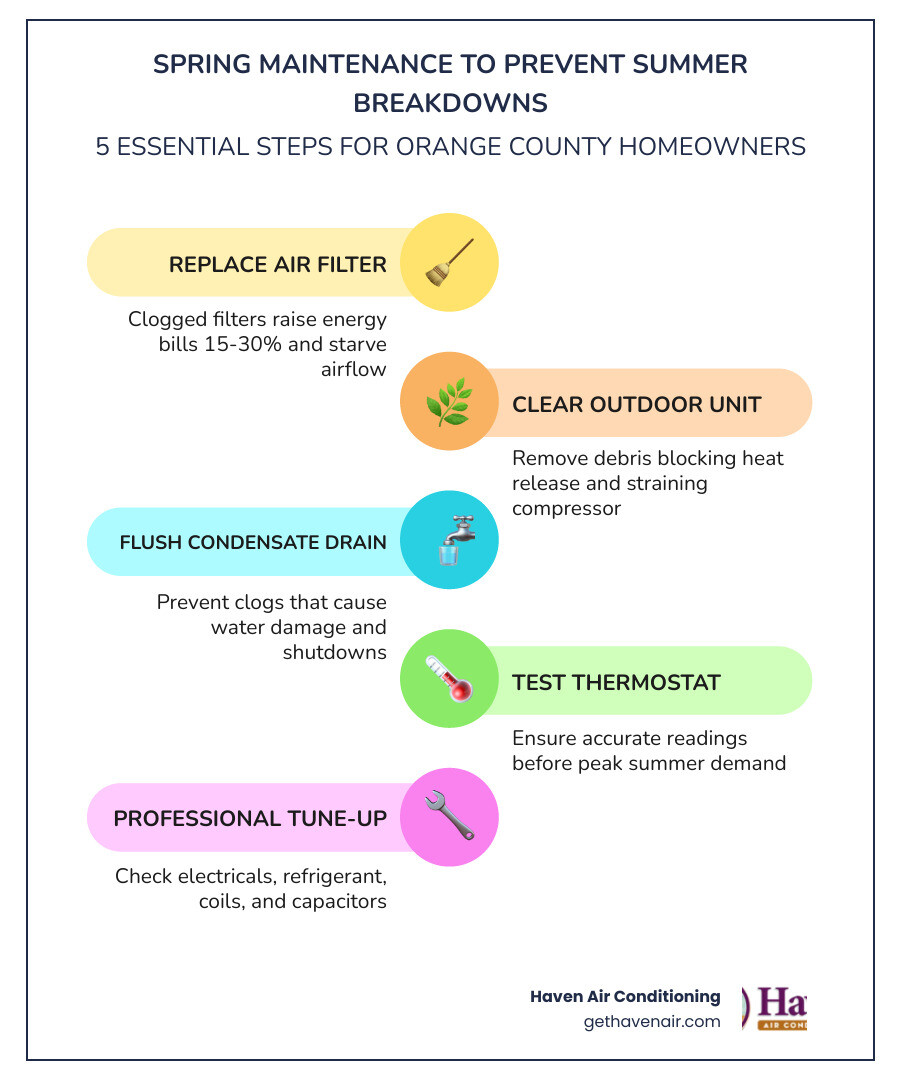
Here’s a quick look at what spring AC maintenance covers and why it matters:
What spring maintenance to prevent summer breakdowns includes:
- Replace the air filter — A clogged filter can raise energy bills by up to 15–30% and starve your system of airflow.
- Clean and clear the outdoor condenser unit — Debris blocks heat release and strains the compressor.
- Flush the condensate drain line — Clogs cause water damage and system shutdowns.
- Test the thermostat — Confirm it’s reading and responding accurately before peak demand.
- Schedule a professional tune-up — Covers electrical connections, refrigerant levels, coil cleaning, and capacitor testing.
The stakes are real. According to industry data, up to 87% of emergency AC calls could have been prevented with a routine spring tune-up. Systems that skip annual maintenance run 15–25% less efficiently — and heating and cooling already account for roughly 50% of your total electricity bill. Skipping spring prep doesn’t just risk a breakdown. It quietly inflates your energy costs all summer long.
For Orange County homeowners, this is especially true. The combination of high pollen counts in spring, coastal salt air near the coast, and dry, dusty heat inland puts extra wear on HVAC systems that aren’t properly maintained. The time to catch a failing capacitor or a dirty coil isn’t on the hottest day of July — it’s right now, while the weather is mild and technicians still have availability.
This guide walks you through exactly what to do, what to watch for, and when to call in a professional so your home stays cool and comfortable all summer long.
Explore more about spring maintenance to prevent summer breakdowns:
Why Spring is the Best Time for Spring Maintenance to Prevent Summer Breakdowns
Timing is everything in home services. As we navigate June 2026, scheduling your air conditioning service in the spring—before the intense Southern California heatwaves arrive—is the smartest move you can make. During the mild spring months, the demand for HVAC services is at its lowest seasonal point. This “shoulder season” gives you maximum flexibility when booking an appointment, ensuring you can choose a time that fits your schedule rather than waiting days for an emergency opening.
Furthermore, performing diagnostics when the weather is warm but not oppressive allows our technicians to run your system under realistic, moderate conditions. We can thoroughly check your system’s performance without the pressure of a boiling house. If a failing component is discovered during a spring tune-up, there is plenty of time to order parts and complete the repair before your household actually needs to run the AC all day long.
To learn more about optimizing your scheduling, check out our guide on Timing is Everything When to Schedule Your Annual AC Maintenance.
Why Orange County Homeowners Need Spring Maintenance to Prevent Summer Breakdowns
Living in the Greater Orange County and Riverside areas brings unique environmental challenges that directly impact your cooling system. In cities like Anaheim, Fullerton, and Irvine, spring brings heavy pollen counts. This fine yellow powder quickly coats outdoor condenser coils and clogs indoor filters.
For coastal locations like Laguna Beach, Costa Mesa, and Aliso Viejo, salt-heavy air can accelerate the corrosion of delicate aluminum condenser fins. Meanwhile, inland communities such as Corona, Riverside, and Ontario experience dry, dusty summers where windblown dirt accumulates rapidly on your outdoor unit.
When dust and debris coat your outdoor condenser, they act as an insulating blanket. This makes it incredibly difficult for the system to release heat, forcing it to run longer and work much harder to cool your home. Investing in early care ensures these regional factors do not lead to a mid-season catastrophe.
For a closer look at local performance checks, explore our article on Summer AC Performance Check in Orange.
Common Causes of Summer AC Failures and How to Avoid Them
When an air conditioner breaks down on a hot summer afternoon, it is rarely a sudden, random event. Most mid-season failures are the result of minor, quiet issues that went unnoticed during the winter and spring.
Here are the most common culprits behind summer AC breakdowns:
- Capacitor Failure: Capacitors act like temporary batteries, providing the electrical “kick” your compressor and fan motors need to start running. Summer heat degrades capacitors rapidly. If a capacitor is weak in the spring, the extreme strain of a July heatwave will cause it to fail completely, which can ultimately burn out your expensive compressor.
- Loose Electrical Connections: Loose wires are responsible for nearly 30% of all AC failures. The natural vibrations of your system can loosen electrical terminals over time, leading to electrical shorts, failed components, or even localized melted wiring.
- Dirty Evaporator Coils: Even a thin layer of dust on your indoor evaporator coil can cut cooling efficiency by up to 30%. This dust restricts heat absorption, which often causes the refrigerant lines to drop below freezing, turning your indoor coil into a solid block of ice.
- Clogged Condensate Drains: Your AC removes gallons of moisture from your home’s air daily. If algae, mold, or dust blocks the narrow drain line, water will back up. This triggers safety switches that shut down your system entirely, or worse, causes water to overflow into your ceiling or walls.
- Refrigerant Leaks: Low refrigerant levels indicate a leak. Running an AC with insufficient refrigerant starves the compressor of necessary cooling, causing it to overheat and fail prematurely.
By addressing these issues proactively, you can prevent a chain reaction of failures. For more details on avoiding these headaches, read about how AC Tune-Ups Prevent Mid-Season Breakdowns.
To put this in perspective, let’s look at how simple spring fixes compare to the costly consequences of ignoring them:
| Minor Spring Issue | Summer Consequence | Severity & Cost Impact |
|---|---|---|
| Dirty Air Filter | Frozen evaporator coil / burned-out blower motor | High utility bills & moderate repair costs |
| Weak Capacitor | Failed compressor (requires complete system replacement) | Extremely high replacement costs |
| Small Refrigerant Leak | Compressor overheating and complete system shutdown | High repair costs & long system downtime |
| Algae in Drain Line | Water overflow, ceiling damage, and mold growth | High property damage & emergency service fees |
| Loose Electrical Wire | Damaged control board or localized electrical fire | High repair costs & safety hazard |
Essential DIY Tasks for Your Spring Maintenance to Prevent Summer Breakdowns Checklist
While complex technical diagnostics require professional expertise, there are several highly effective tasks you can perform yourself to keep your system healthy:
- Inspect and Replace Your Air Filter: Check your filter every 30 days. For most homes, high-quality pleated filters with a MERV rating between 8 and 11 offer the perfect balance of filtration and airflow. Avoid ultra-high MERV filters unless your system is specifically designed for them, as they can restrict airflow and strain your blower motor.
- Maintain a Clear Zone Around the Outdoor Unit: Keep a minimum 2-foot clearance around your outdoor condenser. Clear away dead leaves, weeds, mulch, and overhanging branches. This ensures your system has plenty of room to draw in fresh air and release heat.
- Flush the Condensate Drain: Pour a cup of diluted white vinegar down your condensate drain line cleanout once a month during spring and summer. This simple step kills algae and prevents clogs before they block your drain.
- Replace Thermostat Batteries: Don’t let a dead battery stand between you and a cool home. Swap out your thermostat’s batteries every spring to ensure reliable communication with your HVAC system.
- Clean Vents and Registers: Walk through your home and vacuum dust or pet hair from all supply and return grilles. Ensure that furniture, rugs, or drapes are not blocking your vents, which can cause pressure imbalances and strain your system.
What is Included in a Professional Spring HVAC Tune-Up?
While DIY tasks are a fantastic starting point, they only cover about 40% of what your system needs to survive a grueling Southern California summer. A professional tune-up is a comprehensive, deep-dive inspection performed by certified technicians.
When we perform a professional spring tune-up, we handle the highly technical tasks that keep your system safe and efficient:
- Electrical Connection and Control Testing: We inspect all electrical wiring, tighten loose terminals, and measure voltage and current on motors. We also test your capacitors using a digital multimeter to ensure they are within the manufacturer’s specified microfarad range.
- Refrigerant Charge Verification: We measure refrigerant pressure and temperatures (superheat and subcooling) to verify your system has the exact charge required for optimal cooling. If the charge is low, we locate and repair the leak before adding more refrigerant.
- Chemical Coil Cleaning: We use specialized, self-rinsing cleaners to thoroughly wash your outdoor condenser coils and indoor evaporator coils, restoring maximum heat transfer.
- Blower Motor Adjustment and Lubrication: We inspect the blower wheel, measure the motor’s amp draw, and lubricate any moving parts to reduce friction and wear.
- Safety Control and Thermostat Calibration: We test all safety switches—including the condensate overflow float switch—to guarantee your system will safely shut down if an issue arises. We also calibrate your thermostat to ensure it communicates accurately.
Spring is also the ideal time to inspect your heating system after a winter of hard work. Ensuring your furnace is clean and safe is a key part of transitioning your home from heating to cooling. To learn more about seasonal transition care, explore our resources on the Benefits of Regular Home Furnace Maintenance, read our Top Furnace Maintenance Tips from Experts, and discover how Furnace Maintenance Keep System Running safely.
For a complete breakdown of our cooling tune-up process, check out our guide on Spring AC Tune-Ups and System Inspection.
Maximizing Energy Efficiency and Extending System Lifespan
Proactive maintenance is one of the smartest financial investments you can make for your home. According to the U.S. Department of Energy, routine maintenance can cut your cooling energy use by 15% to 20%, leading to significantly lower utility bills throughout the hottest months of the year.
Furthermore, regular care can extend your system’s lifespan by 5 to 10 years. A central AC unit is typically designed to last 15 to 20 years with consistent, documented care, whereas neglected systems often fail completely in as little as 7 to 10 years.
Regular professional maintenance also protects your manufacturer’s warranty. Major brands like Daikin, Carrier, and Mitsubishi require documented annual professional service to honor their 10-year parts warranties. If a major component fails and you cannot provide proof of annual maintenance, you could be left paying for the repair out of pocket.
Finally, we inspect your ductwork during a tune-up. The average forced-air system loses 20% to 30% of its conditioned air to duct leakage. Sealing these leaks ensures the air you pay to cool actually makes it into your living spaces.
For more tips on keeping your system running efficiently, check out our article on HVAC Preventive Maintenance.
Warning Signs Your AC Needs Immediate Attention Before Summer
You don’t have to wait for your system to stop blowing cold air entirely to know there is a problem. Your air conditioner will usually drop several hints that it is struggling.
If you notice any of the following warning signs, it is time to schedule a professional inspection immediately:
- Weak or Warm Airflow: If the air coming out of your vents feels weak or lukewarm, your system may be dealing with a clogged filter, a failing blower motor, or a refrigerant leak.
- Unusual Noises: Squealing, grinding, rattling, or banging noises are clear indicators of mechanical trouble, such as a failing belt, worn motor bearings, or loose internal components.
- Short-Cycling: If your air conditioner turns on and off rapidly every few minutes, it is short-cycling. This places immense strain on your compressor and electrical components, drastically increasing your energy bills.
- Musty or Burning Odors: A musty smell usually indicates mold or mildew growth inside your ductwork or drain pan. A burning, metallic odor suggests electrical components are overheating or wires are melting.
- Rising Utility Bills: If your electricity bills are climbing significantly compared to the same month last year—without a corresponding rise in outdoor temperatures—your system is losing efficiency and working too hard.
Catching these signs early prevents minor issues from snowballing into total system failures. For a detailed guide on checking your system’s health, read our End of Summer AC System Check.
Frequently Asked Questions about Spring HVAC Care
How often should I replace my air filters during a California spring?
You should check your air filter every 30 days. In high-pollen areas or homes with pets, smoke, or allergy sufferers, we recommend replacing your pleated filter every 30 to 60 days. In homes without pets or allergies, replacing the filter every 90 days is usually sufficient.
Can regular maintenance really lower my summer electricity bills?
Yes! Regular maintenance can lower your cooling costs by up to 23%. By cleaning the coils, calibrating the thermostat, and lubricating moving parts, we provide a 15% to 30% efficiency boost. This ensures your system runs for the shortest time possible to keep your home comfortable, saving you money on your monthly energy bills.
Is an HVAC maintenance plan worth the investment?
Absolutely. A maintenance plan pays for itself by preventing expensive emergency repairs and lowering your monthly energy bills. Our maintenance plan members also enjoy priority scheduling, which means you jump to the front of the line if you ever need service during a heatwave.
To learn more about how we can take the guesswork out of your home comfort, check out our Air Conditioner Maintenance Plan.
Conclusion
Don’t wait for the first triple-digit heatwave of the summer to find out if your air conditioner is up to the task. Taking a proactive approach to spring maintenance to prevent summer breakdowns is the best way to ensure your home remains a cool, comfortable sanctuary all season long.
At Haven Air Conditioning, we are committed to providing Greater Orange County and Riverside homeowners with exceptional customer service, meticulous attention to detail, and friendly, certified professional care. Whether you are in Anaheim, Fullerton, Irvine, Costa Mesa, or Riverside, we treat your home like our own. We take care of your comfort so you can simply relax and enjoy your summer.
Invest in your peace of mind and protect your home today. Contact us to schedule your spring tune-up, or sign up for our comprehensive HVAC Maintenance Plan Anaheim CA to enjoy priority scheduling, year-round efficiency, and ultimate home comfort.