(714) 332-6302

Why Your AC Making Strange Noises Matters — and What Each Sound Means
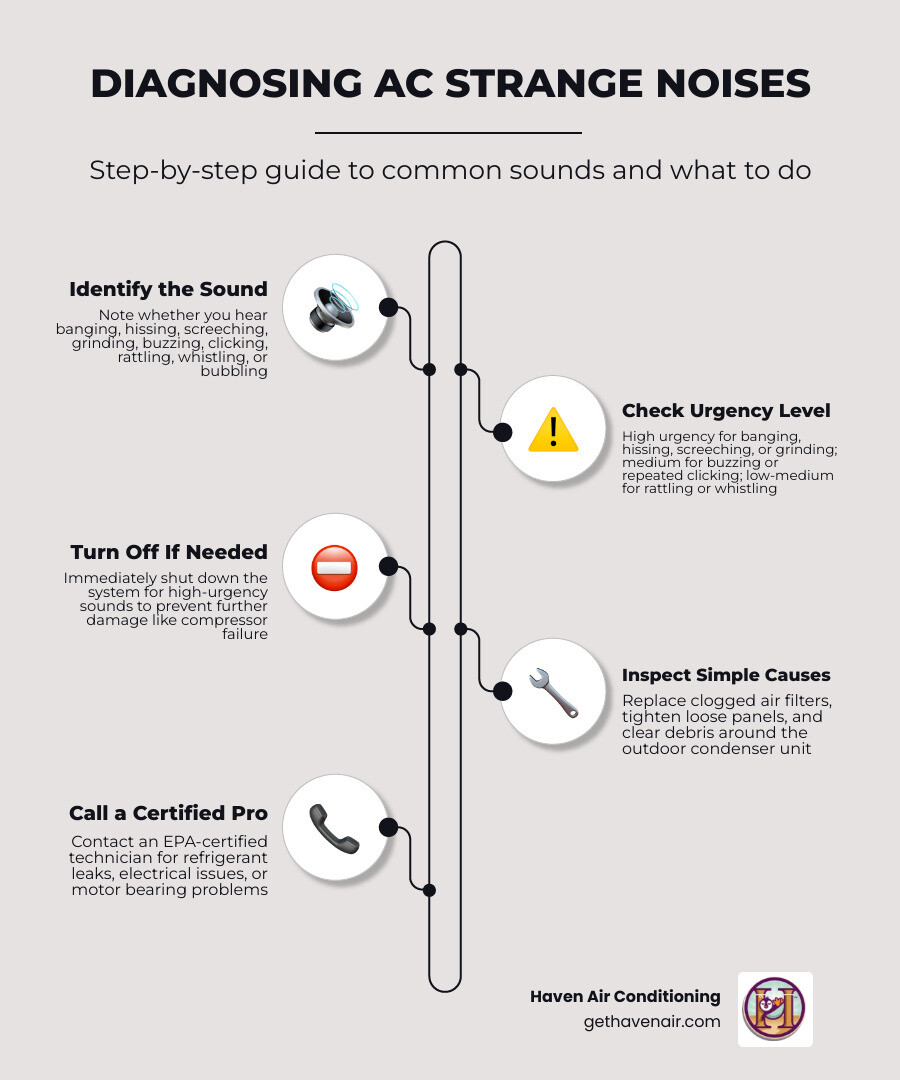
If your AC is making strange noises, here’s a quick breakdown of what each sound typically means:
| Sound | Most Likely Cause | Urgency |
|---|---|---|
| Banging / Clanking | Loose or broken part inside the unit | High — turn off immediately |
| Hissing | Refrigerant leak or ductwork gap | High — call a pro |
| Screeching / Squealing | Worn fan belt or failing motor bearings | High — shut down now |
| Grinding | Worn motor bearings | High — stop running the unit |
| Buzzing | Electrical issue, failing capacitor, or debris | Medium-High — inspect soon |
| Clicking (repeated) | Faulty thermostat relay or failing capacitor | Medium — schedule service |
| Rattling | Loose panels, screws, or debris | Low-Medium — check and tighten |
| Whistling | Clogged air filter or restricted airflow | Low — replace filter first |
| Bubbling / Gurgling | Refrigerant leak or blocked condensate drain | Medium — have it checked |
Your air conditioner is designed to run quietly in the background — a steady, low hum you barely notice. Modern systems can operate as softly as 19 decibels, which is quieter than a whisper. So when your system starts banging, screeching, or buzzing on a hot Orange County summer day, it’s not something to brush off.
Here in Anaheim, Fullerton, Irvine, and across the greater Orange County area, AC units work hard — sometimes running around the clock during peak summer heat. That kind of demand puts real stress on components, and strange noises are often the first sign your system is telling you something is wrong. Catching those sounds early is the difference between a simple fix and a costly breakdown.
This guide walks you through exactly what each noise means, which ones need immediate attention, and what you can safely do yourself before calling in a certified HVAC technician.
Ac making strange noises what they mean terms explained:
AC Making Strange Noises: What They Mean for Your Orange County Home
When you live in a place like Orange County or Riverside, your air conditioner is the heart of your home’s comfort. It’s easy to take it for granted until it starts sounding like a kitchen blender full of silverware. As we head into May 2026, many homeowners are realizing that their systems—which typically last 10 to 15 years—are beginning to show their age through a variety of odd sounds.

Banging and Clanking
If you hear a loud banging or clanking coming from your outdoor unit, it’s usually a sign that something has come loose or broken entirely. This could be a connecting rod, a piston pin, or a crankshaft inside the compressor. It might also be a loose fan blade hitting the housing. Because the compressor is a “sealed” unit, a heavy banging sound often means the entire compressor needs to be replaced. If you hear this, turn the system off immediately to prevent further damage.
Rattling and Buzzing
Rattling is one of the most common sounds homeowners hear, and while it’s often simple to fix, it shouldn’t be ignored. Rattling and Buzzing AC Sounds: What They Mean often boils down to loose panels, vibrating screws, or even small sticks and pebbles that have fallen into the outdoor condenser. However, if the rattling is coming from the compressor itself, it could indicate that internal motor mounts have failed.
Screeching and Grinding
A high-pitched screeching or squealing is usually related to the fan motor. In older units, this often points to a worn-out fan belt that is slipping. In newer units, which are typically direct-drive, screeching usually signals that the motor bearings are failing. Grinding is a similar “metal-on-metal” sound that almost always points to worn bearings in the blower motor or the outdoor fan.
In our local coastal areas like Laguna Beach or Huntington Beach, the salt air can accelerate the corrosion of these metal parts, leading to these noises sooner than in inland areas like Ontario or Chino.
Deciphering Common Sounds: From Banging to Screeching
Understanding ac making strange noises what they mean requires a bit of detective work. Not every sound is a “total system failure” alarm, but some are definitely more urgent than others.
Hissing and Bubbling
A persistent hissing sound is a major red flag. This is almost always the sound of refrigerant escaping through a leak in the coils or line sets. Because refrigerant is under high pressure, it makes a distinct “hiss” as it escapes. If the leak is happening underwater (like in a pool of condensate), you might hear bubbling or gurgling instead.
Handling refrigerant requires EPA Section 608 certification, so this is never a DIY job. If you hear hissing and notice your Air Conditioner Not Cooling: What to Check list isn’t helping, it’s time to call the pros at Haven Air Conditioning.
Electrical Buzzing and Clicking
A soft click at the start and end of a cycle is normal—that’s just your thermostat communicating with the system. However, repeated, rapid clicking means an electrical signal is failing to “engage” the system. This often points to a failing capacitor or a faulty contactor.
Buzzing can also be electrical. A failing motor, a loose wire, or a stuttering relay switch can create a constant “zapping” or humming sound. In some cases, an inverter-driven compressor might produce a high-frequency buzz as it changes speeds, which can be normal, but a loud, aggressive buzz usually means a component is about to fail.
Whistling
If your AC sounds like it’s trying to whistle a tune, it’s likely “gasping” for air. Whistling is caused by restricted airflow. This usually happens when your air filter is so clogged with dust that air is being forced through tiny gaps at high velocity. It can also happen if too many supply vents are closed throughout the house, causing a pressure imbalance in the ductwork.
Indoor vs. Outdoor Unit Noise Differences
Where the noise is coming from tells us a lot about which part is struggling. Your AC system is split into two main halves, and each has its own set of moving parts.
The Indoor Unit (The Air Handler)
The indoor unit is responsible for moving air through your home. If you hear noises here, it’s likely the blower motor or the evaporator coil.
- Thumping or Vibrating: Could be an unbalanced blower wheel.
- Chirping: Often a sign that a motor needs lubrication.
- Gurgling: Likely a clogged condensate drain line where water is struggling to flow out.
- Mini-Split Specifics: If you have a ductless system, Mini Split AC Making Unusual Sounds might include plastic “popping” as the casing expands and contracts with temperature changes, which is often normal.
The Outdoor Unit (The Condenser)
The outdoor unit houses the compressor and the condenser fan. Because it’s exposed to the elements in places like Fullerton and Anaheim, it deals with more debris.
- Clattering: Usually a stick or leaf caught in the fan blades.
- Humming: Can be a normal sound of the compressor, but a loud hum often indicates a starting issue (capacitor).
- Pinging: In some high-efficiency units, you might hear a muffled “thump” or “ping” when the unit shuts off as refrigerant pressures equalize—this is often normal operation.
| Feature | Indoor Unit Noises | Outdoor Unit Noises |
|---|---|---|
| Primary Components | Blower motor, evaporator coil, expansion valve | Compressor, condenser fan, contactor |
| Common Sounds | Whistling, gurgling, chirping | Banging, buzzing, clattering |
| Typical Cause | Dirty filters, clogged drains, motor wear | Debris, electrical failure, compressor age |
| DIY Fix Potential | High (filter change, drain cleaning) | Low (clearing debris, tightening panels) |
When to Call a Professional for AC Repairs
We know it’s tempting to try and “wait it out” when you hear a new noise, but with HVAC systems, silence is golden and noise is expensive. Ignoring a small rattle today can lead to a seized motor tomorrow.
You should shut off your system and call Haven Air Conditioning immediately if you experience:
- A Burning Smell: This indicates electrical components are overheating or wires are melting.
- Screeching or Grinding: This means metal is rubbing against metal, and the motor could seize at any moment.
- Loud Banging: This usually means a part has already broken and is flying around inside the cabinet.
- Hissing: Refrigerant leaks are hazardous to the environment and your health, and they will eventually cause your system to stop cooling entirely.
Recognizing the Signs Your System Needs HVAC Repair Services early is the best way to save money. A simple tune-up or part replacement is much more affordable than a full system install during a July heatwave.
DIY Troubleshooting for AC Making Strange Noises What They Mean
Before you pick up the phone, there are a few safe “homeowner-approved” checks you can perform.
-
Check the Air Filter: A dirty filter is the #1 cause of whistling and even some buzzing sounds (due to frozen coils). Replace your filter every 1–3 months.
-
Clear the Debris: Turn off the power at the outdoor disconnect switch and check the top of your condenser. If you see leaves or twigs stuck in the fan grate, carefully remove them.
- Tighten Loose Panels: Sometimes a “scary” rattling is just a loose screw on the metal cabinet. If you can safely reach it, a quick turn of a screwdriver might solve your problem.
- Clear the Drain Line: If you hear gurgling, your condensate line might be starting to clog. Using a wet/dry vac on the outside end of the drain line can often pull out the “sludge” that causes the noise.
For more detailed steps, check out our guide on AC Repair: Air Conditioner Troubleshooting Orange CA.
Frequently Asked Questions about AC Making Strange Noises What They Mean
Is it normal for my AC to click when it starts?
A single, distinct “click” is perfectly normal—that’s the relay switch engaging to send power to the motors. However, if you hear rapid-fire clicking (like a playing card in bicycle spokes) or clicking that doesn’t lead to the unit actually starting, you likely have an electrical issue.
Why is my AC making a whistling sound in my Anaheim home?
In Anaheim and surrounding cities, dust can build up quickly. A whistling sound is almost always a sign of restricted airflow. Check your air filter first. If the filter is clean, you might have an undersized return duct or a leak in your ductwork that is sucking in air at a high velocity.
Can a dirty filter cause loud buzzing or rattling?
Yes! A dirty filter restricts airflow, which can cause the evaporator coils to get too cold and freeze over. When the ice builds up, it can block the fan or cause the unit to vibrate and buzz aggressively. If you see ice on your indoor or outdoor lines, turn the AC off and let it thaw before calling us.
Conclusion
At Haven Air Conditioning, we believe your home should be a sanctuary of quiet comfort. Whether you’re in Anaheim, Fullerton, Irvine, or anywhere in the Greater Orange County area, we are here to ensure your “indoor comfort is in expert hands.”
Strange noises are your AC’s way of asking for help. By listening early and acting smart, you can prevent major breakdowns and keep your energy bills low. If your unit is making a sound you just can’t identify, don’t guess—give us a call for a professional second opinion.
Consider joining our Maintenance Membership Plan to stay ahead of these issues. Our members enjoy priority scheduling and bi-annual tune-ups that catch loose screws and worn bearings before they turn into midnight emergencies. We’re your local neighbors, and we’re ready to help you stay cool and quiet all year long.
For more information on keeping your system in top shape, explore our Expert AC Repair Orange County Guide.