(714) 332-6302

Understanding Geothermal Heating and Cooling Installation
Geothermal heating and cooling installation harnesses the earth’s stable underground temperature to heat and cool your home with remarkable efficiency. For Orange County homeowners exploring energy-efficient HVAC alternatives, geothermal systems offer a proven path to lower utility bills, reduced environmental impact, and decades of reliable comfort—but the installation process differs significantly from traditional systems.
The Geothermal Installation Process at a Glance:
- Site assessment – Evaluate your property size, soil conditions, and space for ground loops
- System design – Choose between vertical, horizontal, pond/lake, or open-loop configurations
- Permitting – Secure necessary local approvals and inspections
- Ground loop installation – Drill boreholes (100–400 feet deep) or dig trenches (4–6 feet deep) for piping
- Indoor unit connection – Install the heat pump and connect to ductwork and ground loops
- Testing and commissioning – Flush, pressure-test, and calibrate the system for optimal performance
For comprehensive support throughout your HVAC upgrade journey, explore our residential HVAC services, or connect with our team for a professional installation consultation.
The installation timeline typically spans several days to a few weeks depending on your property layout and system complexity. While the upfront investment exceeds traditional HVAC, geothermal systems in Anaheim, Irvine, and surrounding Orange County communities can save homeowners 30–60% on heating and 20–50% on cooling annually, with ground loops lasting 50+ years and indoor units lasting 25 years.
Explore more about geothermal heating and cooling installation:
Understanding Your Geothermal System Options
Once you’ve decided to explore geothermal heating and cooling installation, the next step is understanding what system will work best for your home. Unlike traditional HVAC systems that burn fossil fuels or wrestle with fluctuating outdoor temperatures, geothermal systems work smarter—they simply move heat from one place to another. This fundamental difference makes them remarkably efficient and gentle on the environment.
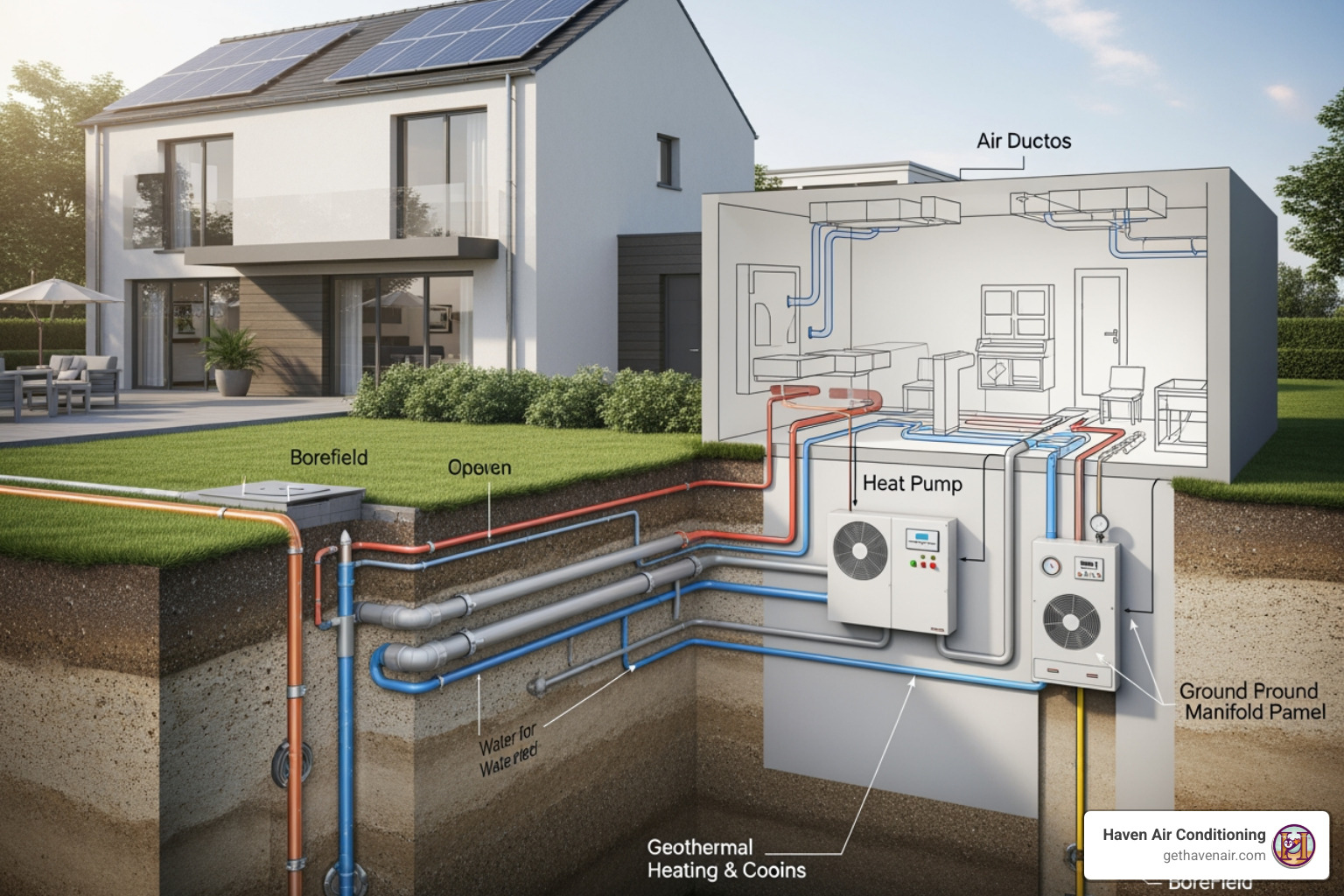
Every geothermal system has three essential components working together. The ground loop serves as your underground heat exchanger—a network of pipes buried beneath your property where the magic happens. The geothermal heat pump unit sits inside your home, looking much like a conventional furnace or air handler, and does the actual work of processing the fluid from the ground loop. Finally, the distribution system—typically your home’s ductwork—carries the heated or cooled air throughout your living spaces.
If you’re curious how geothermal compares to other options, exploring the different types of HVAC systems can help you appreciate what makes this technology special. For homeowners ready to make the switch, our residential HVAC services provide comprehensive support from design through installation.
The ground loop is where most of the decision-making happens during geothermal heating and cooling installation. Your property’s unique characteristics—especially here in Orange County and Riverside—will guide which type makes the most sense.
Closed-loop systems are the most popular choice, circulating a sealed mixture of water and environmentally safe antifreeze through buried pipes. Within this category, vertical loops shine when land space is limited, which happens frequently in areas like Anaheim, Irvine, and Fullerton. Installers drill boreholes 100 to 400 feet deep, leaving your yard mostly undisturbed. Once the drilling is complete, you’d hardly know the system is there.
Horizontal loops work beautifully when you have more land to work with—think the more spacious properties you’ll find in parts of Riverside or Corona. Pipes are laid in trenches about 4 to 6 feet deep, requiring more surface area but often costing less for the ground loop installation itself. If you’re fortunate enough to have a pond or lake on your property, pond/lake loops offer an neat solution. Coiled pipes rest at least eight feet below the water’s surface, where temperatures stay remarkably stable.
Open-loop systems take a different approach entirely. They pull water from a well, extract its heat energy, then discharge it back into another well or surface water. These systems can be incredibly efficient, but they require an abundant, clean water source and must comply with local regulations.
System sizing deserves special attention because it directly impacts your comfort and energy bills. Our team uses the industry-standard Manual J calculation to precisely determine your home’s heating and cooling needs. This careful analysis prevents the common pitfalls of oversized systems that cycle on and off wastefully, or undersized systems that struggle to keep up during temperature extremes.
Choosing the Right System for Your Property
Every property tells a different story, and choosing the right geothermal system means listening to what yours is saying. Property size matters tremendously—a compact lot in Irvine might call for vertical loops, while a sprawling Riverside property could accommodate horizontal trenching beautifully.
Soil conditions play a surprisingly important role. Different soils conduct heat differently, affecting how efficiently your system operates. Rocky terrain might require different drilling techniques than sandy or clay-rich soil. Our technicians assess these factors during the initial site evaluation.
The climate considerations specific to Orange County work in your favor. The earth maintains a consistent temperature between 40°F and 70°F just below the surface, and our mild winters and warm summers mean your geothermal system operates in an ideal temperature range year-round. Even during Fullerton’s hottest summer days or Yorba Linda’s coolest winter nights, the ground temperature stays remarkably stable.
Whether you’re planning new construction or considering a retrofit for an existing home changes the installation approach significantly. New builds offer the luxury of designing everything around the geothermal system from the start. Retrofits require more creativity, but they’re absolutely achievable—especially when you’re already planning an HVAC system upgrade.
Finding a Qualified Geothermal Contractor
Here’s the truth: geothermal heating and cooling installation isn’t something you want to trust to just anyone. This technology requires specialized knowledge, proper equipment, and real-world experience. The right contractor makes all the difference between a system that performs beautifully for decades and one that becomes a source of frustration.
Certifications matter here more than with traditional HVAC work. Look for contractors certified by the International Ground Source Heat Pump Association (IGSHPA), which demonstrates they’ve invested in proper training and stay current with industry best practices. Our certified technicians bring this expertise to every installation.
Local experience in Anaheim, Irvine, and throughout Orange County means your contractor understands our specific soil conditions, knows the local permitting process inside and out, and has relationships with inspectors who need to approve your installation. They’ve worked in neighborhoods like yours and understand what works best in our climate.
Reading reviews from other homeowners gives you insight into what working with a contractor actually feels like. Are they responsive? Do they explain things clearly? Do they clean up after themselves? We’re proud of our reputation for exceptional customer service and attention to detail—it’s what sets us apart.
Getting multiple quotes helps you understand the full scope of work and compare not just pricing but also the approach different contractors take. A detailed, itemized quote shows you exactly what you’re paying for and helps prevent surprises down the road.
Understanding why hiring certified HVAC technicians matters becomes crystal clear with geothermal systems. The stakes are higher, the installation more complex, and the long-term performance entirely dependent on proper installation. When you’re ready to move forward, choosing professional HVAC installation isn’t just a smart decision—it’s essential.
Our team combines technical expertise with a friendly, transparent approach. We’ll walk you through every decision, answer every question, and make sure you feel confident about your investment in geothermal technology.
The Complete Geothermal Heating and Cooling Installation Process
A geothermal heating and cooling installation is more than just a home improvement—it’s a change of how your home interacts with the earth itself. We understand that undertaking such a project can feel overwhelming, which is why we guide you through every step with transparency and care. From the moment we begin planning to the day we hand over the keys to your new system, you’ll know exactly what’s happening and why.
The journey starts with securing all necessary local permits. While this might sound bureaucratic, it’s actually an important safeguard. Geothermal installations involve significant subsurface work, and local regulations ensure everything is done safely and correctly. The good news? We handle the entire permitting process for you, navigating the specific requirements in Anaheim, Irvine, Fullerton, and throughout Orange County and Riverside. For a broader look at what to expect, check out our guide on what to expect during HVAC installation.
Once permits are secured, we move to site preparation. This involves carefully marking out areas for drilling or trenching, planning access routes for equipment, and identifying any underground utilities. We take great care to minimize disruption to your daily life and protect your landscaping wherever possible.
The overall timeline typically ranges from several days for simpler installations to a few weeks for more complex systems. Factors like your property size, chosen loop type, and site conditions all play a role. Throughout the process, we follow proven steps to an expert HVAC installation, ensuring quality never gets sacrificed for speed.
Step 1: Ground Loop Installation
This is where your geothermal heating and cooling installation becomes real—and honestly, it’s pretty impressive to watch. Your yard temporarily transforms into a carefully orchestrated work site as we install the underground network that will provide decades of efficient heating and cooling.
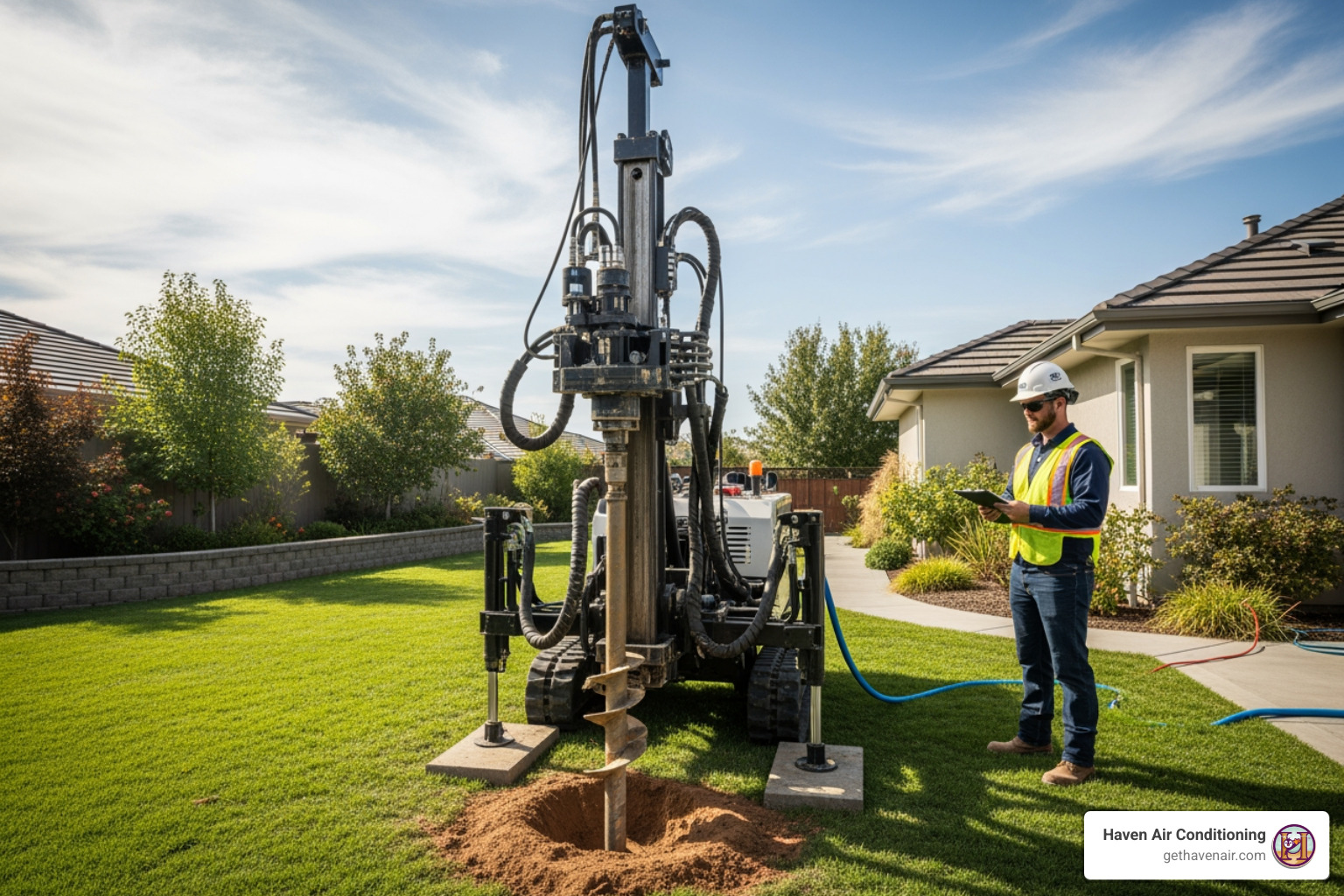
For vertical loops, specialized drilling equipment creates boreholes that reach 100 to 400 feet into the earth. The depth depends on your home’s heating and cooling needs and the thermal properties of your soil. It’s fascinating—at these depths, the temperature remains remarkably stable year-round, typically between 50 and 60 degrees in our Southern California region. This consistency is what makes geothermal systems so efficient.
For horizontal loops, we excavate trenches typically 4 to 6 feet deep. While this requires more surface area than vertical systems, it can be an excellent option if your property has the space. We carefully plan the layout to work around your landscaping, driveways, and any future construction plans you might have.
The piping itself deserves special mention. We use high-density polyethylene (HDPE) pipes that are incredibly durable—these loops are designed to last 50 years or more. Each section is carefully fused together using specialized equipment that creates seamless, leak-proof connections. There are no mechanical joints to fail or weaken over time.
Once the loops are positioned and connected, we begin the careful process of backfilling. For trenches, we restore the soil in layers, compacting as we go to prevent settling. For boreholes, we use a special grout mixture that ensures good thermal contact between the pipes and the surrounding earth. Yes, your yard will look disturbed for a short time, but we work hard to restore it as close to its original condition as possible. Most homeowners are surprised at how quickly their landscaping recovers.
Our team brings years of experience to every HVAC installation in Orange County, and ground loop installation is where that expertise really shines. Every detail matters—from the depth and spacing of loops to the quality of pipe fusion—because this underground network is the foundation of your system’s performance.
Step 2: Indoor Unit and Ductwork Connection
With the ground loop expertly installed underground, we shift our focus indoors to connect the heart of your geothermal system: the heat pump unit. This is where the earth’s stable temperature gets transformed into comfortable air throughout your home.
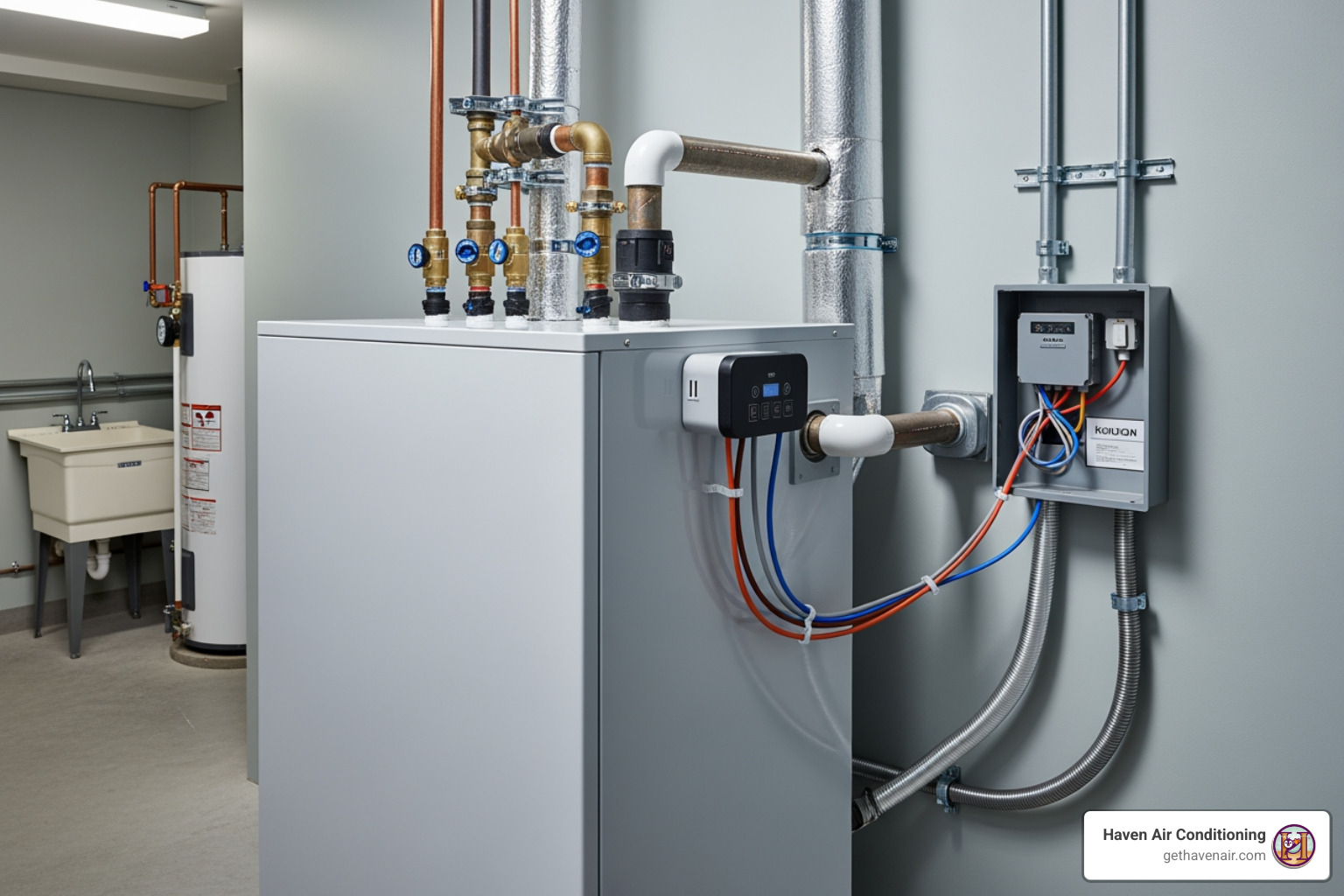
The geothermal heat pump typically finds its home in a utility room, basement, or garage—similar to where you’d find a traditional furnace. One pleasant surprise for most homeowners is how quiet these units are. Unlike noisy outdoor condensers, geothermal heat pumps operate with a gentle hum that won’t disturb your living spaces.
We carefully connect the ground loop pipes to the indoor unit, ensuring every fitting is secure and properly sealed. This connection point is critical—it’s where the fluid that has absorbed or released heat underground enters your home’s climate control system.
Most geothermal systems work beautifully with your existing ductwork, distributing conditioned air through the same vents you’ve always used. However, if your current ducts are leaky, poorly insulated, or undersized, we’ll let you know. Sometimes upgrading your duct services alongside your geothermal installation makes sense—after all, there’s no point in generating super-efficient heating and cooling only to lose it through leaky ducts. For new construction homes, we design and install optimal ductwork from scratch.
The electrical and plumbing connections complete this phase. Your heat pump needs power, and we ensure it’s wired correctly and safely. The closed-loop system requires plumbing connections for the heat transfer fluid, and if you’re adding domestic hot water generation to your system, we’ll integrate those connections as well.
Our certified technicians treat every connection with the attention it deserves. This meticulous approach is part of what makes every HVAC installation we complete a source of pride for our team and comfort for you.
Step 3: System Flushing, Testing, and Commissioning
The final phase of your geothermal heating and cooling installation might not be the most visible, but it’s absolutely essential. This is where we ensure your system doesn’t just work—it works perfectly.
We start by flushing the ground loop system thoroughly. Even with careful installation, air pockets and debris can find their way into the pipes. Flushing removes these, ensuring smooth, unobstructed fluid circulation. Proper flow is critical for heat transfer efficiency.
Next comes pressure testing. We pressurize the entire ground loop system and monitor it carefully, checking for any pressure drops that would indicate a leak. This rigorous testing gives us—and you—confidence that the system is completely sealed and ready for decades of service.
When we start up the system for the first time, it’s a methodical process. We don’t just flip a switch and hope for the best. Our technicians carefully monitor temperatures, pressures, and flow rates, comparing them against the system’s design specifications. We’re looking for smooth operation and optimal performance from the very first run.
Calibrating the controls ensures your thermostat and system communicate perfectly. We program settings for maximum efficiency while maintaining your desired comfort levels. Modern geothermal systems are sophisticated, and proper calibration makes a real difference in both performance and energy savings.
Throughout the commissioning process, we’re verifying performance at every stage. Is the system heating and cooling effectively? Are all zones balanced? Is the temperature differential across the heat pump where it should be? We test, measure, and adjust until everything is dialed in perfectly.
Finally, we provide a thorough homeowner orientation. We walk you through your new system’s operation, show you how to adjust settings, explain basic maintenance tasks like filter changes, and answer all your questions. We want you to feel completely comfortable and confident with your investment. This hands-on education is part of the expert HVAC services that set us apart.
Your geothermal system represents a significant investment in your home’s comfort and efficiency. Our comprehensive commissioning process ensures it delivers on that promise from day one and for decades to come.
Costs, Savings, and Long-Term Value
Let’s talk numbers—because while a geothermal heating and cooling installation requires a bigger upfront investment than traditional HVAC, the long-term financial picture tells a compelling story for Orange County homeowners.
Yes, you’ll pay more initially. The ground loop installation alone—whether drilling 400 feet down or trenching across your property—represents a significant portion of the cost. But here’s the thing: you’re essentially prepaying for decades of dramatically lower utility bills. For a detailed breakdown of what to expect financially, visit our page on the cost to install geothermal HVAC.
Several factors influence your total investment. System size matters—a larger home in Yorba Linda will need more heating and cooling capacity than a smaller property in Anaheim. Loop type plays a role too; vertical loops generally cost more due to specialized drilling equipment, while horizontal loops require more land but can be less expensive if you have the space. Site conditions in Orange County and Riverside—rocky soil, limited access, or challenging terrain—can also impact the final price.
Here’s how geothermal stacks up against traditional systems:
| Feature | Geothermal HVAC | Traditional HVAC (Furnace/AC) |
|---|---|---|
| Upfront Cost | Higher initial investment | Lower initial investment |
| Operating Cost | 30-60% lower heating costs; 20-50% lower cooling costs | Standard utility costs |
| Lifespan | Ground loop: 50+ years; Heat pump: 25 years | 15-20 years typical |
| Maintenance | Minimal; annual check-ups recommended | Regular maintenance required |
| Environmental Impact | Significantly reduced carbon footprint; no combustion | Higher emissions; burns fossil fuels |
The numbers speak for themselves, but let’s put them in context for your Orange County home.
Your Return on Investment: Payback and Lifespan
This is where geothermal truly shines. Homeowners in Irvine, Fullerton, and throughout Orange County typically see 30-60% savings on heating costs and 20-50% savings on cooling. In our climate, where air conditioning runs a good portion of the year, those cooling savings add up fast.
The payback period—the time it takes for your energy savings to equal your initial investment—typically ranges from 5 to 10 years, depending on your specific circumstances, energy usage, and local utility rates. After that? Pure savings, year after year.
But here’s what really sets geothermal apart: longevity. Your ground loop can last 50 years or more with virtually no maintenance. The indoor heat pump unit typically runs strong for 25 years—significantly longer than the 15-20 year lifespan of conventional systems. When you factor in replacement costs for traditional HVAC systems over that timeframe, the value proposition becomes even clearer.
Regular HVAC preventive maintenance keeps your system running at peak efficiency, maximizing your savings and extending equipment life. It’s a small investment that protects a much larger one.
Incentives and Environmental Benefits of Your Geothermal Heating and Cooling Installation
The financial benefits don’t stop at energy savings. Federal tax credits can significantly reduce your upfront costs—the federal government recognizes geothermal as renewable energy and offers substantial incentives. State and local programs may provide additional rebates or incentives for Orange County and Riverside residents. Check the Database of State Incentives for Renewables and Efficiency for current programs in your area.
Beyond your wallet, geothermal benefits the environment in ways traditional systems simply can’t match. You’ll dramatically reduce your carbon footprint—no combustion means no direct greenhouse gas emissions from your heating system. The quiet operation is a welcome bonus; no noisy outdoor condenser rattling away on hot summer days in Anaheim. And because geothermal systems don’t rely on combustion, they contribute to improved indoor air quality, with no risk of carbon monoxide and less circulation of outdoor pollutants.
For homeowners in the Greater Orange County area who value both financial wisdom and environmental responsibility, geothermal represents an investment that pays dividends for decades—in comfort, savings, and peace of mind.