(714) 332-6302

What Every Orange County Homeowner Should Know About How a Heat Pump Works for Heating and Cooling
Understanding how a heat pump works for heating and cooling is simpler than you might think — and it could change the way you think about home comfort forever.
Here’s the short answer:
A heat pump moves heat from one place to another using electricity — it doesn’t burn fuel to create it.
- In summer: It pulls heat out of your home and sends it outside, cooling your indoor air.
- In winter: It runs in reverse, pulling heat from the outdoor air and moving it inside to warm your home.
- Year-round: One system handles both jobs, using up to 75% less energy than traditional electric resistance heating.
That’s it. No combustion. No fossil fuels. Just smart, efficient heat transfer — and it works even when it’s cold outside, because there’s still heat energy in the air well below freezing.
For homeowners in Anaheim, Irvine, Fullerton, and across Orange County, heat pumps are an increasingly popular choice. Our mild-but-real winters and warm summers make the region nearly ideal for heat pump performance. And with energy costs climbing, more families are asking whether this technology is the right fit for their home.
In this guide, we’ll walk you through exactly how the system works — from the refrigeration cycle to cold-weather performance — so you can make a confident, informed decision.
The Science of Comfort: How a Heat Pump Works for Heating and Cooling
To understand how a heat pump works for heating and cooling, we have to look at the second law of thermodynamics. Naturally, heat wants to move from a warm place to a cold place. A heat pump uses a small amount of mechanical energy to flip that script, moving heat “uphill” against its natural flow.
Think of it like a sponge. In the winter, the outdoor unit “soaks up” whatever heat energy is available in the ambient air. In the summer, the indoor unit soaks up the heat inside your home to “squeeze it out” outdoors. This process of moving heat rather than generating it is the secret to its incredible efficiency. Whether you are in Whittier or San Clemente, the air around your home contains thermal energy as long as the temperature is above absolute zero (-459°F).
Because these systems are fully electric, they are a cornerstone of the “home electrification” movement. By ditching the gas line, you reduce your home’s carbon footprint while gaining a versatile, two-in-one system. For a deeper dive into the basics, check out our Heat Pump 101: How It Heats and Cools Your Home guide.
How a heat pump works for heating and cooling in the summer
When the Southern California sun starts beating down on your roof in July, your heat pump acts exactly like a traditional central air conditioner. Inside your home, the indoor unit contains an evaporator coil filled with cold, liquid refrigerant.
As your home’s warm air is blown over this coil, the refrigerant absorbs the heat. This process doesn’t just lower the temperature; it also addresses indoor humidity. As the air cools, it loses its ability to hold moisture, which condenses on the coil and drains away. This makes your home feel much more comfortable on those rare humid days in Huntington Beach.
The now-warmed refrigerant travels to the outdoor unit to release that heat into the environment. If you’ve ever stood next to an outdoor AC unit and felt the blast of hot air, you’ve felt this heat transfer in action. To see how this compares to a standard AC unit, read our comparison on Heat Pumps vs Air Conditioning.
How a heat pump works for heating and cooling in the winter
This is where the magic happens. Unlike a furnace that burns gas to create flames, a heat pump uses a reversing valve to switch the direction of the refrigerant.
Even on a “bone-chilling” 40°F night in Anaheim, there is plenty of thermal energy in the outdoor air. The heat pump makes its internal refrigerant even colder than the outside air, allowing it to absorb heat from the environment. This heat is then concentrated and brought indoors.
Modern cold-climate technology has advanced significantly by May 2026. While older models struggled when temperatures dropped, today’s high-performance heat pumps can provide 100% of their heating capacity down to 5°F. There are three primary sources a heat pump can draw from:
- Air: The most common “air-source” heat pumps used in Orange County.
- Ground: Geothermal systems that use stable underground temperatures.
- Water: Systems that pull heat from a nearby water source.
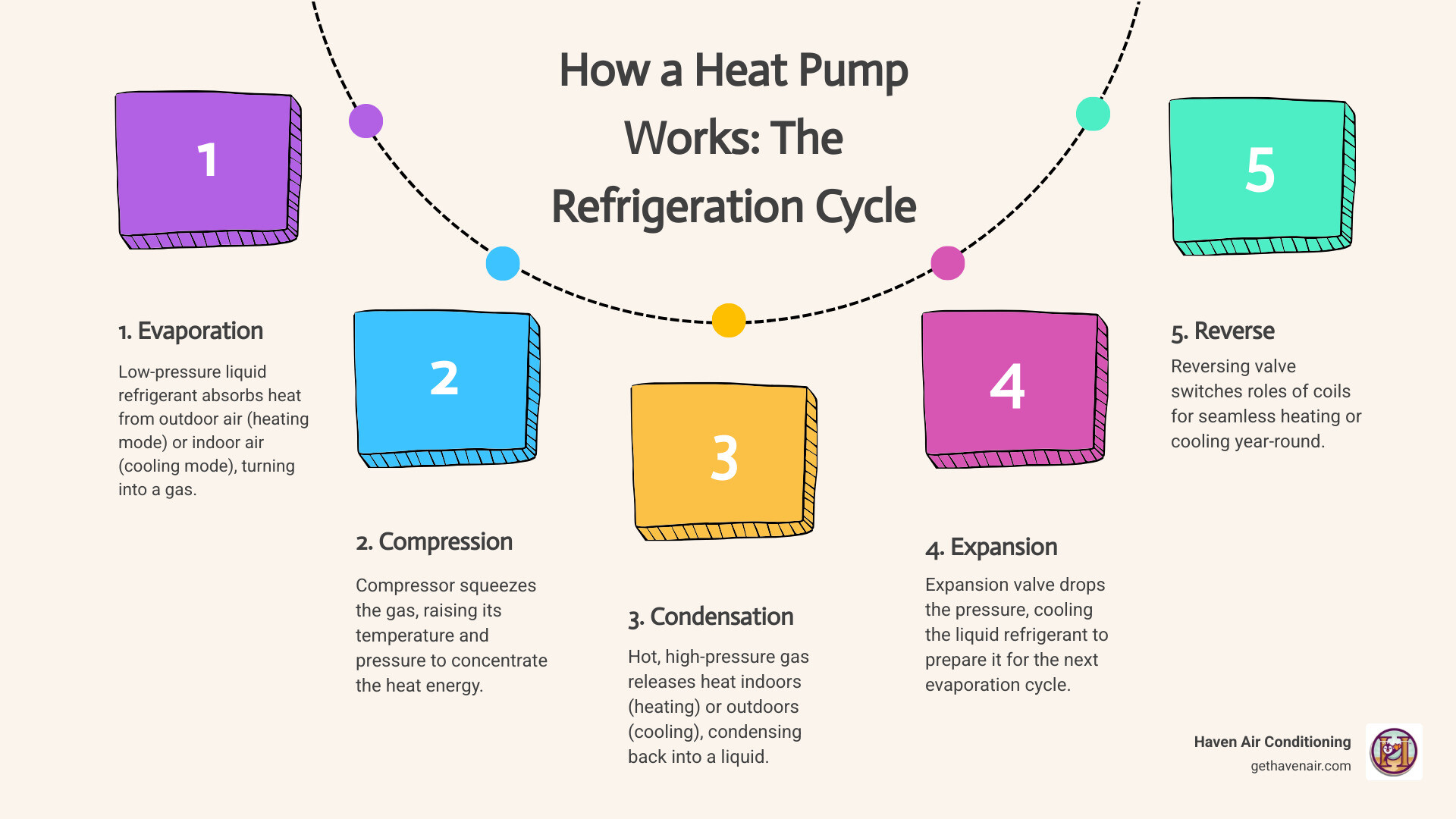
The Refrigeration Cycle: Four Stages of Heat Transfer

At the heart of how a heat pump works for heating and cooling is the refrigeration cycle. This cycle relies on a special substance called refrigerant that changes from a liquid to a gas (and back again) at very low temperatures. This phase change is what allows the system to move massive amounts of heat with very little electricity.
If you’ve ever noticed your system behaving strangely, such as blowing air that doesn’t feel hot enough, you might wonder, “Why is My Heat Pump Blowing Cold Air?” Often, this is just the system doing its job, but understanding the four stages helps clarify what’s happening inside the cabinet.
The role of the compressor and expansion valve
The compressor is the “engine” of the heat pump. It takes low-pressure gas and squeezes it into a high-pressure gas. According to the pressure-temperature relationship, when you compress a gas, its temperature rises dramatically. Think of a bicycle pump getting hot as you use it; that’s the same principle.
On the flip side, the expansion valve acts like the nozzle on a spray can. As the refrigerant passes through, the pressure drops instantly, causing the temperature to plummet. This allows the refrigerant to become cold enough to absorb heat from the outdoor air, even in winter.
Condenser and evaporator coils
These are the heat exchangers. In the cooling mode, the indoor coil is the evaporator (absorbing heat), and the outdoor coil is the condenser (releasing heat). In heating mode, the reversing valve swaps their roles.
The indoor air handler circulates your home’s air over these coils, while the outdoor unit manages the exchange with the environment. It’s a constant loop of energy movement that keeps your living room at a steady 72 degrees regardless of what’s happening in the backyard.
Efficiency and Performance: Why Heat Pumps Outshine Traditional Systems
When we talk about efficiency, heat pumps are in a league of their own. A high-efficiency gas furnace might be 98% efficient, meaning for every dollar you spend, 98 cents goes toward heat and 2 cents goes up the chimney.
In contrast, a heat pump can reach 300% to 400% efficiency. Because it moves heat rather than creating it, it can deliver three to four units of heat for every one unit of electricity it consumes. This is measured by the Coefficient of Performance (COP).
| System Type | Efficiency Rating | Heat Source |
|---|---|---|
| Heat Pump | 300% – 400% (COP of 3-4) | Ambient Air/Ground |
| Gas Furnace | 80% – 98% (AFUE) | Fossil Fuel Combustion |
| Electric Resistance | 100% | Electricity to Heat |
For a head-to-head breakdown, see our guide on Heat Pumps vs Furnaces: Which is Better?.
Understanding COP and SEER2 ratings in 2026
As of May 2026, the industry uses SEER2 (Seasonal Energy Efficiency Ratio) for cooling and HSPF2 (Heating Seasonal Performance Factor) for heating. These ratings account for the real-world conditions we face in places like Fullerton and Garden Grove.
Higher ratings mean lower utility bills. While a heat pump might have a higher upfront cost, the Energy Star certified models often pay for themselves through energy savings and available rebates. You can learn more about these metrics in our article, What is a Heat Pump? How Does It Work?.
Performance in extreme cold and dual-fuel options
While Orange County rarely sees “extreme” cold, some of our neighbors in higher elevations or inland areas like Corona might see frost. Cold Climate Heat Pumps (CCHP) are specifically designed for these conditions, maintaining efficiency even at 5°F.
For those who want total peace of mind, a dual-fuel or hybrid system is an excellent choice. This pairs an electric heat pump with a gas furnace. The system automatically chooses the most efficient heat source based on the outdoor temperature — using the heat pump for moderate days and the furnace only when the temperature drops below a certain threshold (usually around 35-40°F).
Frequently Asked Questions about Heat Pump Mechanics
How long does a heat pump last in Orange County?
On average, a well-maintained heat pump has a lifespan of about 15 years. However, in coastal cities like Newport Beach or Laguna Beach, salt air considerations are vital. Salt can corrode outdoor coils faster if they aren’t treated or cleaned regularly. Regular maintenance is the best way to protect your investment. For more details, read How Long Does a Heat Pump Last?.
Why is my heat pump not heating effectively?
If your system is struggling, there are a few common culprits:
- Defrost Cycle: In winter, the outdoor unit may develop frost. The system will occasionally switch to “cooling mode” for a few minutes to melt that ice.
- Airflow: Dirty filters are the #1 cause of poor performance.
- Refrigerant Leaks: If the system is low on “juice,” it can’t move heat effectively. If you’re having trouble, check out our troubleshooting guide: My Heat Pump is Not Heating.
Can a heat pump provide hot water and dehumidification?
Yes! Heat pump water heaters are 2 to 3 times more efficient than standard electric tanks. Some advanced HVAC systems also use desuperheaters, which recover waste heat from the cooling cycle to provide “free” hot water during the summer. Additionally, because they run more consistently than “on-off” furnaces, they provide superior whole-home dehumidification.
Your Indoor Comfort, In Expert Hands
At Haven Air Conditioning, we believe that understanding how a heat pump works for heating and cooling is the first step toward a more comfortable, efficient home. Whether you live in the heart of Anaheim, the hills of Fullerton, or the coastal breeze of Irvine, our team is here to help you navigate the transition to electric HVAC.
We aren’t just installers; we are your neighbors. Our certified technicians provide expert service across Orange County and Riverside, ensuring your system is sized perfectly through precise load calculations. We know that a heat pump is only as good as its installation, which is why we focus on transparency and attention to detail.
To keep your system running at peak efficiency for years to come, we offer a membership maintenance plan that includes priority scheduling and regular check-ups. Whether you need a 24/7 emergency repair, a second opinion on a quote, or a brand-new installation, we are ready to help.