(714) 332-6302

The Frustration of the Perpetually Cold Room
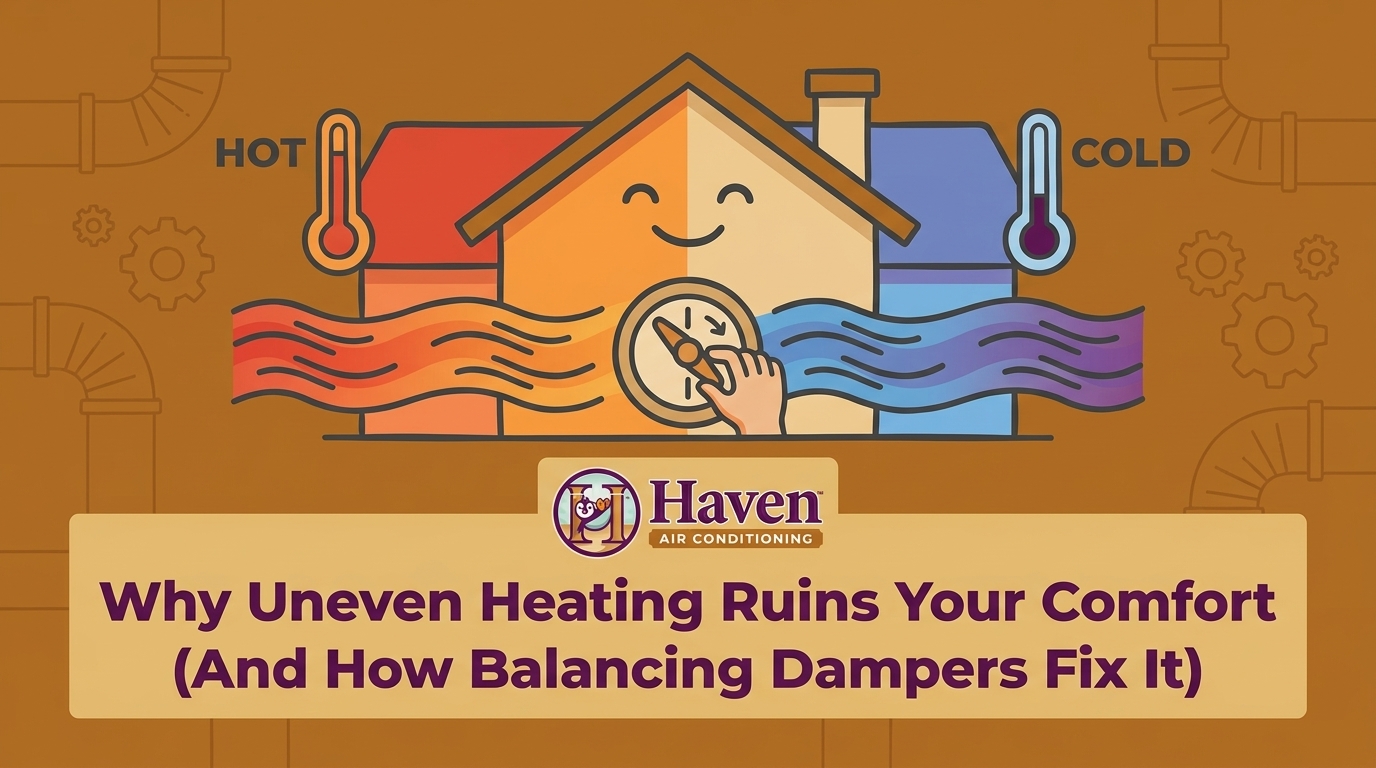
Your hallway thermostat reads a perfectly comfortable 72 degrees, but the moment you step into the master bedroom or the new home addition, the temperature plummets. If you are wondering why uneven heating ruins your comfort (and how balancing dampers fixes it), you are not alone. This is one of the most common complaints our team at Haven Air Conditioning hears from homeowners as the weather begins to cool down. You hear the furnace running, you feel warm air in the living room, but that one specific room remains an absolute icebox.
During the September pre-heating-season transition, many families react to this problem by purchasing portable space heaters. While a space heater might provide temporary relief for a chilly fall night, it is an inefficient, expensive, and sometimes hazardous band-aid. Running a space heater pulls a massive amount of electricity, frequently tripping breakers and driving up your monthly utility bills. More importantly, it forces you to choose between paying a premium for localized heat or addressing the root airflow issue hiding inside your walls.
If you are tired of relying on space heaters, understanding your home’s ductwork and working with a trusted heating repair company can permanently solve the problem. In most cases, a freezing room does not mean you need to replace your entire furnace. It simply means the warm air your furnace produces is not reaching its final destination.
Why Anaheim Two-Story Homes Struggle with Uneven Heating
To understand why certain rooms stay cold, we have to look at the physics of airflow and the specific architecture of your house. In our experience servicing local neighborhoods, we find that Anaheim two-story homes are particularly vulnerable to temperature imbalances. While our regional climate offers mild, pleasant days, the fall and winter nights frequently drop into the chilly 40- and 50-degree range. These rapid temperature swings make any weakness in your home’s heating distribution highly noticeable.
The primary culprit is usually distance. Your furnace relies on a blower motor to push conditioned air through a network of ducts. The rooms closest to the indoor unit receive a strong, immediate blast of warm air. However, by the time that air travels through long runs of ductwork to reach an upper-level bedroom or a distant ground-floor addition, the air pressure naturally drops off. If your ductwork is aging, leaking, or poorly designed, that pressure drop becomes even more severe.
Thermal Stratification and Airflow
Another factor at play is thermal stratification—the natural tendency for heat to rise and cold air to sink. While this is primarily thought of as a summer cooling issue, it heavily impacts winter comfort as well. If you have ever researched why your upstairs stays hot in July, you know that airflow problems affect your home year-round. In the winter, poor airflow means the warm air fails to circulate properly, leaving dense, cold air trapped in specific rooms.
It is critical to recognize that a cold room does not automatically mean your furnace is failing or undersized. Below is a quick breakdown of how our technicians tell the difference between an equipment failure and an airflow distribution issue:
| Symptom | Likely Airflow Issue | Likely Furnace Issue |
|---|---|---|
| Temperature Variance | One or two specific rooms are always cold, while the rest of the house is warm. | The entire house struggles to reach the temperature set on the thermostat. |
| Airflow Strength | Air barely trickles out of the vents in the cold room, but blasts in the hallway. | Airflow is weak across every single vent in the entire house. |
| System Cycling | The furnace runs normal cycles, but shuts off before the distant room gets warm. | The furnace short-cycles, shutting on and off every few minutes. |
What Are HVAC Balancing Dampers (And Where Do They Hide)?
If your furnace is generating enough heat but that heat isn’t reaching your bedroom, the solution lies in redirecting the airflow. This is where HVAC balancing dampers come into play. A manual balancing damper is essentially a built-in valve located inside the main supply trunks of your ductwork. You can think of them as traffic cops for your heating system.
When the blower motor pushes air into the ductwork, the air naturally follows the path of least resistance. Without intervention, the bulk of the warm air will dump into the rooms closest to the furnace. Manual dampers allow a technician to restrict the airflow to those easily heated rooms, forcing the remaining air to travel further down the ductwork to the notoriously cold rooms.
How Manual Dampers Differ from Automated Zoning
It is important to distinguish manual balancing dampers from automated zoning systems, as they serve different functions and operate differently:
- Manual Balancing Dampers: These are fixed metal plates inside the duct, controlled by a small lever on the outside of the sheet metal. Once a professional sets them to the correct position, they stay locked in place to provide a consistent, balanced airflow throughout the season. They are simple, highly effective, and require no electronics.
- Automated Zoning Systems: These use motorized dampers wired to multiple thermostats throughout the house. When a specific zone calls for heat, the control board automatically opens and closes the motorized dampers to direct air only to that zone. While excellent for customized comfort, they are significantly more complex to install.
For many homeowners, a complex zoning system isn’t necessary. We frequently find that proper adjustment of manual dampers can resolve up to 50 percent of residential hot and cold spot complaints, providing a clear, conceptual solution that satisfies the need for even heating without a massive equipment overhaul.
The Danger of Closing Vent Registers (Why DIY Fails)
When faced with a freezing room, the most common DIY reaction is to walk around the house and close the supply vent registers in the warmer rooms. The logic seems sound: if you block the air from entering the living room, it will be forced into the cold bedroom. Unfortunately, this is a massive misconception that can severely damage your heating system.
The problem with closing vents: Your furnace blower motor is designed to move a specific volume of air against a specific amount of resistance, known as static pressure. Closing the vent registers at the end of the line is like pinching the end of a drinking straw while trying to blow through it. The air does not magically reroute to the open vents; instead, the pressure builds up dangerously inside the ductwork.
The cause of equipment failure: Modern furnaces use ECM (Electronically Commutated Motor) blower motors, which are designed to adjust their speed to maintain consistent airflow. When you close vent registers and increase the static pressure, the ECM motor has to work significantly harder to push the air. It spins faster, draws more electricity, and overheats. Over time, this constant strain will burn out the blower motor entirely, leading to a highly expensive repair and reducing the overall lifespan of the heating system.
The professional solution: Adjusting trunk dampers is conceptually different and much safer than choking off room registers. A manual damper restricts the air closer to the source, allowing the main trunk lines to maintain proper pressure dynamics while gently redirecting the volume. However, locating and adjusting these levers requires a professional understanding of airflow to ensure the static pressure remains within the safe operating limits of the equipment.

How Professional Air Balancing Solves the Problem
Because of the risks associated with static pressure, air balancing is not a weekend DIY project. It requires specialized tools, mathematical calculations, and a deep understanding of HVAC dynamics. When a Haven Air Conditioning technician arrives to balance your system, they do not just guess which levers to pull.
The process is rooted in ACCA Manual D concepts, which govern proper residential duct design. Our technicians evaluate the entire system to measure the current airflow at each register and the total static pressure at the furnace. By methodically adjusting the manual dampers, we can gently push warm air to the rooms that need it most without over-stressing the blower motor.
Hidden Duct Irregularities
Professional balancing also involves checking for hidden duct irregularities that might be contributing to the issue. Sometimes, a damper adjustment isn’t enough because the duct itself is compromised. One local homeowner our team worked with recently needed multiple services, including duct upgrades, AC repair, and eventually a ductless system installation. Because all their projects were handled with a comprehensive view of airflow and system balance, everything was completed efficiently and up to high standards without lingering hot or cold spots.
Having a balanced system provides profound peace of mind. By getting this diagnostic work done during the September pre-heating-season transition, you ensure that your home is ready to handle the peak of winter before the first true cold snap hits.
Honest Diagnostics: When Do You Actually Need a New System?
While balancing dampers fixes a vast majority of uneven heating issues, there are times when simple airflow adjustments are not enough. If your ductwork is severely degraded, crushed, or completely disconnected in the attic, no amount of damper adjustment will force air into the cold room. In older homes, the ductwork may have been poorly designed from day one, making it impossible to balance.
This is where Haven Air Conditioning’s commitment to honest diagnostics truly matters. A pattern we see often in the industry is using a cold room complaint as an excuse to immediately push for a costly system replacement. Our team believes in solving comfort issues through proper air balancing first. We look for the simple, mechanical fixes before ever suggesting new equipment.
During a recent routine visit, our team encountered a homeowner with an airflow issue that required careful troubleshooting. By expertly diagnosing the problem at the source rather than just guessing or pushing a replacement, we resolved the issue effectively. That same philosophy applies to heating. We measure, we test, and we adjust.
Targeted Solutions for Stubborn Rooms
If your ductwork simply cannot deliver the necessary heat to a distant addition, there are targeted solutions available that don’t require ripping out your entire central system. Exploring a ductless heating guide can show you how a mini-split system provides independent, highly efficient heat exactly where you need it.
Of course, there are times when an expert heating installation is genuinely necessary. If your furnace has a cracked heat exchanger, if the unit is drastically undersized for your home’s square footage, or if the entire duct system is compromised beyond repair, a replacement becomes the safest and most logical path forward. But that conclusion should only come after a thorough, honest diagnostic process by a qualified technician.
Frequently Asked Questions About Home Air Balancing
Why is one room in my house always so cold?
A single cold room is usually caused by its distance from the blower motor, disconnected ductwork, or improperly set manual dampers, rather than a broken furnace. When warm air has to travel through long stretches of ducting, it loses pressure and heat along the way. Proper air balancing helps push that conditioned air all the way to the end of the line.
How do you balance heat in a two-story house?
You balance heat in a two-story house by adjusting manual dampers in the ductwork to direct more warm air upstairs or to distant rooms. This must be done carefully while measuring static pressure to protect the heating equipment. Because heat naturally rises, a professional will calibrate the dampers differently for the winter heating season than for the summer cooling season.
Should HVAC dampers be open or closed in winter?
Dampers should rarely be fully closed, as this creates dangerous pressure backups inside the ductwork. Instead, they should be partially adjusted to restrict airflow to easily heated rooms and left fully open to hard-to-heat rooms. This partial restriction gently reroutes the air without suffocating the blower motor.
Where are the dampers on my HVAC system?
Manual dampers are typically located near the main supply trunk line close to the indoor air handler or furnace. You can usually identify them by looking for a small metal lever or wingnut on the outside of the sheet metal duct. If your basement or attic is finished, these levers might be hidden behind access panels.
Can I balance my own HVAC system?
While you can easily locate the levers on your ductwork, professional balancing is strongly recommended. Adjusting dampers without measuring the system’s static pressure can easily increase resistance beyond safe limits, which can burn out the blower motor. A professional uses specialized manometers to ensure the system remains balanced and safe.
Prepare Your Home for Winter Comfort
Living with a notoriously cold room is frustrating, but you do not have to settle for inefficient space heaters this winter. By adjusting the manual dampers hidden within your ductwork, you can effectively redirect warm air to the spaces that need it most, resolving the root cause of uneven heating.
The September pre-heating-season transition is the perfect time to get this maintenance done. Addressing airflow issues now ensures your system is calibrated and ready before the chilly nights arrive. If you want a clear, conceptual explanation of your home’s airflow and a permanent solution to those freezing spots, reach out to Haven Air Conditioning for professional airflow diagnostics today. Protect your equipment, lower your energy waste, and finally enjoy consistent comfort in every room of your house.