(714) 332-6302

The Late-Summer Threat to Your Cooling System
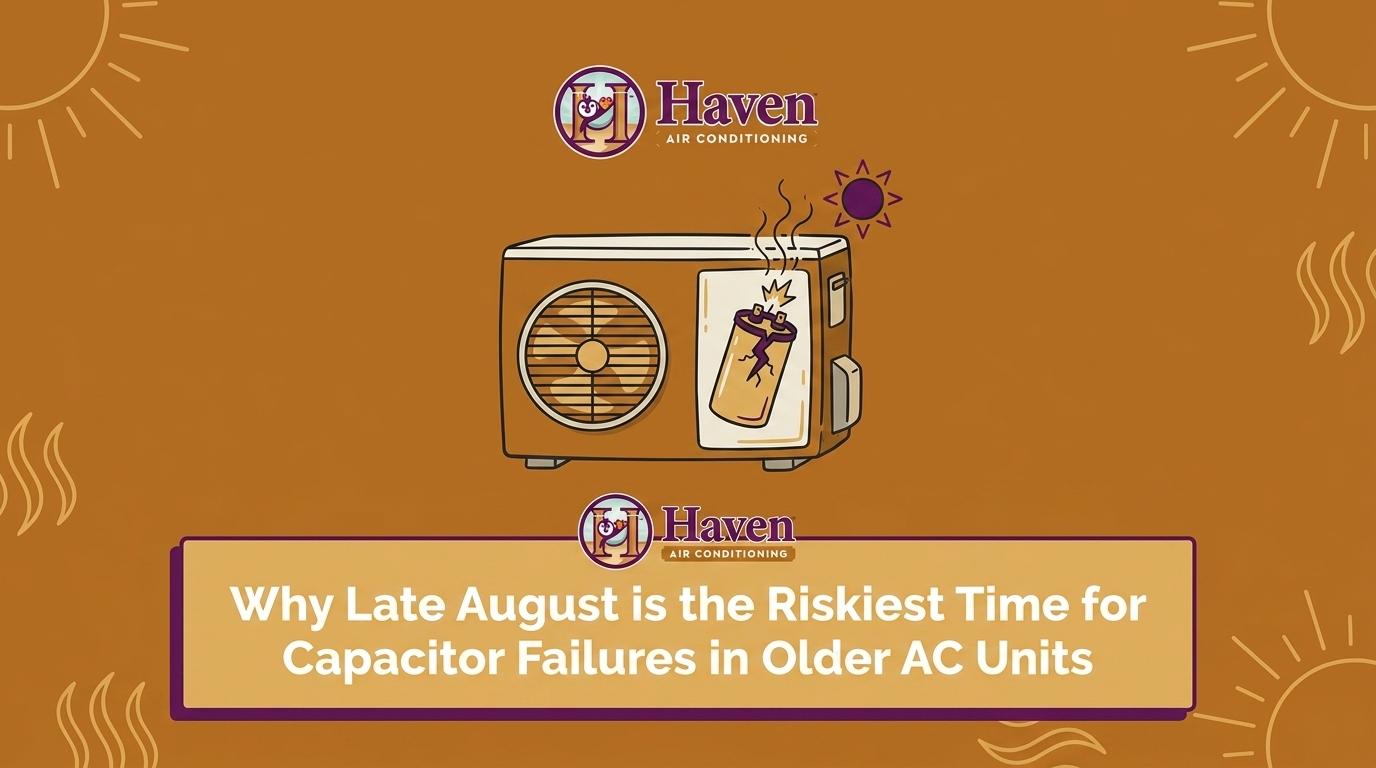
The back-to-school transition is already underway across Southern California, and you might assume your cooling system has successfully survived the worst of the summer heat. However, if you are wondering why late August is the riskiest time for capacitor failures in older AC units, our team at Haven Air Conditioning can tell you the answer comes down to months of relentless, cumulative heat stress. By the time late summer arrives, your air conditioner has been working overtime for hundreds of hours. This is the exact moment when aging electrical components are pushed past their physical limits.
When a system breaks down right before Labor Day, we often hear homeowners write it off as random bad luck. In reality, these late-season failures are predictable mechanical breaking points. The extreme temperatures inside your condenser cabinet have been compounding since May. Catching the subtle warning signs of a degrading capacitor before it fails completely can save your entire system from severe damage. If you need professional Anaheim AC repair, having an expert evaluate your electrical components now is the smartest move you can make.
The Myth of Random Bad Luck
It is easy to think that an air conditioner simply decides to quit on a hot Tuesday afternoon. But mechanical systems do not fail randomly; they fail when the stress applied to them exceeds their operational capacity. Throughout the early summer, your AC unit likely had enough overnight downtime to cool its internal components. As the late August heat sets in, those vital cooldown periods disappear. The metal cabinet sits in direct sunlight, and the internal temperature of the condenser remains elevated 24 hours a day. This environment creates a ticking clock for any electrical part that is already showing its age.
What a Dual Run Capacitor Actually Does
To understand why this specific part fails, you have to understand its job. A dual run capacitor is essentially a massive, high-voltage battery that lives inside your outdoor condenser unit. Its primary function is to store energy and deliver a massive jolt of electricity to jump-start the heavy motors. When your thermostat calls for cooling, the home’s standard electrical current is not strong enough to overcome the mechanical inertia of the compressor and the fan on its own.
The capacitor bridges that gap. It sends a powerful start-up surge to the compressor motor (which pumps the refrigerant) and the condenser fan motor (which blows exhaust heat away from the unit). Once the motors are running, the capacitor continues to supply a steady, regulated current to keep them spinning smoothly.
Why Older Units Carry Higher Risk
Under ideal, laboratory conditions, a high-quality capacitor has a typical lifespan of 10 to 20 years. However, real-world conditions are rarely ideal. Constant exposure to extreme heat, power fluctuations, and heavy usage significantly reduces that lifespan. In our years of servicing Anaheim homes, we’ve found that older AC units (8+ years) are particularly vulnerable to sudden failure. By the time a unit reaches this age, the capacitor has cycled on and off tens of thousands of times. Its ability to hold and discharge electrical energy—measured in microfarads—slowly degrades. When you combine an aging, weakened capacitor with the brutal heat of late summer, a total failure becomes highly probable.
The Timeline of Cumulative Summer Heat Stress
The journey to a late-summer breakdown begins months before you actually hear a strange noise coming from your backyard. The degradation is a slow, cumulative process driven by weather patterns and run times.
- May and June (The Warm-Up Phase): During the early summer, the system handles moderate heat with ease. The ambient outdoor temperature peaks in the afternoon but drops significantly at night. This provides adequate cooldown periods, allowing the electrical components inside the metal cabinet to return to a safe baseline temperature before the next day’s work begins.
- July (The Endurance Test): As peak summer heat sets in, continuous running begins to tax the electrical components. The air conditioner cycles on more frequently and stays on longer to maintain your indoor temperature. The internal temperature of the condenser elevates, and the components spend less time in a cooled state. The thermal fatigue begins to accumulate inside the capacitor.
- Late August (The Thermal Breaking Point): By the time the late August heat / back-to-school transition arrives, the accumulated thermal fatigue reaches its maximum limit. The system runs almost non-stop. The ambient temperature inside the metal condenser cabinet can easily exceed 158 degrees Fahrenheit—the maximum heat rating for many standard capacitors. Pushed past its design limits, the component finally gives out.
| Summer Phase | Average AC Run Cycle | Overnight Cooldown | Capacitor Stress Level |
|---|---|---|---|
| May / June | Short to moderate cycles | Excellent (Full recovery) | Low to Moderate |
| July | Long, frequent cycles | Fair (Partial recovery) | High |
| Late August | Continuous / non-stop operation | Poor (Minimal recovery) | Critical / Breaking Point |

How Continuous Operation Degrades Electrolytic Fluid
To see exactly why the late summer heat is so destructive, we have to look inside the metal cylinder of the capacitor itself. These components rely on a specialized electrolytic fluid (or a dielectric dielectric material) to store their electrical charge. This fluid operates perfectly within a specific temperature range, but it reacts violently to prolonged, excessive heat.
As local HVAC experts in Anaheim CA, we know firsthand that our weather patterns often create a perfect storm for mechanical stress. The region frequently experiences prolonged late-summer heatwaves, compounded by the onset of dry, hot Santa Ana winds. This weather forces older AC units to run continuously. If you are wondering is it normal for your AC to run 16 hours a day in August, the answer is that while it may be necessary to cool your home, it is incredibly punishing on the equipment.
The Physical Breakdown Process
When a metal condenser cabinet bakes in direct SoCal sunlight while the system runs continuously, the operational heat combines with the solar heat. The electrolytic fluid inside the capacitor literally begins to boil and expand. Because there is no overnight cooldown period to allow the fluid to stabilize, the internal pressure builds continuously.
Eventually, the physical casing of the capacitor cannot contain the pressure. The top of the cylinder—which is designed to expand as a safety mechanism—begins to bulge outward, taking on a mushroom-like shape. In severe cases, the casing may split and leak the fluid entirely. Once the capacitor bulges or leaks, it loses its ability to hold a microfarad charge, leaving your heavy motors without the energy they need to start.
Recognizing the Subtle Warning Signs of Capacitor Failure
A late evening heat wave failure rarely happens without warning. The system usually gives off subtle signs earlier in the day or week. Recognizing these symptoms in older AC units (8+ years) allows you to call for help before you are left sweating in a hot house.
- Distinct humming or clicking sounds: If you stand near your outdoor unit when it tries to turn on, you may hear a loud electrical hum or a repeated clicking noise. This is the sound of the motors trying to pull power, but failing to start because the capacitor cannot deliver the necessary jolt.
- Hard starting and stuttering: Watch for “hard starting,” where the AC struggles to turn on. You might notice the lights in your house dim momentarily, or the outdoor unit might stutter and shake before finally catching. This means the capacitor is weak but not entirely dead yet.
- The fan won’t spin: If you can hear the compressor running but the top fan blade is completely stationary, the “fan” side of your dual run capacitor has likely failed. (You can sometimes push the blade with a stick to get it spinning, but this is a temporary and dangerous workaround).
- Blowing warm air indoors: If the indoor blower is running but the outdoor compressor won’t start, your vents will blow unconditioned, warm air into the home.
Ignoring these signs often leads to an emergency. We recently had one homeowner reach out for help on a Friday evening during a brutal late-summer heat wave when their AC suddenly stopped blowing cold. Our own Technician Cody was dispatched promptly, quickly identifying a swollen, failed capacitor. By swapping it out efficiently, the system was brought back online before the house became unbearably hot. If you notice any of these symptoms, reviewing the signs you need emergency HVAC service can help you make the right call.
The Cascading Danger to Your AC Compressor
A failing capacitor is a relatively straightforward electrical issue, but ignoring it can trigger a catastrophic chain reaction. The compressor is the heart of your air conditioning system, and it relies entirely on the capacitor to start safely. When a weak capacitor fails to deliver the right amount of energy, the compressor doesn’t just give up—it tries to pull the power directly from your home’s electrical grid.
This creates a condition known as pulling locked rotor amps. The compressor draws a dangerously high amperage in a desperate attempt to overcome its own mechanical inertia. This massive electrical draw leads to severe overheating inside the compressor shell. If the system continues to try and start without a working capacitor, it will repeatedly trip its internal thermal overload protector. Eventually, this extreme heat bakes the internal windings, leading to catastrophic compressor failure. At that point, you are no longer looking at a simple electrical replacement; you are likely looking at replacing the entire outdoor unit.
Strict DIY Warning: Lethal Voltage
Because a capacitor looks like a simple metal battery, many homeowners are tempted to order a replacement online and swap it out themselves. Never attempt a DIY capacitor replacement. Capacitors are designed to store massive amounts of electrical energy, and they retain lethal high voltage even after the main power to the AC unit has been completely shut off at the breaker. Touching the wrong terminals can result in severe injury or death. Professional diagnostics and specialized discharge tools are absolutely mandatory for safe and accurate electrical repairs.
Emergency Readiness for Late-Summer Breakdowns
When a capacitor fails during peak August heat, your home’s indoor temperature can rise to dangerous levels within a matter of hours. Waiting days for a contractor to order a part is simply not an option for your comfort, safety, or peace of mind. This is why the speed and preparedness of your HVAC provider matter so much during the late summer stretch.
The key to surviving an end-of-season breakdown is relying on a local team that arrives fully prepared for single-visit repairs. At Haven Air Conditioning, we maintain a proactive readiness for late-summer emergencies. By dispatching our technicians in fully stocked trucks, we ensure that the most common sizes and ratings of dual run capacitors are already on hand. This level of preparation means Anaheim homeowners aren’t left stranded, sweating out a heatwave while waiting on a shipping delay. A fast, proactive response restores your cooling immediately and prevents the indoor environment from becoming a hazard.
Don’t Let a Bad Capacitor Ruin the End of Summer
As the late August heat / back-to-school transition pushes your system to its absolute limits, remember that capacitor failure is a mechanical certainty for stressed, older units, not a mystery. Months of cumulative heat, expanding electrolytic fluid, and non-stop operation inevitably take their toll. But a breakdown does not have to mean the end of your compressor.
A clear, professional diagnosis can resolve the issue safely, restoring your comfort while protecting the most expensive components of your system. If you hear loud humming, notice the system struggling to start, or feel warm air coming from your vents, do not wait for the unit to fail completely. Prompt intervention is the best defense against major damage. Schedule an inspection today or call for emergency AC repair the moment you suspect your equipment is struggling.
Frequently Asked Questions
Why do AC capacitors fail in summer?
AC capacitors fail in the summer because the extreme heat causes the internal electrolytic fluid to expand and break down. Continuous operation during hot weather prevents the component from cooling off overnight, leading to cumulative thermal stress. Eventually, this heat causes the capacitor’s casing to bulge or leak, destroying its ability to hold an electrical charge.
How long do AC capacitors last?
Under ideal conditions, an AC capacitor can last between 10 and 20 years. However, in regions with intense, prolonged summers, continuous heat exposure significantly reduces that lifespan. Units that are 8 years or older are at a much higher risk for sudden capacitor failure due to long-term wear and tear.
What happens when an AC capacitor goes bad?
When an AC capacitor goes bad, it can no longer deliver the massive jolt of electricity needed to start the compressor and fan motors. You will typically hear a loud humming or clicking sound from the outdoor unit as the motors struggle to pull power. If left running in this state, the compressor can overheat and suffer catastrophic damage.
Can extreme heat cause a capacitor to fail?
Yes, extreme heat is the primary cause of premature capacitor failure. Capacitors are generally rated to withstand ambient temperatures up to 158 degrees Fahrenheit, but the inside of a metal condenser cabinet baking in the sun can easily exceed this limit. The excess heat boils the internal fluids, causing the part to swell and fail.
What are the signs of a failing AC capacitor?
The most common signs of a failing capacitor include a humming noise from the outdoor unit, the fan failing to spin, and the system blowing warm air inside the house. You may also notice “hard starting,” where the AC stutters, hesitates, or causes the lights in your home to dim momentarily when it tries to turn on.
Is it safe to replace an AC capacitor myself?
No, it is never safe to replace an AC capacitor yourself. Capacitors store lethal amounts of high-voltage electricity and can deliver a dangerous shock even when the main power to the AC unit is turned off. Only a licensed professional with the proper tools should discharge, test, and replace electrical components.